Geauga County has 7 verified active nests
“The eagle’s comeback in Ohio and across the country proves that we can overcome any challenge when we work together.” – Gov. Mike DeWine
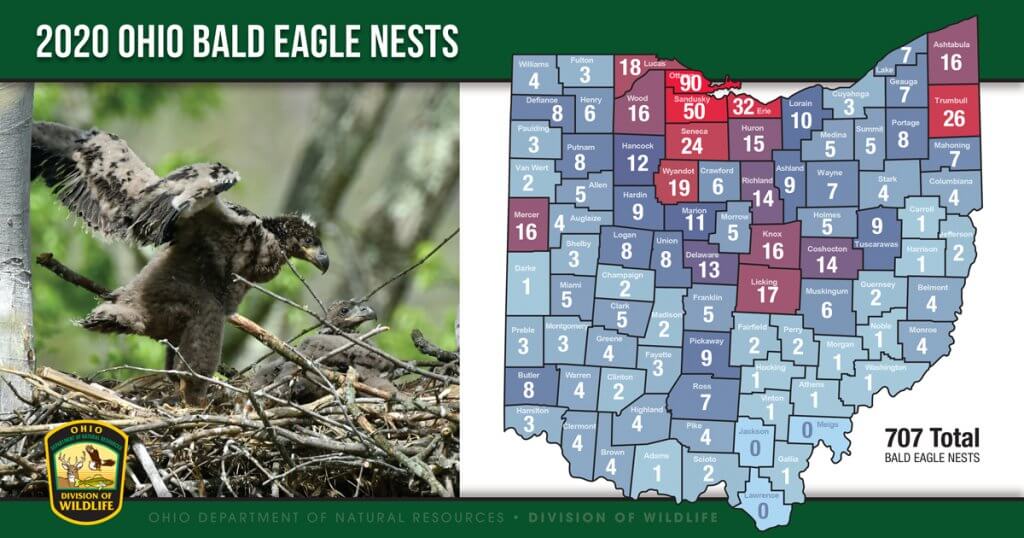
Thanks to thousands of reports from citizen scientists during February and March, 707 bald eagle nests have been confirmed in Ohio, according to the Ohio Department of Natural Resources (ODNR) Division of Wildlife.
The bald eagle is one of Ohio’s greatest wildlife success stories. The nest census was the first undertaking to discover all such sites for the first time in eight years. The results show an increase of 151 percent from the 2012 census, when 281 nests were recorded in Ohio, according to an April 22 news release.
“The bald eagle is a symbol of American strength and resilience,” Gov. Mike DeWine said in the release. “The eagle’s comeback in Ohio and across the country proves that we can overcome any challenge when we work together.”
Added ODNR Division of Wildlife Chief Kendra Wecker, “We are grateful to every Ohioan who contributed to this effort and thank those who support conservation of high-quality habitat that kept eagles nesting in Ohio.”
The Division of Wildlife received approximately 2,500 reports from the public for the 2020 census. Wildlife staff, including wildlife officers and biologists, verified nest locations in 85 counties, the release said.
Counties along or near Lake Erie have the highest number of bald eagle nests. Bald eagles thrive near Lake Erie because of the abundance of food and nesting habitat.
The 12 counties with the highest number of eagle nests include: Ottawa (90), Sandusky (50), Erie (32), Trumbull (26), Seneca (24), Wyandot (19), Lucas (18), Licking (17), Ashtabula (16), Knox (16), Mercer (16) and Wood (16).
The bald eagle was once an endangered species, with only four nesting pairs in Ohio in 1979. However, thanks to partnerships between the Division of Wildlife, Ohio zoos, wildlife rehabilitation facilities, concerned landowners, and sportsmen and women its population increased.

After much hard work and continued conservation, the bald eagle was removed from the federal list of threatened and endangered species in 2007 and from Ohio’s list in 2012.
Bald eagles in Ohio typically lay eggs and incubate in February and March. Young eagles leave the nest about three months later, usually in June. The birds nest in large trees such as sycamores, oaks, and cottonwoods near large bodies of water. Fish and carrion are preferred foods.
ODNR noted bald eagles are protected under both state law and the federal Bald and Golden Eagle Protection Act. It is illegal to disturb bald eagles. The Division of Wildlife advises when viewing these birds to respect the bird’s space and stay at least 100 yards away from the bird or nest. Disturbing bald eagles at the nest site could lead the pair to abandon the eggs.
As with many of Ohio’s native wildlife species, bald eagles require specific habitat conditions to thrive. Bald eagle habitat protection and research is funded by the sale of bald eagle conservation license plates, income tax check-off donations to the Endangered Species and Wildlife Diversity Fund and sales of the Ohio Wildlife Legacy Stamp.
Learn how to support Ohio’s magnificent wildlife like the bald eagle atwildohio.gov/support.
Editor’s Note: A county list of all verified active bald eagle nests in 2020 is shown below. The first number following the county’s name shows the number of nests for 2020, with the 2012 number in parentheses. These numbers are raw data and subject to change.
Adams: 1 (0); Allen: 5 (0); Ashland: 9 (2); Ashtabula: 16 (9); Athens: 1 (0); Auglaize: 4 (0); Belmont: 4 (1); Brown: 4 (1); Butler: 8 (0); Carroll: 1 (0); Champaign: 2 (0); Clark: 5 (0); Clermont: 4 (0); Clinton: 2 (0); Columbiana: 4 (1); Coshocton: 14 (6); Crawford: 6 (3); Cuyahoga: 3 (2); Darke: 1 (0); Defiance: 8 (2); Delaware: 13 (7); Erie: 32 (17); Fairfield: 2 (0); Fayette: 3 (0); Franklin: 5 (3); Fulton: 3 (0); Gallia: 1 (0); Geauga: 7 (6); Greene: 4 (0); Guernsey: 2 (1); Hamilton: 3 (1); Hancock: 12 (4); Hardin: 9 (1); Harrison: 1 (1); Henry: 6 (0); Highland: 4 (1); Hocking: 1 (1); Holmes: 5 (1); Huron: 15 (5) Jackson: 0 (0); Jefferson: 2 (1); Knox: 16 (7); Lake: 7 (4); Lawrence: 0 (0); Licking: 17 (3); Logan: 8 (1); Lorain: 10 (3); Lucas: 18 (8); Madison: 2 (0); Mahoning: 7 (5); Marion: 11 (6); Medina: 5 (1); Meigs: 0 (0); Mercer: 16 (3); Miami: 5 (0); Monroe: 4 (1); Montgomery: 3 (1); Morgan: 1 (1); Morrow: 5 (2); Muskingum: 6 (2); Noble: 1 (1); Ottawa: 90 (46); Paulding: 3 (0); Perry: 2 (0); Pickaway: 9 (3); Pike: 4 (2); Portage: 8 (5); Preble: 3 (0); Putnam: 8 (2); Richland: 14 (5); Ross: 7 (4); Sandusky: 50 (33); Scioto: 2 (2); Seneca: 24 (7); Shelby: 3 (0); Stark: 4 (1); Summit: 5 (2); Trumbull: 26 (9); Tuscarawas: 9 (6); Union: 8 (4); Van Wert: 2 (0); Vinton: 1 (0); Warren: 4 (2); Washington: 1 (1); Wayne: 7 (2); Williams: 4 (0); Wood: 16 (7); Wyandot: 19 (12).
2020 total: 707
2012 total: (281)