


History Resides at Chagrin Falls Cemetery
When you want to know about history, sometimes you need to listen to the voices of the past. And the Chagrin Falls Evergreen Hill Cemetery is one place to begin.
When you want to know about history, sometimes you need to listen to the voices of the past. And the Chagrin Falls Evergreen Hill Cemetery is one place to begin.
In a presentation by the Geauga County Genealogical Society, Chagrin Falls Cemetery Sexton Rob Arnold briefed participants about the “life of a cemetery sexton.”
He has been in his roll for the past 28 years and has had a lifelong interest in historical preservation, beginning his career by working maintenance and landscaping, trimming the trees, shrubs and keeping up the grounds.
“My biggest challenge in my job is handling the emotion. I need compassion during the sad time, but need to be efficient, too,” Arnold said, reflecting on handling residents’ needs.
He offered the suggestion of pre-planning funerals and final wishes as a way of making the parting less painful.
Arnold said he is sensitive to all the traditions of final resting places, even to making sure husbands’ graves go on the north side and wives on the south, just the way they were standing at the altar at their wedding.
Arnold said Evergreen Hill Cemetery was established in 1863 and opened with 13 sections of hand dug graves.
Some remains were moved over to the new cemetery from the old Grove Hill Cemetery. At that time, winter burials were impossible, so remains were held in Solon in a vault for $1 per month, Arnold said.
By 1879, the village built its own vault out of sandstone, a popular material of the day. It had an iron gate, wooden door and a stone floor hollowed out for ventilation, he said, adding this vault was used to keep remains cool until a proper burial could be performed.

Today, it has been converted to a columbarium. This is a mausoleum-type facility used to house cremation remains and urns, which is becoming more and more popular today as cremations become more common due to cost and remains preservation, Arnold said.
He explained how a coffin was the wedge-shaped wooden box used for burial in the old days — appearing diamond shaped at the top and tapering off to a narrow foot. A casket is the more modern, full rectangular and well-appointed mechanism used today.
Prior to 1950, metal or stone vaults were not used like today, Arnold said, adding old graves, therefore, often sank into the ground as decomposition took place. Today, vaults are mandatory and prevent this sinking from happening.
The old expression “six feet under” referred to graves, even though they are only dug 5-feet deep. It is thought the 6 feet referred to a depth that exceeded animal detection, he said.
Arnold went on to explain sandstone was the material of the day in the 1800s and early 1900s, however, it was replaced by marble and finally granite used most often today. A visitor to cemeteries of old can see the pitting and weathering sandstone markers have endured. Granite stones still look brand new despite their age.
Gravestone markers are set by friction and weight and no pins or cement are used to erect them, Arnold said, adding they are placed on a 2-to-3-foot concrete base and always at the head of the casket. Markers for veterans are free, he said.

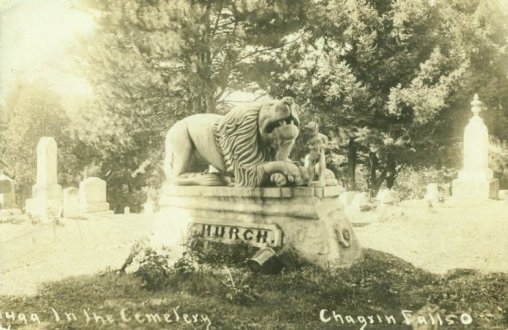
Perhaps the most interesting marker in Evergreen Hill Cemetery is that of the Church family, Arnold said.
The majestic lion sitting on top of a large base marks the grave of Henry Church, Jr. The Church family was instrumental in the development of Chagrin Falls as one of its first seven families to settle there, he said.
The family, including daughter Jane Church, were strict abolitionists and often made their home available to escaping slaves, he added.
War dead also received their final resting place at Evergreen. The cemetery has graves representing The Civil War, War of 1812, Spanish American War, WWI, WWII, Korean War, Vietnam War, as well as the more recent conflicts. There are also members of the Woman’s Relief Corp. This and more history can be found on the Chagrin Falls historical site, chagrinhistorical.org.
The Evergreen site has been expanded over the years to accommodate Chagrin Falls’ growing population, Arnold said.
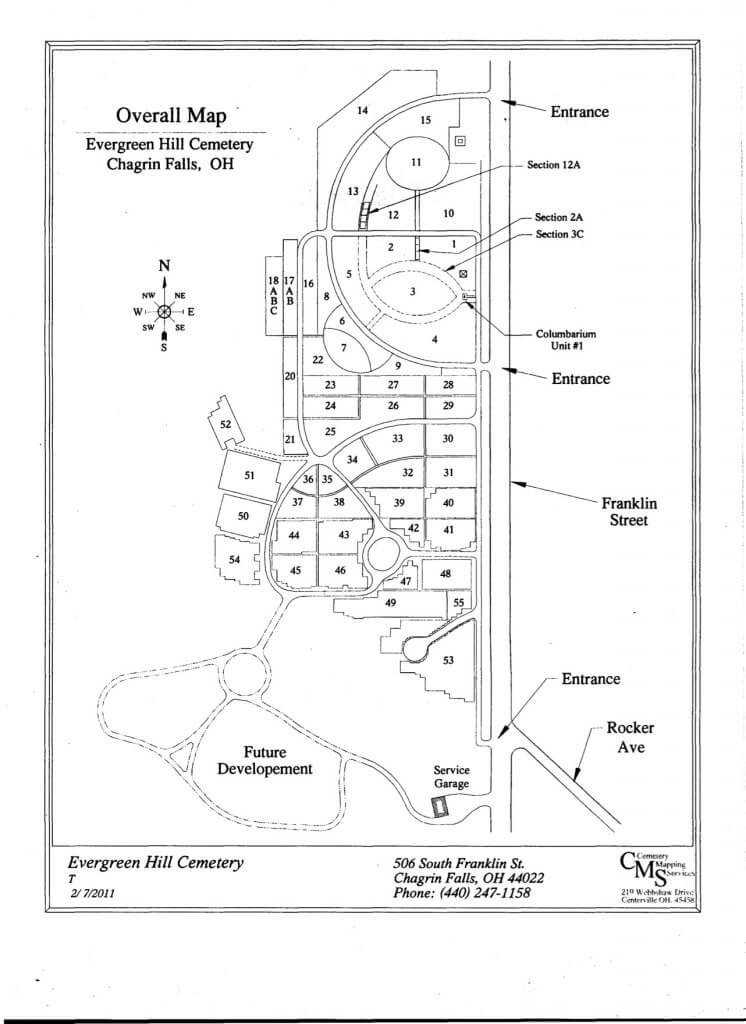
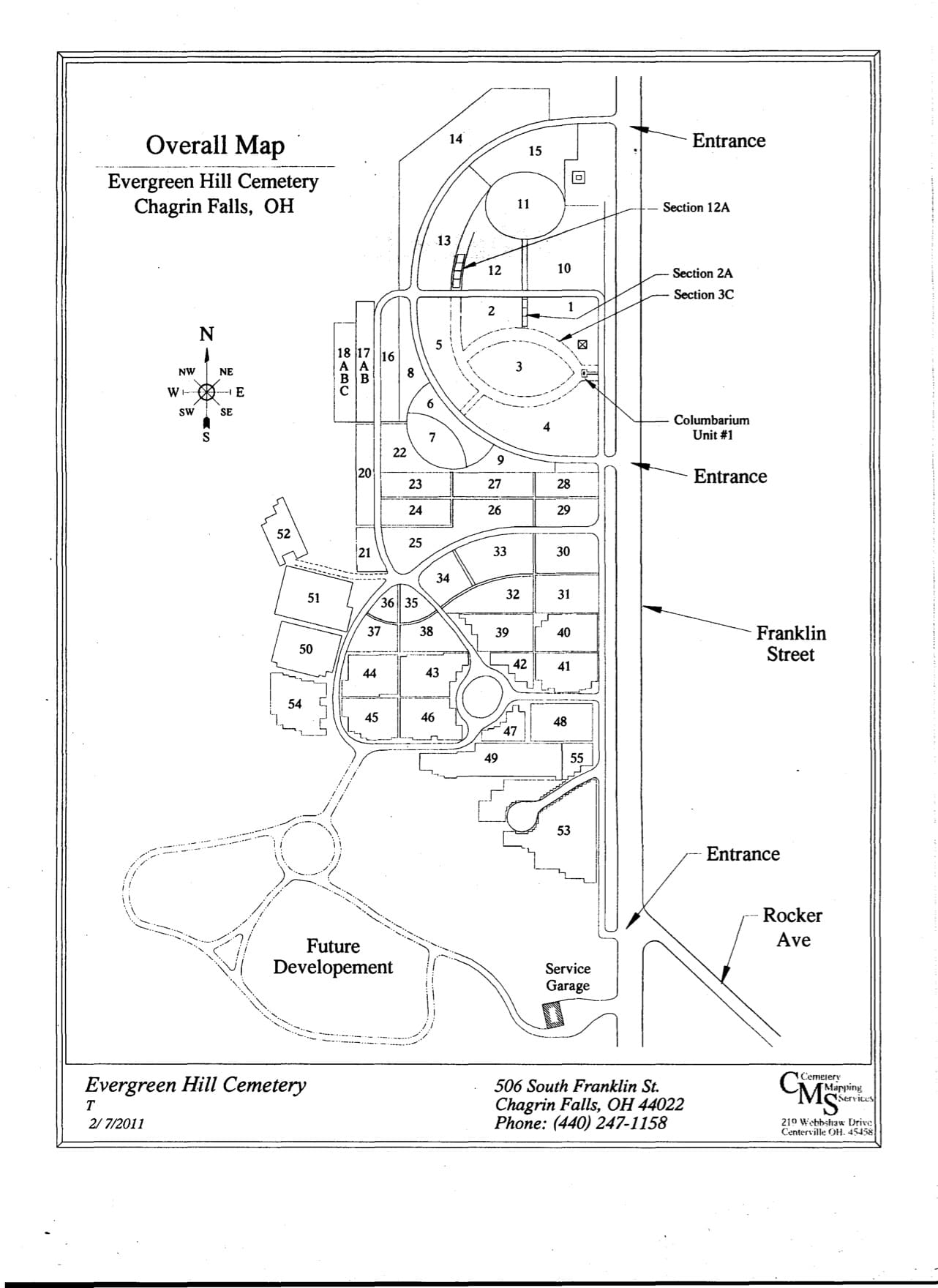
Beginning with 13 sections, the 26-acre grounds now have 55 sections and future planning is underway to house more graves and columbarium, he said, adding burial sites are provided and sold only for Chagrin Falls residents.
A state-of-the-art software system is now in place for Arnold to map each and every internment. He has completed more than 8 % of this work.
Residents also have access to this mapping to identify where their loved one’s final resting place is. It can be accessed on their site at www.chagrin-falls.org, he said.
Amy Lydan from the Geauga County Public Library was on hand at the presentation to offer research assistance through the library system.
The Anderson Allynd Room in the Chardon branch has become a well-known source for genealogical research, she said, adding the GCPL has recently been declared a family search affiliate, allowing access to 25% more records than previously.
Information from their sources can be accessed at history@geaugalibrary.net, however, much research remains available only through personal visits to the branches.


