


Geauga County voters might justifiably think abortion is on the ballot Aug. 8, considering much of the conversation in the press and on social media regarding Issue 1 centers on the debate over reproductive rights in Ohio.
Geauga County voters might justifiably think abortion is on the ballot Aug. 8, considering much of the conversation in the press and on social media regarding Issue 1 centers on the debate over reproductive rights in Ohio.
However, what is technically up for a vote is an amendment that would make it more difficult for ballot initiatives — like the Ohio Right to Make Reproductive Decisions Including Abortion Initiative proposed for the November ballot — to appear before voters and harder to pass once they make it to the ballot.
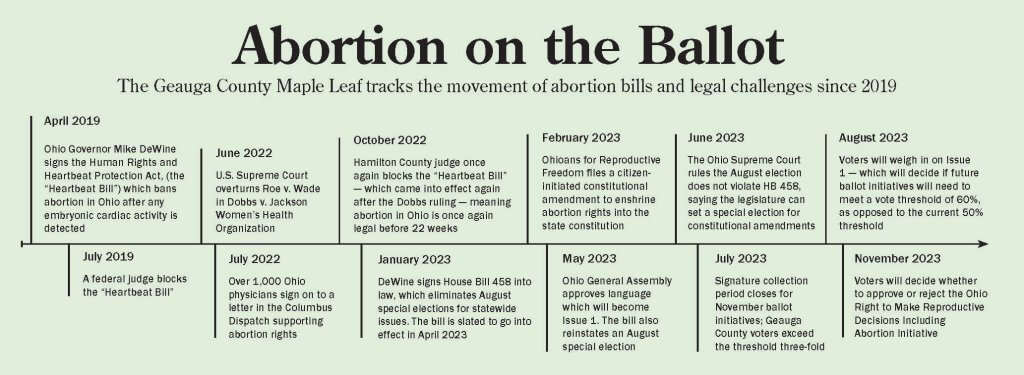
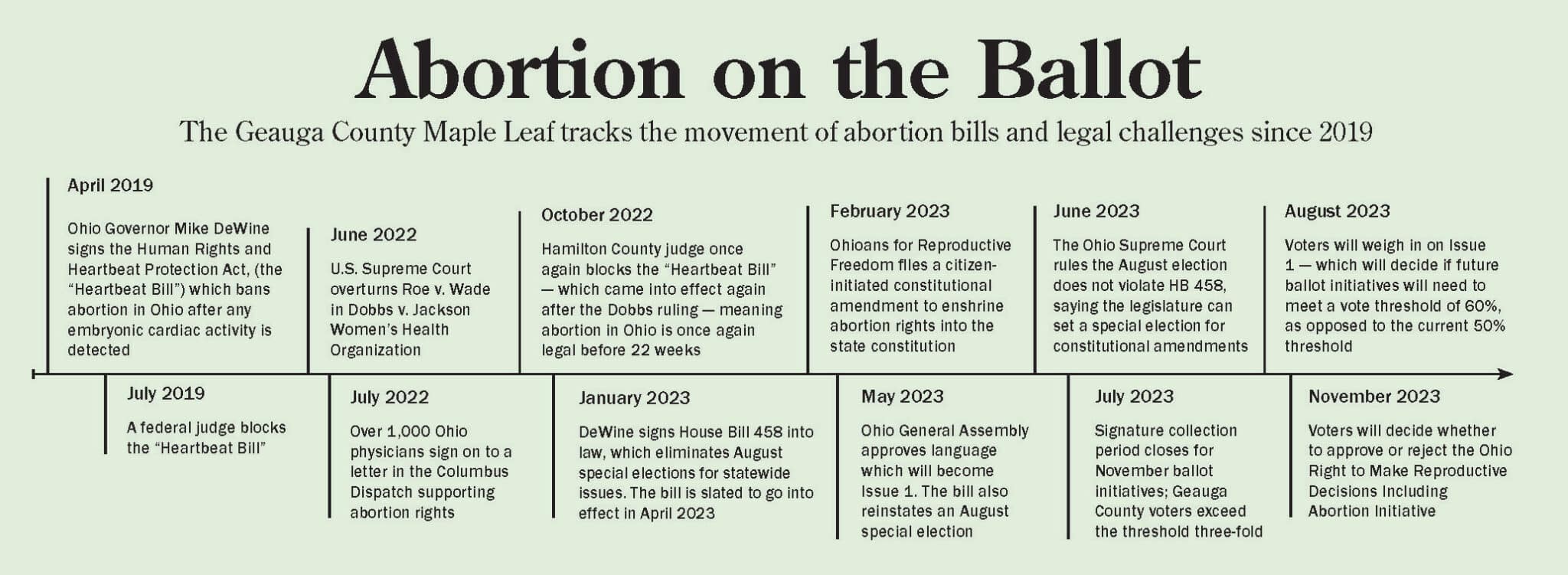
Issue 1, which both houses of the Ohio General Assembly approved May 10, would increase the threshold for citizen-led constitutional amendments from 50% to 60% and require signatures for ballot proposals to meet the appropriate threshold in all 88 of Ohio’s counties instead of current law, which only requires 44 counties.
Although supported by most Republican state and federal elected officials, according to online election encyclopedia Ballotpedia.org, the issue is opposed by the Democratic Party, as well as the Libertarian party, and by former Republican governors John Kasich and Bob Taft.
Multiple groups of physicians also oppose Issue 1, viewing it as an attempt to block the citizen-led ballot initiative for the November election that would enshrine the right to abortion in the Ohio Constitution.
Dr. Lauren Beene, a Shaker Heights pediatrician, heads one of those organizations — Ohio Physicians for Reproductive Rights — and helped guide the consolidation of their efforts in a group called Ohioans for Reproductive Freedom to propose the ballot initiative in February.
“Issue 1 is an attack on democracy and majority rule that, as its sponsors openly admit, is intended to make it more difficult for the Reproductive Freedom with Protections for Health and Safety citizen-initiated amendment to pass in the upcoming General Election,” Beene said in an interview with the Geauga County Maple Leaf. “Defeating Issue 1 will ensure that the threshold for approving the reproductive freedom amendment remains at 50% + 1 vote, the standard that has been in place for 111 years.”

Abortion Rulings Set the Stage
In March 2019, Gov. Mike DeWine signed a bill into law that would criminalize abortion after embryonic cardiac activity can be detected, usually between five and six weeks of a pregnancy. Known colloquially as the “heartbeat bill,” the law was blocked by a legal challenge, although it went into effect once again when the U.S. Supreme Court overturned Roe v. Wade, the 1973 abortion rights case, in a ruling last June.
In October 2022, however, a court in Hamilton County granted a motion for preliminary injunction against the abortion ban, once again blocking it from going into effect. The procedure remains legal prior to the point of viability, which the law considers to be at 22 weeks’ gestation.
In the weeks between Roe’s overturning and the blocking of Ohio’s abortion ban, Beene and another physician, Dr. Marcela Azevado, reached out to fellow physicians after each had experiences with patients they said were terrified about the new law. The pair eventually built a coalition that published an open letter in the Columbus Dispatch last July, signed by 1,000 Ohio physicians.
“The ‘heartbeat bill’ is an intrusion of government on personal autonomy and will directly lead to oppression, illness and death of countless women. This will disproportionately affect women of color and individuals without the financial means to seek other options and will perpetuate the cycle of poverty,” the physicians wrote, in part. “Anyone who supports this legislation is complicit in the greatest assault on women’s rights in our lifetime.”
Beene said while opponents of the reproductive rights amendment have named Planned Parenthood and the American Civil Liberties Union as their opponents, OPRR — which is made up of thousands of practicing physicians, including those Beene called highly respected obstetricians and gynecologists — played a major role in drafting the amendment’s language. “Our goals in pursuing this amendment are clear: ensuring that Ohioans have access to safe, legal, equitable and comprehensive reproductive medical care including abortion; (and) enabling all people to make reproductive healthcare decisions free from government interference,” she said.

Exploiting a ‘Loophole’
Lined up on the other side of the issue are anti-abortion advocacy groups, including Ohio Right to Life.
Mike Gonidakis, president of the group for the past 16 years, said the OPRR and other groups have found a “loophole” in state law that would allow them to advance their pro-abortion agenda against the will of voters.
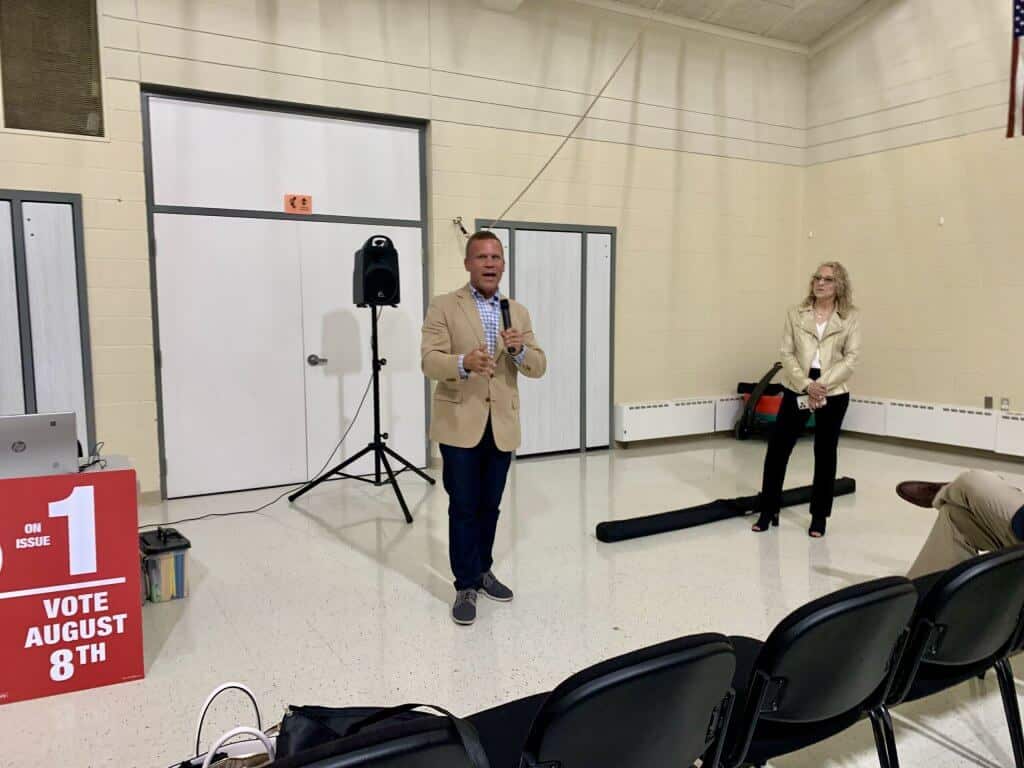
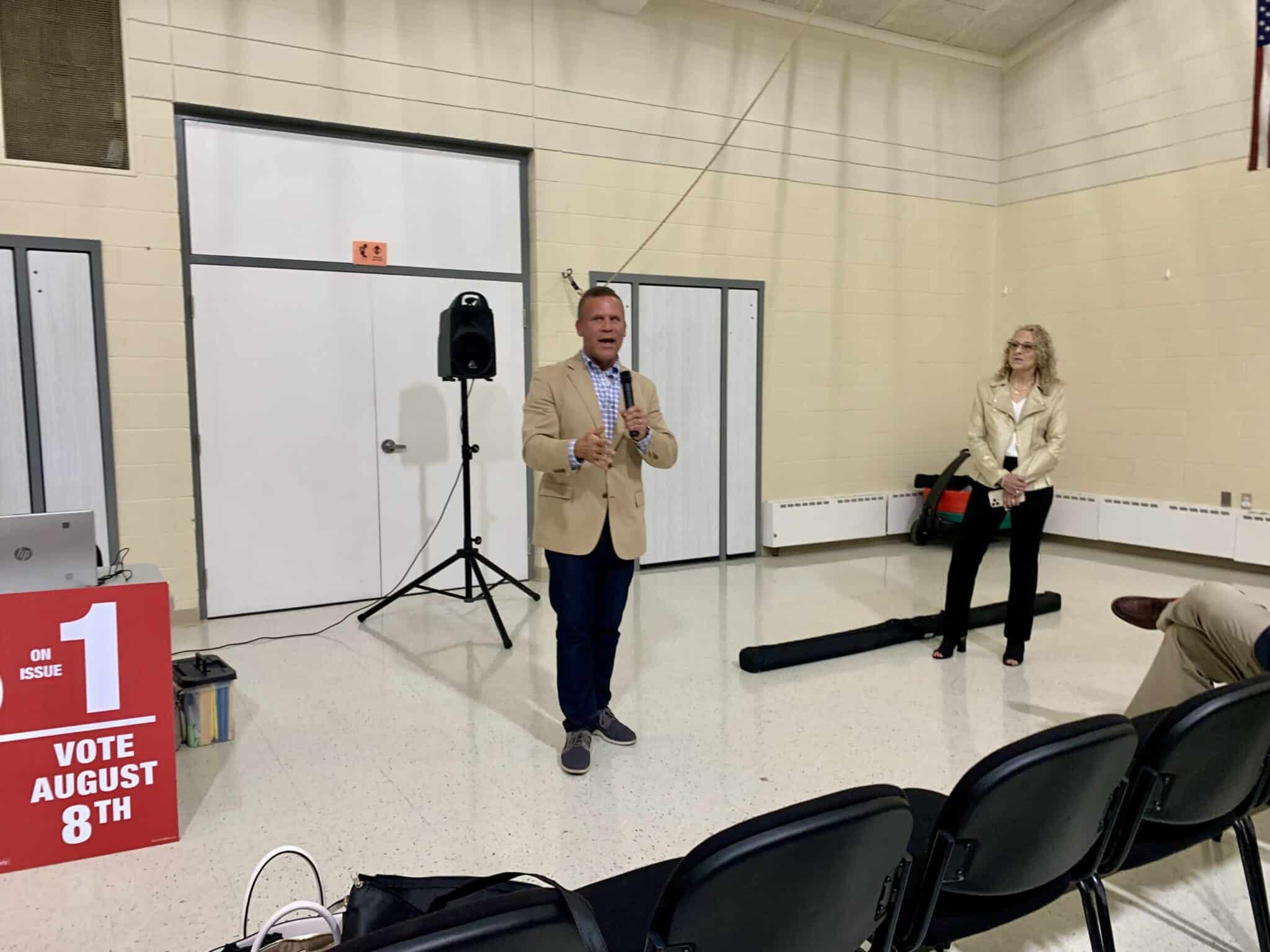
In remarks made before the annual meeting of the Geauga County Republican Party Central and Executive Committee July 19, Gonidakis said the public’s checks and balances are elections.
“And every two and four years, if (State Sen. Sandra O’Brien), (state Rep. Steve Demetriou) and (state Rep. Sarah Fowler Arthur) aren’t doing a good job, you can go in with your voice and your vote and vote them out, or if you like what they’re doing, you can keep them in,” he said.
However, when the agenda of the “other side” is blocked in the statehouse by people like O’Brien, Demetriou and Fowler Arthur, they seek to amend the constitution instead, Gonidakis said.
“When they can’t get through the state house what they want, the loophole that they found is our state Constitution,” he said.
Gonidakis said if the OPRR’s amendment is passed in November, it would overturn 29 laws Ohio RTL has helped pass in his 16-year tenure.
The full text of the proposed amendment, which is available at protectohiochoice.com, says “every individual has a right to make and carry out one’s own reproductive decisions, including but not limited to decisions on: contraception; fertility treatment; continuing one’s own pregnancy; miscarriage care and abortion.”
“And they said individual not just because of the woke gender issues that they have, but also because they think a minor should be able to have an abortion without mom and dad’s consent, without mom and dad’s knowledge,” Gonidakis said, adding he believes the amendment would also overturn parental consent laws “because that is a law that would either directly or indirectly interfere with an individual’s right to an abortion.”
However, Beene said contrary to statements made by opponents, passage of the reproductive rights amendment will have no impact on existing law beyond restoring and protecting the rights once afforded by Roe v. Wade.
“All other laws will remain in effect until litigated or repealed by the General Assembly,” she said. “Here in Ohio, the General Assembly is controlled by abortion opponents as is the Ohio Supreme Court — the tribunal that would eventually rule on all challenges to existing abortion laws, including the state’s onerous TRAP laws that the American Medical Association and American Congress of Obstetricians and Gynecologists oppose because they hurt people by blocking access to safe medical care.”

A Slippery Slope?
Gonidakis additionally accused opponents of Issue 1 — which, if passed, would move the threshold to 60% for OPRR’s amendment in November — of using out-of-state donors to fund their campaign, including billionaire philanthropist George Soros and Democratic politician Michael Bloomberg.
He also said the failure of Issue 1 would trigger a deluge of ballot initiatives aimed at changing laws on gun rights, police unions, the minimum wage, agriculture, animal rights and small businesses.
“They’re coming for you,” he told the crowd. “The (National Rifle Association) is standing shoulder-to-shoulder with Ohio Right to Life and telling their members, all of the members across the whole, this great state, to vote yes on Issue 1. … The firearms industry is also putting out mailers, too, because they know, they see that in 10 states where the George Soroses, the Michael Bloombergs of the world who have bottomless pits of cash — more money than all of us combined could ever see or could ever imagine — want to amend state constitutions to eliminate your constitutional right to bear arms.”
Gonidakis said if those laws are changed, state legislatures will no longer be able to help.
“You can’t call Mike DeWine or whoever the governor is at the time and say, ‘Hey, do something.’ They’re gonna look at you and say, ‘Well, we can’t because it’s in the constitution,’” he said. “It’s the loophole. The loophole the radical out-of-state people have found.”
Opponents of Issue 1 have pointed out proponents also have out-of-state donations filling their coffers. In an April 23 report, the Columbus Dispatch said Illinois billionaire Richard Uihlein spent about $1.1 million in donations to a political action committee supporting Issue 1.
“If we want to keep Ohio Ohio, a midwestern state with midwestern values, and we don’t want to see Ohio turned into California, we vote yes on Issue 1 on Aug. 8. It’s that important,” Gonidakis said July 19.
However, Beene said the OPRR and Protect Choice Ohio have been pleased, but not surprised by what she called an enthusiastic response to their amendment proposed for the November ballot in every part of this state, starting from the day their campaign launched.
That proved true in Geauga County, where a signature drive to place the amendment on the November ballot drew three times the number of signatures needed. A report from the Geauga County Board of Elections showed 6,128 signatures collected while only 2,122 were needed to meet the threshold for eligibility.
Notably, about 85% of signatures collected were valid, beating the numbers for a cannabis legalization ballot issue — which only drew 1,284 total signatures in Geauga County, 74% certified as valid by the office of the secretary of state.
“Polling has consistently shown that a vast majority of Ohioans opposed the repeal of Roe and support restoring and protecting reproductive rights and access to abortion,” she said. “The success of our petition drive and growth of the coalition demonstrate how strongly the public feels about this issue.”


