Gurney Elementary School STEM teacher Sally Gallik wanted to find a hands-on lesson that would show her K-3 STEM students exactly what happens with the alignment of the sun, moon and Earth to create a solar eclipse...
Solar Eclipse Lesson
Gurney Elementary School STEM teacher Sally Gallik wanted to find a hands-on lesson that would show her K-3 STEM students exactly what happens with the alignment of the sun, moon and Earth to create a solar eclipse. After searching for ideas, she found a great model that allowed the students to move the moon over the sun.
Gallik started each lesson with students watching a short solar eclipse video and demonstrating how the sun, moon and Earth orbit around one another with a large yellow Chinese lantern as the sun, a globe, and a foil ball for the moon. They also talked about how everyone on Earth has a different view of the eclipse, and that there is a path of totality.
The best part of the lesson was when Gallik showed the class the path of totality and pointed out where they were located. The class erupted with cheers when they learned that they were in the path of totality. They were so excited.
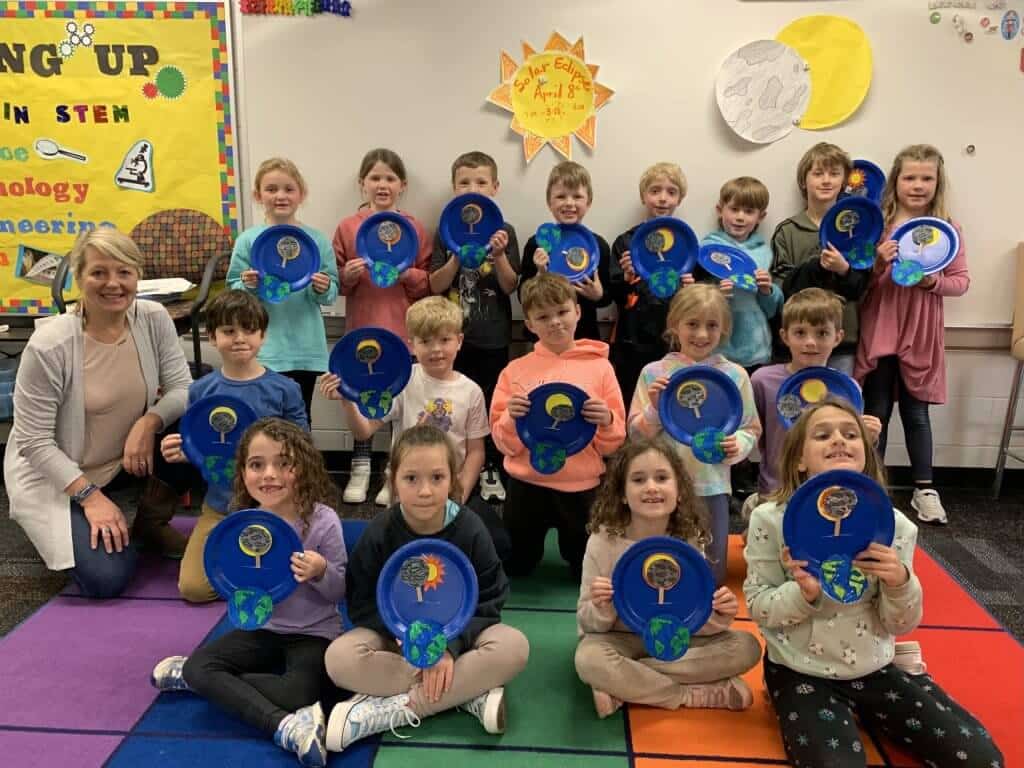
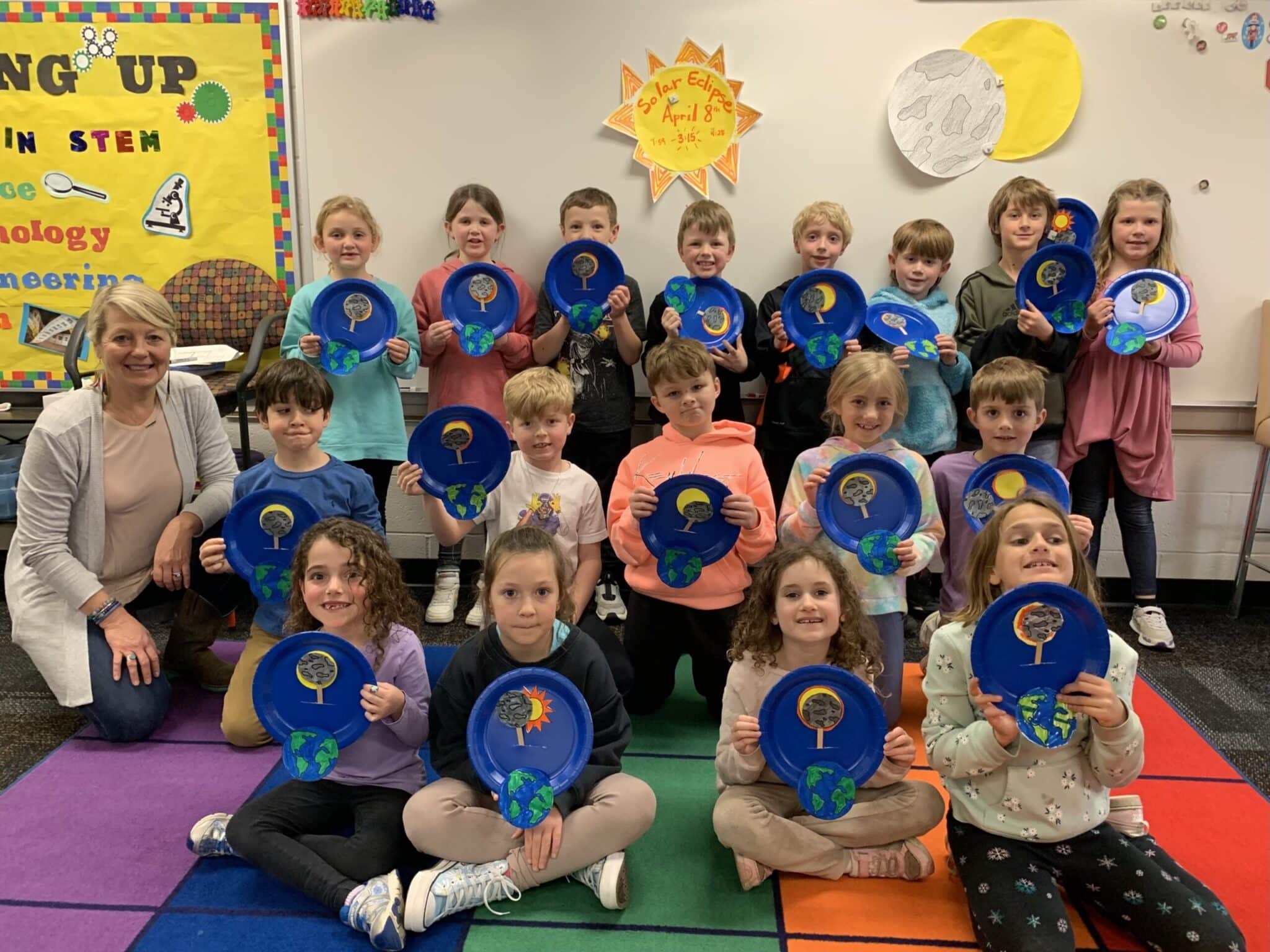
Finally, they started making the models. They colored and cut out the sun, moon, and Earth. The sun and Earth were glued to a blue plate while the moon was glued to a popsicle stick so they could move it over the sun. Then they simulated the eclipse. Sally asked them to tell her what it would look like at various times starting at 1:59 and ending at 4:28. Of course, they loved showing the total eclipse at 3:15.
Chagrin Falls Schools Receives National Recognition for Music Education
Chagrin Falls Schools has been honored with the Best Communities for Music Education designation from The NAMM Foundation for its outstanding commitment to music education. It is the third consecutive year the district has received this recognition.
Now in its 25th year, the Best Communities for Music Education designation is awarded to districts that demonstrate outstanding achievement for providing music access and education to all students.
To qualify for the Best Communities designation, Chagrin Falls Schools answered detailed questions about funding, graduation requirements, music class participation, instruction time, facilities, support for the music program and community music-making programs. Responses were verified by school officials and reviewed by The Music Research Institute at the University of Kansas.
“There is wonderful music-making happening here at Chagrin Falls Schools,” said Casidy Reed, director of bands. “I am very proud to teach such wonderful students who are committed to excellence. Along with the support from our families, our boosters and our community, we are able to strive to continue to improve our program and provide more opportunities for our students.”
Research into music education continues to demonstrate educational/cognitive and social skill benefits for children who make music: After two years of music education, researchers found that participants showed more substantial improvements in how the brain processes speech and reading scores than their less-involved peers and that students who are involved in music are not only more likely to graduate high school but also to attend college as well. In addition, everyday listening skills are stronger in musically trained children than in those without music training. Significantly, listening skills are closely tied to the ability to: perceive speech in a noisy background, pay attention, and keep sounds in memory. Later in life, individuals who took music lessons as children show stronger neural processing of sound: young adults and even older adults who have not played an instrument for up to 50 years show enhanced neural processing compared to their peers.
AP Art Students Showcase Portfolios at Board Meeting
At the March 20 Chagrin Falls Board of Education meeting, 2D Art Teacher Jill Eisert and four of her talented AP art students showcased their exceptional work from their AP portfolios that were accepted into the prestigious Ohio Governor’s Art Exhibition. The statewide exhibition celebrates the artistic talents of Ohio’s high school students and the quality of art instruction in the state.
Eisert expressed pride in her “amazing and committed group of AP artists” who consistently pushed themselves creatively. Five Chagrin students had eight pieces accepted into the top 300 works in the exhibition, which is on display at the Ohio Department of Education in Columbus.
The students spoke about the concepts and processes behind their compelling artwork.
Anna Baker’s artistic concept revolved around exploring the interactions between inanimate, lifeless objects and the chaotic, emotional essence of humanity. In many of her pieces, she intentionally created stark, still life domestic scenes and then injected them with imperfections and disorder – those qualities she feels define the human experience. One notable work involved a photo shoot she conducted in her own bathroom. The foreground featured a composed, presentable version of herself, while the background contained a concealed figure engulfed in erupting flames. The creation process was extensive – beginning with the staged photography, then digitally compositing the two figures, translating that to a hand-drawn sketch, applying a vivid neon pink acrylic underpainting to make the skin tones pop, and finally, rendering the detailed oil painting on top. Though the background flames were not originally planned, she decided that element was crucial to infusing a sense of frenzy and pandemonium into the otherwise mundane setting.
Isabel Nerpouni’s artwork stemmed from a desire to experience original ideas and explore alternative perspectives, while still maintaining a sense of familiarity and comfort. Her pieces invited the viewer to find relief from the mundane through incredible acts of discovery.
One of her works was a multi-layered shadow box construction. Each layer began as an individual piece, but felt incomplete on its own. By cutting away portions of the foreground layer, it allowed the background layers to be revealed through the negative spaces. On the suggestion of Mrs. Eisert, Isabel decided to encase the layers into a shadow box format. The final piece depicts a frenzied, overlapping array of forms and figures in the background meant to symbolize the chaotic inner workings of the mind. This visual busyness contrasts with the single standing figure in the foreground, representing the outer facade of composure shielding the turmoil underneath.
Clara Ives’ portfolio explored the experiences and sensations of growth, maturation, and the inevitable passage of time that pulls us along whether we want it or not. Her pieces grappled with the unstoppable forces of change. One of her works featured the imposing, rigid architecture of a cathedral rendered in shades of purple. Ives wanted to capture the feeling of finding oneself suddenly an adult, burdened with responsibilities, expectations, and a fear of not measuring up to one’s own perceived strength. The cathedral’s stern visage symbolized the sense of being watched and judged during this transition. She experimented with stark black-and-white contrasts as well as brighter, bolder color palettes before settling on the muted, somber tones she felt best conveyed the uneasy atmosphere.
Kaz Kanieski’s portfolio primarily focused on depicting the battle between optimism and pessimism, as well as exploring themes of deception, evil, and the darker aspects of the real world. However, Kanieski aimed to represent these heavy, serious topics in an exaggerated, comedic way in order to lighten the mood and make the subject matter more accessible to viewers. For his skateboard piece specifically, Kanieski concentrated on the relationship and interplay between light and dark – both literally in terms of contrasting tones, but also conceptually examining the tensions between opposing forces. He employed layering techniques, varied and complex line work, intricate shading, and a densely detailed composition that becomes more puzzling the deeper one tries to analyze every element occurring simultaneously within the frame. Kanieski’s work was juried into the top 25 in the state of Ohio.
Andrew Brackett was not present, but Eisert explained how his art explored the conflict between urban development and nature through mixed media pieces. He questioned how environments could be altered to convey this conflict, as well as how to represent the eventual reclamation of the planet by nature following humanity’s reign. To investigate these concepts, Andrew created a series of mock-ups combining photography and drawings to depict the interactions between natural and urban environments. He then utilized a process called sublimation, working with Mr. Kimball in the Innovation Center. Sublimation allows drawings and photographs to be dyed directly onto specialized drawing papers of Andrew’s choosing.
Board member Lori Bendall inquired about the intensive AP portfolio process. Eisert explained that students create 5-8 thematically linked projects over the year, with a minimum of 15 slides showcasing their best works. Clara Ives gratefully acknowledged Eisert’s invaluable guidance in helping them transform their ideas into cohesive visual expressions.
The Chagrin Falls students’ insightful artwork and dedication impressed all in attendance, highlighting the remarkable talents being nurtured in the district’s art program. Previous AP portfolios through the years are displayed in the shared hallway at Chagrin Falls Middle/High School.
Harris Field Track Renewal
Summer 2024 is set to bring an exciting renovation to the Chagrin Falls Schools’ Harris Field running track, thanks to a matching grant from the Ohio EPA. The existing track surface, originally installed in 2012 and subsequently patched and recoated over the years, has begun to show signs of failure, necessitating a full resurfacing to ensure a first-class running surface for the spring 2025 season.
The scope of the project involves removing the existing rubber running surface and installing a new one-half-inch black rubber surface, sourced from recycled tires supplied by an Ohio rubber supplier. The lane lines, event markings, and lane numbers will be laid out and striped according to NFHSA regulations. Additionally, the existing asphalt will be evaluated and addressed as necessary, with plans in place to handle potential spot repairs, milling, or even a complete repaving of the entire track, should extensive asphalt repairs be required.
Late last year, during meetings with the Ohio Schools Council, the district became aware of the Ohio EPA’s Ohio Recycles Grant, which provides matching funding for projects that incorporate recycled materials. After consulting with the Ohio EPA, the District decided to pursue this opportunity and applied for grant funding for the track replacement. Their application was approved this month, and the grant will provide up to $200,000 in matching funds for the project, contingent upon the submission of documentation proving that the rubber used was sourced from Ohio scrap rubber. Grant funds such as these represent new money for the district that is not from local taxpayers.
The supplier for this project, a leading recycled rubber supplier with over 50 years of experience working with recycled materials, has assured the district that they will provide the necessary recycled materials certification to meet the grant requirements. By using recycled rubber from Ohio, the district not only secures matching funds for the project but also contributes to the removal of scrap rubber from Ohio landfills.
The planned project duration is 30 days, with a targeted start date of July 1 and an expected completion date of July 30, which is weather-dependent. The time frame includes a 14-day cure period for the asphalt, should asphalt work be required. The track will be striped later in the fall, once the surface has had ample time to cure.
At the March 20 board meeting, items for approval were accepted for the grant, paving the way for this exciting track renewal project that combines functionality, environmental responsibility and financial prudence.
CFMS Speech and Debate
The 2023-24 speech and debate season for Chagrin Falls Middle School was nothing short of amazing. A team of 38 students dedicated their Fridays to practice and their Saturdays to competition, spanning the months of November through March. With an impressive number of students placing or winning tournaments throughout the season, the district was poised for an outstanding performance at the state competition on March 9.
Thirteen students represented Chagrin Falls Middle School at the state level, competing against more than 35 schools from across Ohio. Sedona Bundy, a standout in Congressional Debate, advanced to the finals. Meanwhile, Abe Somogyi’s talent in Extemporaneous Debate earned him an impressive fourth place finish at the state competition.
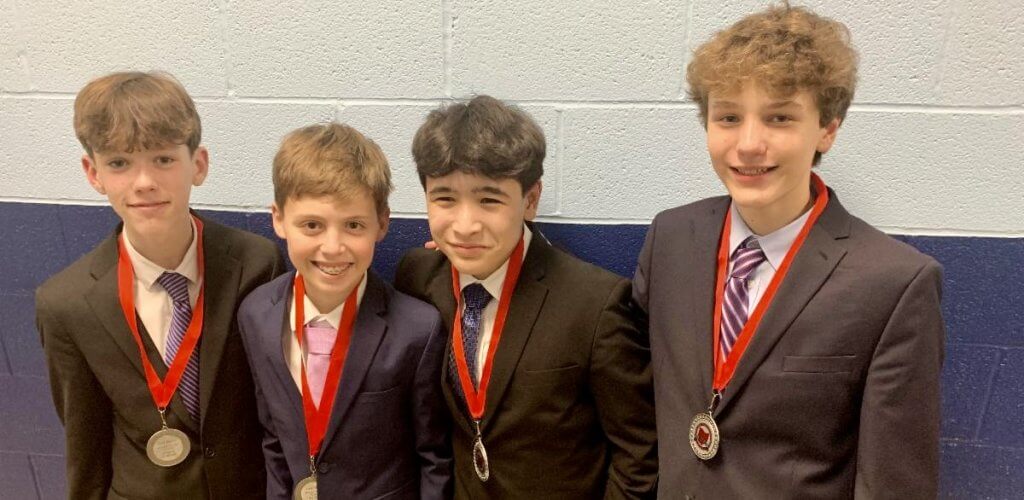
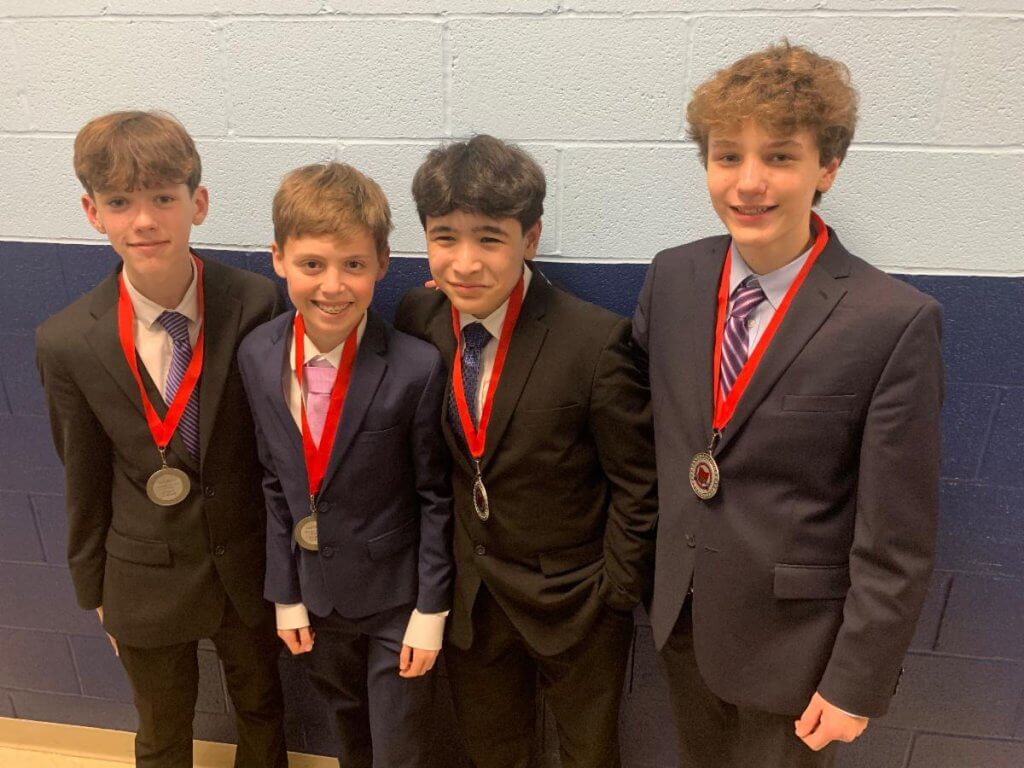
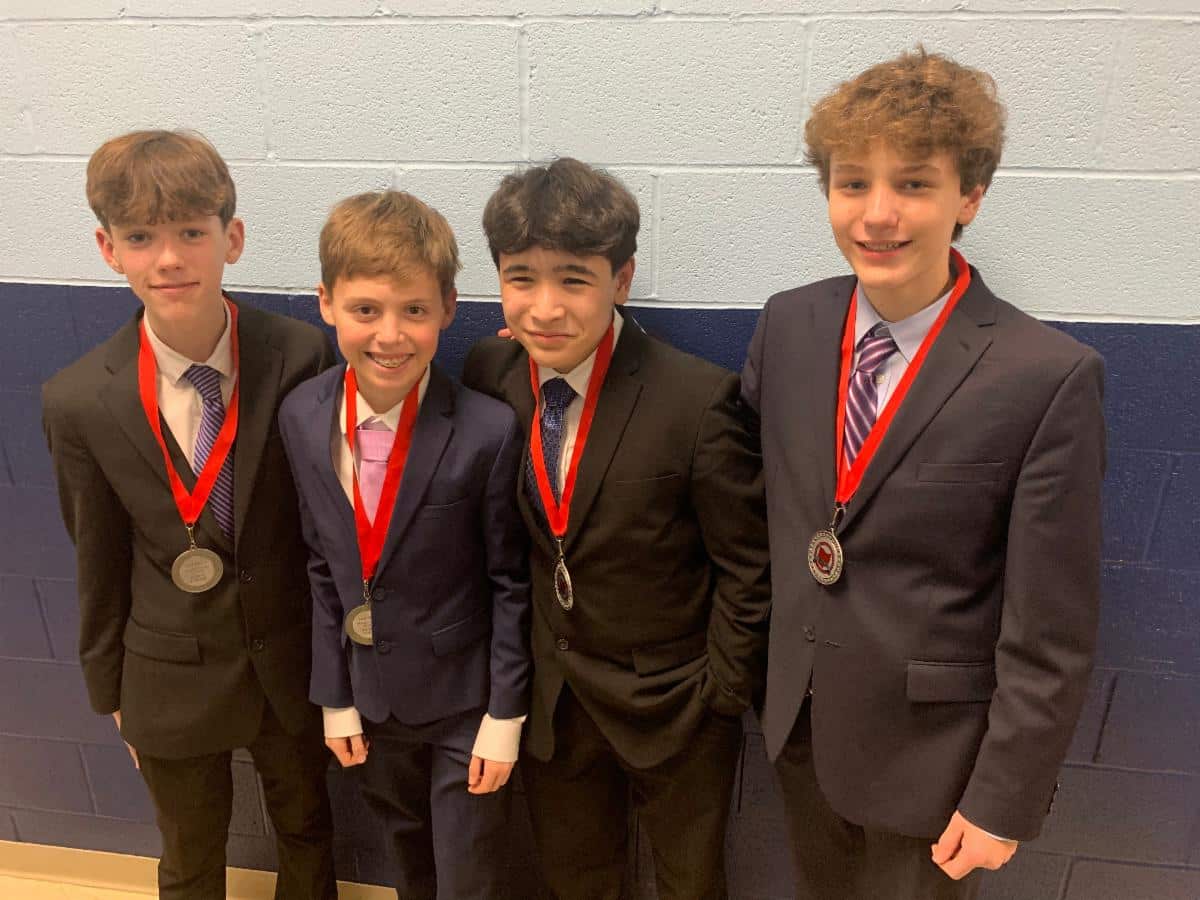
Gavin Chan and Dominic Pantuso, and Ben Lyndall and Jack Shein, proved their skills by emerging as the 2024 Ohio State Champions for Public Forum Debate. Their hard work, dedication, and mastery of the craft paid off in the most remarkable way, solidifying Chagrin Falls Middle School’s reputation as a powerhouse in speech and debate.
The remarkable achievements of the Chagrin Falls Middle School Speech and Debate team this season are a testament to the students’ talent, commitment, and the guidance of their coaches.