


By the end of the American Civil War, as many as 851,000 soldiers were dead, according to the book “Civil War History,” by J. David Hacker, which Kent State University Press published in 2011.
By the end of the American Civil War, as many as 851,000 soldiers were dead, according to the book “Civil War History,” by J. David Hacker, which Kent State University Press published in 2011.
Hacker, a demographic historian at Binghamton University in New York, studied the national census figures from that time and wrote previous estimates of 720,000 dead may be too low by about 20%, said Molly Sergi, a full-time KSU history instructor.
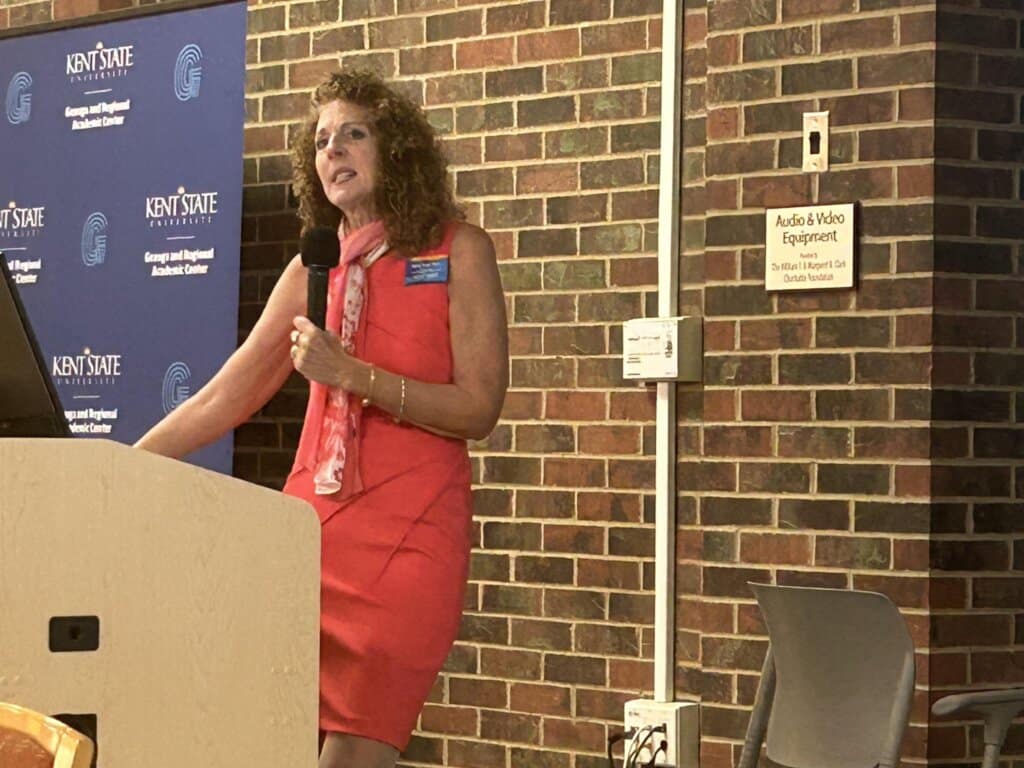
Sergi spoke May 3 at the Geauga Economic Leadership breakfast at KSU – Geauga about the effects of the Civil War on the U.S. population.
Her focus was on the historic figure of Emily Nash, a professional mourner who lived in Geauga County and kept a journal in which she recorded the deaths of hundreds during her career, Sergi said.
“The journal was referenced as the death record in Geauga County. It is not simply 450 pages of handwritten accounts,” she said, noting the journal is housed at the Chardon branch of the Geauga County Public Library.
She credited the late local historian, Teeter Grosvenor, for typing up the pages of poor grammar and spelling to preserve Nash’s journal.
“(The original) is very hard to read. She used every scrap of paper,” Sergi said. “It’s a wonder the journal survived.”
Nash began her career as a mourner during the Age of the Beautiful Death, becoming a member of the local circle of mourners as she came of age, visiting the homes of individuals in their final moments, observing and recording their deaths, Sergi said.
“It was very important in America to watch people die,” she said.
In the process, Nash detailed numerous diseases that carried Geauga residents off, including diphtheria, dysentery, tuberculosis, typhoid scarlet fever, smallpox and cholera. She survived the epidemic of black measles, which may have been caused by an infection of the liver.
“She was shocked by the amount of cholera,” Sergi said, adding life expectancy in the U.S. fell as settlers moved west from 1790 to 1860, introducing disease as they traveled. The war exasperated that trend.

During the Civil War, many diseases were brought to communities by soldiers on leave. Ohio sent the largest army to fight for the North and sanitary conditions in the military camps were dreadful, causing the spread of any disease, she said.
Epidemics, such as the one in Cincinnati that killed an estimated 60,000 residents between 1849 and 1851, were common because Americans did not know how disease spread, how to treat it or the need to isolate those infected, Sergi said.
Hacker’s figures dealt only with the military casualties of disease, she noted.
Civilian casualties from disease could have pushed the total closer to a million, she said, adding the census showed the U.S. had about 21 million citizens in the north and nine million in the south, so the loss was significant.
“It’s mind boggling. Many deaths could have been prevented with sanitation,” Sergi said.
Geauga County was lucky to have a physician, Dr. Erastus Goodwin, who worked with Nash over the years, but many of the women used homeopathic treatments for disease so a doctor was rarely called.
“Women were quite knowledgeable about disease,” Sergi said.
Nash outlived four husbands, dying in 1888 and only in her later years did she come to understand how valuable her scribbled notes may be to history.
“Nash was doing an incredible service,” Sergi said.


