


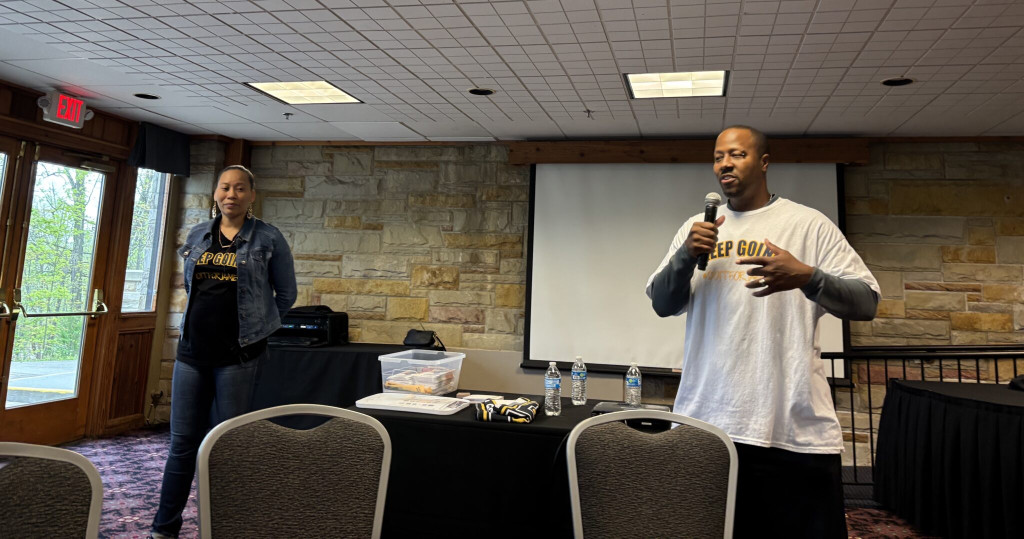
Co-founders of the Do It For James Foundation, Timothy and Tamia Woods, spoke to Geauga County parents at the Punderson Manor Lodge and Conference Center in Newbury Township May 8 about the dangers of child sextortion after losing their son to it.

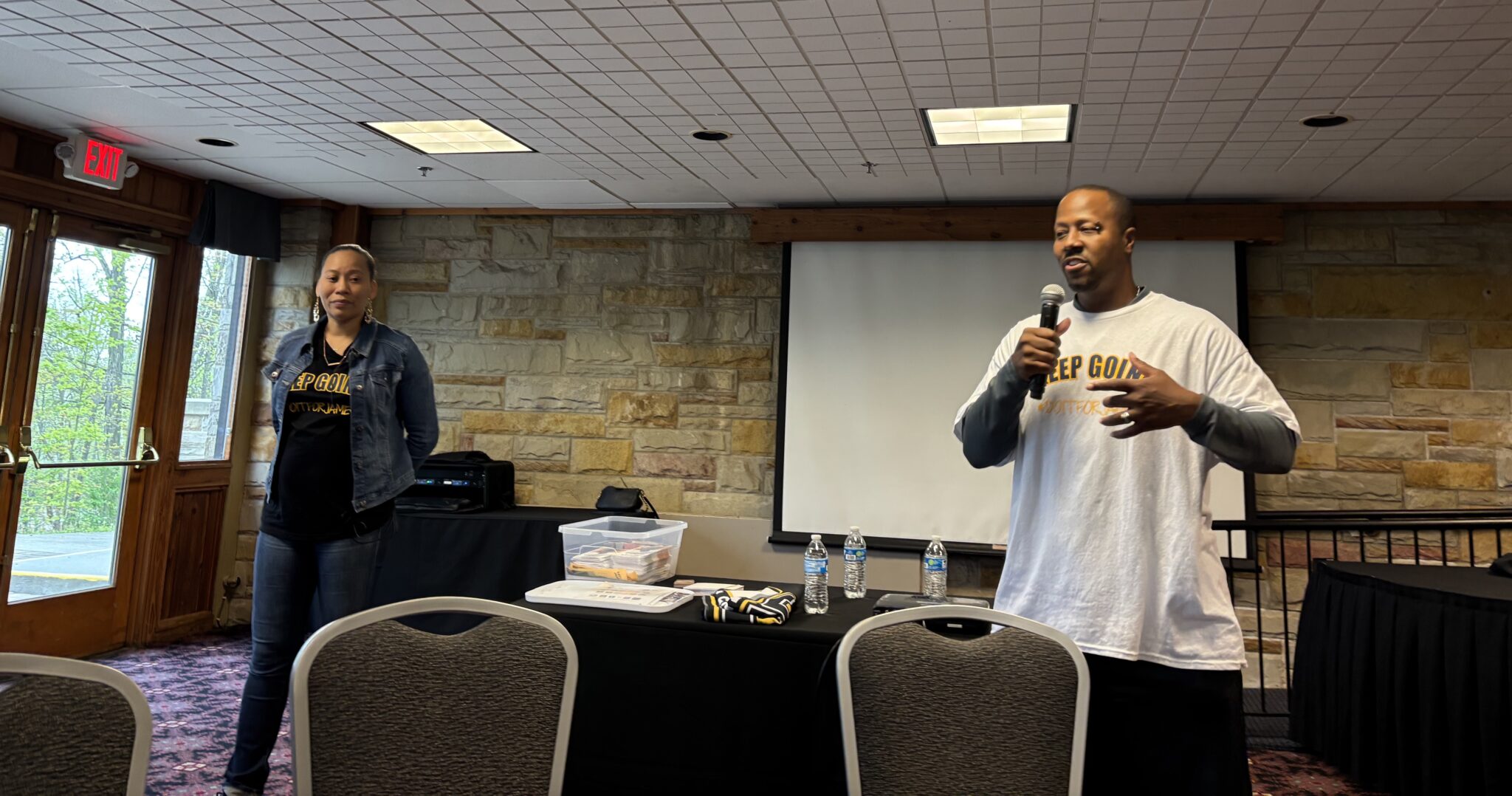

Co-founders of the Do It For James Foundation, Timothy and Tamia Woods, spoke to Geauga County parents at the Punderson Manor Lodge and Conference Center in Newbury Township May 8 about the dangers of child sextortion after losing their son to it.
Geauga County Job and Family Services sponsored the presentation, which aimed to educate parents and prevent more victims of sextortion — a form of blackmail that involves an offender receiving sexually explicit material from a child and then threatening to release the material unless the child sends money and/or gift cards, according to the Federal Bureau of Investigation.
“(We are) really getting the parents involved in reinforcing some of the things that we’re teaching and talking about with students about online safety,” said Jennie Canganelli, a licensed school counselor and Ohio certified prevention specialist, in a May 12 interview. “We can go in and tell kids every day that there are dangers like sextortion, but … hearing it firsthand is — you hear it a little differently. I think parents hearing (stories) firsthand is important.”
James’ Story
James Woods was born to Tamia and Timothy Woods, of Streetsboro, on the morning of July 23, 2005.
“It was the best day of my life … I never had a kid before … and I was excited,” Timothy said.
James was projected to be number one in Ohio for Division Two for 110-meter hurdles and indoor track, 60-meter hurdles, Tamia said.
Timothy and Tamia went to every track meet James had to cheer on the track star.
“He was always telling jokes, he was always smiling, he was always cheering people up (and) making them feel better,” Timothy said. “He just had one of those magnetic personalities that made people want to be around him.”
Tamia and Timothy instilled in James a loving and accepting environment, which James took with him wherever he went, Timothy said, adding James had goals of studying law once he graduated college.
Those plans, however, never came to be.
Timothy found James dead Nov. 19, 2022, following a 19-hour, 200-message exchange between James and an online predator, who messaged him on Instagram.
She gained his trust and asked him to video chat, during which she asked him to expose himself and he obliged.
The woman began spamming James with an explicit image of James she had taken a screenshot of during the video call, along with the message, “This is you in all of your glory,” over and over.
“Then, she starts to tell him, ‘I own you, you’re never going to get rid of me and I’m going to destroy your life and this is how I’m going to do it,’” Timothy said, adding the woman also told James she would get him kicked out of high school, that he would not be able to go to college, he would not be able to get a job because he would be labeled a “pedophile,” and, therefore, his friends and parents would not love him anymore.
James asked the woman, “What did I do to you? Why are you doing this to me? What can I do to stop this?” Timothy said.
The woman then told him if he gave her $6,000, she could make this all go away. As he did not have that amount of money, she brought it down to $300, which James also did not have, Timothy said, adding he only had $100, which he was “coached” by the woman to put onto a gift card and read the numbers.
“They told him to kill himself,” Tamia said. “They told him all these things, the worst things you could ever tell a child, a promising, beautiful child, and they took everything that we instilled in him and took it away in 19 hours.”
Timothy added, “I had to pick up my phone and call my wife to let her know that the only child she will ever have in her life, this person that she carried around for all of those weeks, this person that she did all these sacrifices for, the person she cheered for all the time, the person she did everything for first before herself — I had to call her and let her know that that one person was gone.”
James’ predator was never caught.
“Every single day, I wake up and I think, ‘Where is my son? Can I have my son?’ (We’ve) done 400 speeches. ‘Can I have him back?’” Tamia said, tearful. “We can’t do it for James anymore, so we have to do it for y’all.”

Preventing Sextortion
The Woods — who also came to speak to students at Chardon High School and Berkshire High School recently — emphasized the importance of educating children and parents about the financial motivations behind sextortion.
“Increase your communication and be upfront,” Tamia told parents.
The couple recommended using Android phones for better access to parental controls, rather than iPhones. In addition, there are phones called GABB and BARK, that allow access to necessary items, like texting and calling.
They also recommended the BARK app, which scans children’s text messages, emails and other online activity for inappropriate and alarming content.
Parents should report any cases of sextortion not only to the police, but also to the National Center for Missing and Exploited Children, as they have better resources to combat sextortion, Tamia said.
“Anytime your child has a phone, a smartphone, parents need to be involved in what they’re doing with that phone, what they’re looking at, what they’re downloading,” Geauga County Sheriff Scott Hildenbrand said earlier this year.
There are ways to remove explicit photos of children online, through takeitdown.ncmec.org.
Many of these predators reside in other countries,where they don’t have extradition treaties with the United States and can’t get caught, notably Nigeria, Tamia said, adding $100 U.S. dollars is equal to 160,306 Nigerian nairas.
Seventy-nine percent of predators are seeking money rather than explicit images, according to The National Center for Missing & Exploited Children.
Holly Jacobson, an Ohio certified prevention consultant, who, along with Canganelli, works for the Educational Service Center of Northeast Ohio, also emphasized the importance of parents keeping lines of communication open with their children.
“It’s so important to have open communication between students and parents about social media, about the good things — but also the dangers that come along with it,” Jacobson said in a May 12 interview. “Because kids are so much smarter than us … we’re always like, several steps behind the students.”
The sheriff’s office provided the following recommendations to keep children safe:
- Discuss Online Safety: Have open and ongoing conversations about the dangers of chatting with strangers online and explain the importance of never sharing personal information and not to accept friend requests from people they don’t know. Let children know they can come to you if they experience bullying, inappropriate content, or anything that feels off.
- Use Parental Controls: Use app management tools or settings to block or restrict access to apps. Adjust the settings to limit who can message, chat and join games with your child. You can also turn off the ability to chat entirely.
- Monitor Activity and Screen Time: Regularly check in their activity, including posts, interactions with others, their experiences and who they’re playing with. Set limits on how much time they spend on apps each day. Regularly check your child’s device for apps that may be hiding in plain sight, like Calculator%.


