Chardon Council Approves One-Year Trial for Downtown DORA
Chardon City Council voted 6-1 on July 10 to establish a designated outdoor refreshment area (DORA) in the city’s downtown, launching a one-year trial program.

Chardon City Council voted 6-1 on July 10 to establish a designated outdoor refreshment area (DORA) in the city’s downtown, launching a one-year trial program.
Council member David Lelko cast the lone dissenting vote, raising concerns about the number and placement of signs required to mark the DORA boundaries.
According to April 28 special meeting minutes, a DORA “…is an area where persons of legal drinking age are permitted to possess and consume alcohol in a public area with certain restrictions.”
Drinks sold by approved businesses must be consumed within the DORA boundaries and taken outdoors after purchase, Joyce Perrico told council at the July 10 meeting. Perrico spearheaded the effort to bring the DORA proposal forward.
Chardon City Manager Randy Sharpe had said at council’s April meeting that the idea has been under consideration since 2022, noting that Ohio law gives cities flexibility to develop DORA rules that fit their community.
“This is a trial run for approximately one year,” said Mayor Chris Grau. “We’ll be in touch with (Police Chief Scott Niehus), we’ll be in touch with the restaurant owners and, of course, the general public.”
The DORA will operate Thursdays through Saturdays from 4-9 p.m. The city manager will have the authority to suspend the DORA temporarily during special events, according to the legislation council passed.
Grau noted the DORA would not be in effect during the annual Maple Festival.
Four establishments within the DORA will be authorized to sell beverages: Square Bistro, Element 41, Noce Gourmet Pizzeria and Cremona.
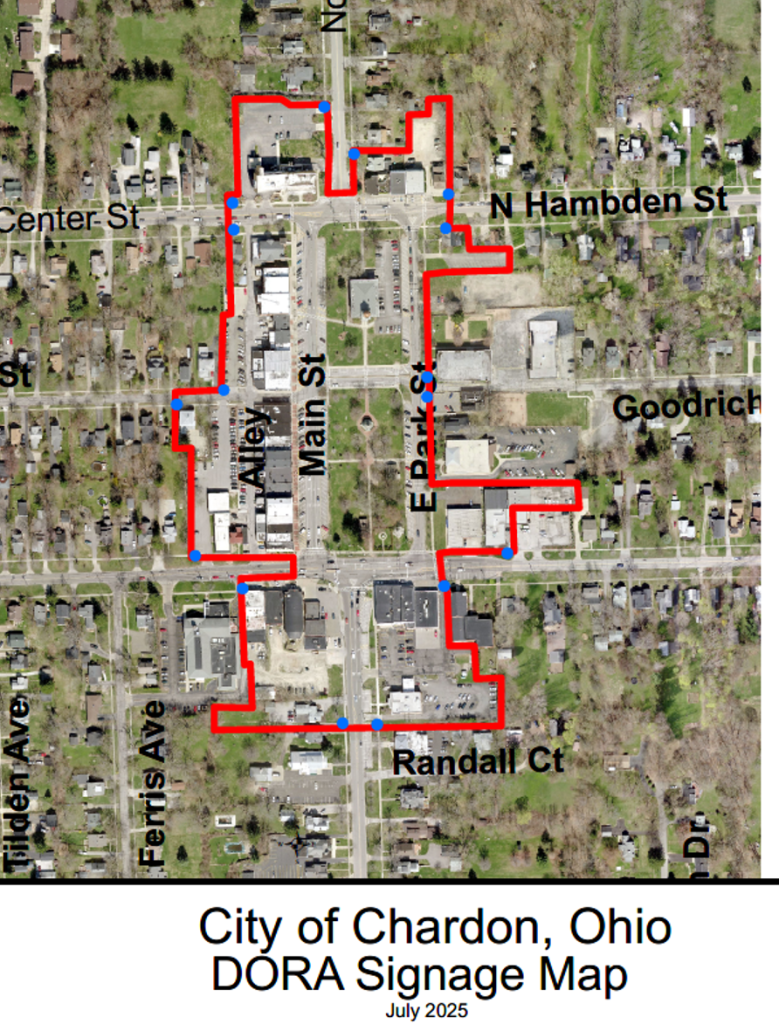
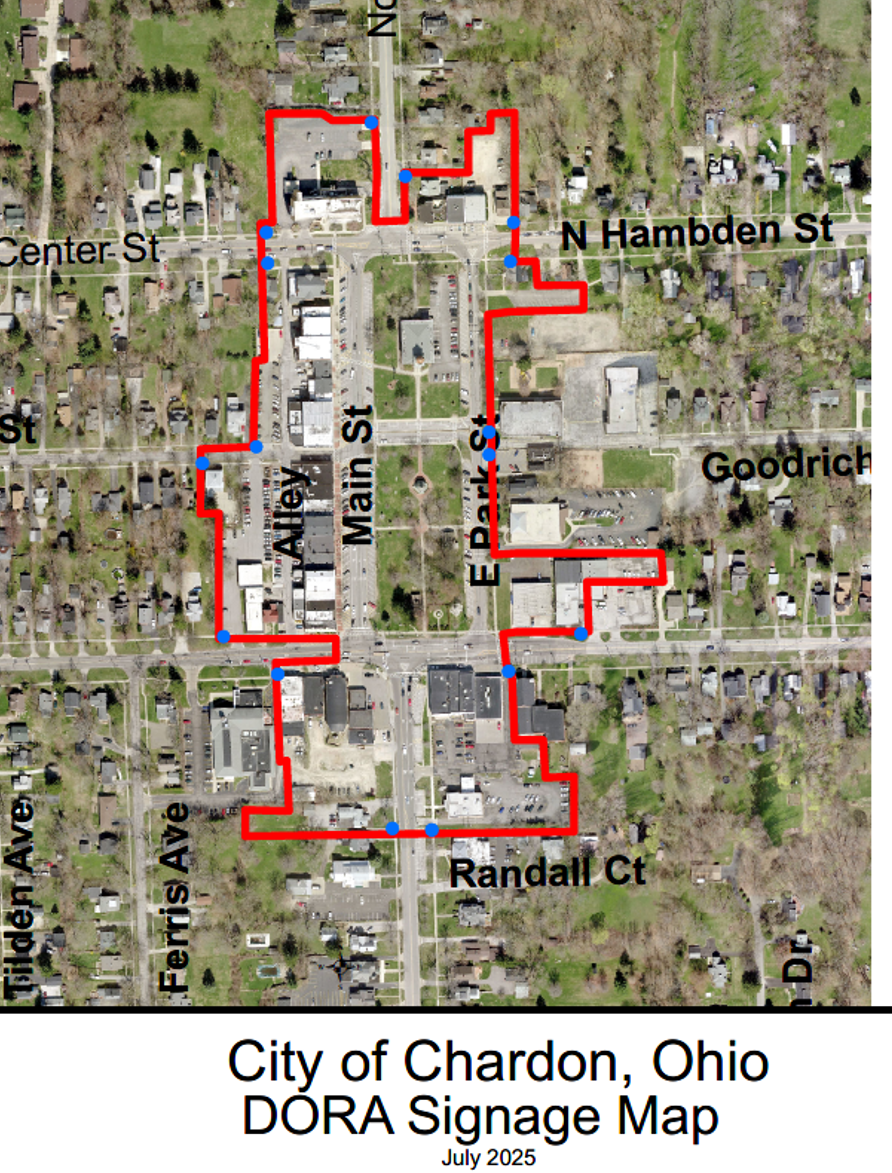
A map included with the resolution outlines the DORA boundaries, covering Chardon Square and portions of adjacent streets.
The legislation calls for 16 signs to be posted at key points around the DORA — a number that concerned Lelko.
“Following my review of the material, I have a very large concern about the signage. I don’t want to see 16 signs up and, therefore, I will not support the creation of the DORA,” Lelko said.
His opposition was based entirely on the signage, he emphasized.

“At this point I’m just basing it on that,” he said. “Some of those signs are going to be in residential areas, on residential streets. I just don’t want to see 16 signs up for eight months a year.”
Other council members suggested the signage could be implemented creatively to reduce its visual impact, including decals on sidewalks or signs mounted on trash cans.
Vice Mayor Heather Means said the signs are typically subtle in other communities.
The signage will also not be “glaring,” she said, noting in other cities they blend in with the rest of the signs.
While Grau acknowledged Lelko’s concerns, he said clear signage is a necessary part of establishing a DORA.
Means agreed. “This is part of having a DORA,” she said.
Law Director Ben Chojnacki explained that while signs are commonly placed at DORA entrances and exits, state law does not mandate exact placement.
Council member Andrew Blackley pointed out that the signage may be positioned beyond typical walking distances, and suggested participating businesses could display their own signage indicating DORA boundaries.
“I think if we don’t have the signs on those points then somebody could very easily say, ‘Well, there’s no signage,’ ‘Oh, I didn’t see that signage,’” Means said. “The goal is to keep people from walking out of the DORA with a beverage. If we don’t put the signs where that’s at, because we’re worried about what it looks like, my ask would be let’s put them out there and see what it looks like.”
Niehus added that enforcement becomes more difficult without clear signage at DORA boundaries.
Perrico noted that other communities provide maps and rule posters for DORA businesses and post the information online, as Fairport Harbor plans to do.
Ben Young, Chardon’s incoming city manager who previously worked in North Canton, shared how that city implemented signage.
North Canton’s signs are at the DORA’s entrance and exits on trash cans, Young said, explaining that the city’s main street initially lacked trash cans.
A few are on street poles because trash cans were blocking the way, he added.
He said this approach helps police officers handle potential violations informally.
“It’s been very helpful at events. The officers can very easily do a, ‘You’re about to leave. There’s a trash can right there, why don’t you just put your cup in it and we can walk away and nobody has to get a ticket,’” he said.
Young added that most DORA cups in North Canton are used during events like concerts or food truck nights, rather than everyday visits downtown.
According to the resolution, Chardon City Council will decide whether to continue the DORA Oct. 31, 2026. The measure takes effect immediately but still requires state approval before the DORA officially launches.