Cardinal Schools’ five-year forecast, like many others in Geauga County, will be impacted by a variety of influences this year — be it state legislature and governor actions, property tax income or inflation.
Cardinal Schools’ five-year forecast, like many others in Geauga County, will be impacted by a variety of influences this year — be it state legislature and governor actions, property tax income or inflation.
However, one thing is certain: Cardinal Schools’ operating fund levy is set to expire in 2027 if voters decide not to renew it.
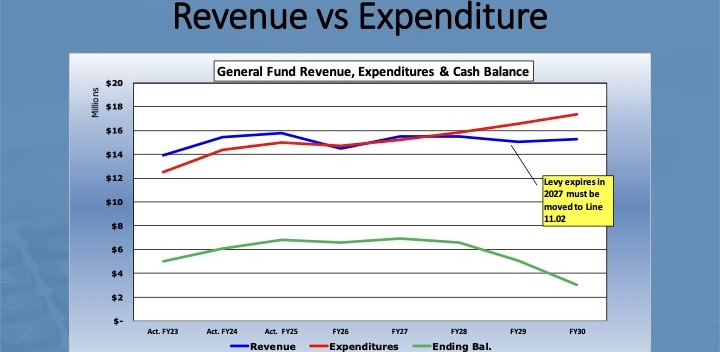
If the 9.7-mill renewal levy — which yields roughly $942,000 per year — fails, the district’s general fund expenditures are projected to exceed its revenue starting some time in early 2028, according to a chart presented Oct. 8 to the Cardinal Schools Board of Education.
District Treasurer Dan Wilson presented the five-year forecast for 2026 through 2030, calling it a key tool the district uses for planning its financial future.
Figures in the forecast show revenues increasing from about $14.5 million in 2026 to about $15.5 million in 2027 and 2028, then dropping back to about $15.1 million and about $15.3 million in 2029 and 2030, respectively.
Expenditures, however, also increase from about $14.7 million in 2026 to roughly $15.2 million in 2027, and about $15.9 million in 2028, an estimated $16.6 million in 2029 and about $17.4 million in 2030, according to the forecast.
Because the district will be spending from its unreserved general fund to make up the difference, the balance from 2026 to 2030 will decrease from roughly $6.3 million in 2026 to about $5 million in 2030, according to the forecast.
These figures assume the operating levy renewal passes, Wilson said.
Legislative action at the state level will affect revenue in fiscal years 2026 and 2027, Wilson said.
“The House voted in July to override one of the governor’s vetoes on levy types. The Senate has not considered this veto, yet, or if they will move to override other vetoes,” he said. “The Senate can act all the way to Dec. 31, 2026. In essence, portions of House Bill 96 may not be final until that date.”

The Taxpayers FreedomTrilogy Act was introduced to the House in August. If HB 420, HB 421 and HB 422 are passed into law, they will eliminate continuing (replacement and emergency) levies, potentially set aside inside millage and create more than 50% voter approval margins for new levies, Wilson said.
“All would be devastating to our local revenues we count on to educate our children,” he said. “Any changes which could be significant to state funding and property taxes will need to be watched and evaluated carefully and planned for in our forecast.”
HB 96 would not increase school funding in any significant way, Wilson said.
“The current state budget provided no increase in foundation funding,” he said. “More importantly, there are still 17 (12 house and five senate) proposed laws to impact local property taxes and/or valuations that could reduce local funding for all public schools in Ohio.”
The Governors Tax Reform Work Group is reviewing ways to stop property tax increases, primarily as they affect school districts, he said.
Proposals from the work group and/or future legislative actions seem imminent. If approved, those actions would negatively impact property taxes, which are 67.8% of the district’s revenue, Wilson said.
HB 96 also included a piggyback tax exemption law that could cost Cardinal Schools $213,000 per year if Geauga County Commissioners approve it, he said.
“The state is creating uncertainty concerning local property taxes due to numerous pieces of legislation and the Governors Tax Reform Work Group,” Wilson said, adding, if the state cuts Cardinal’s funding, that puts the burden back on taxpayers.
If legislators reform property taxation and cut or reduce state funding, they will severely impact public school districts’ ability to raise local funding, creating a dire future, he said.
“Our district will need to make cuts and/or pass new levies in response to maintain our instructional programs for our students,” Wilson said. “Our revenue and ability to manage the district is under threat by the Ohio Legislature.”