


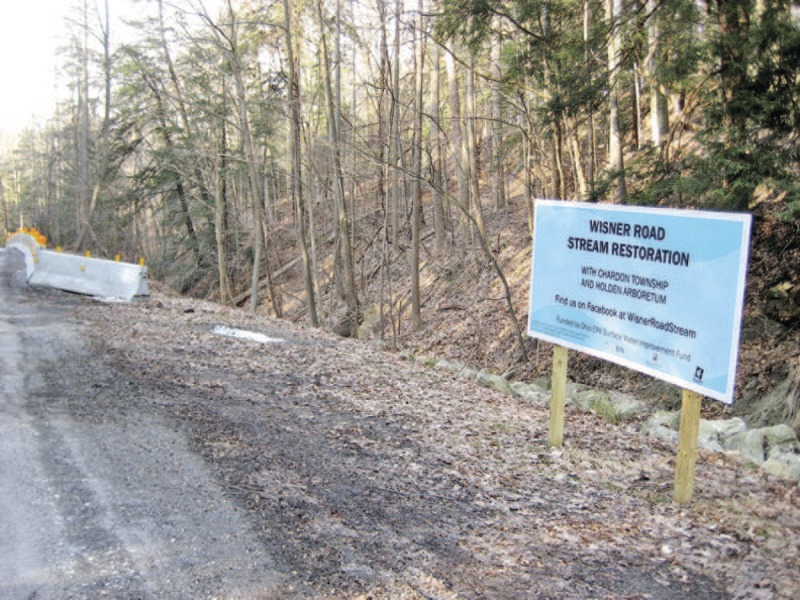
Chardon Township Trustees can now rock and roll on a Chagrin River streambed repair project on Wisner Road.Earlier this month, trustees received verbal approval from…
Chardon Township Trustees can now rock and roll on a Chagrin River streambed repair project on Wisner Road.
Earlier this month, trustees received verbal approval from the Ohio Department of Natural Resources Scenic Rivers division, allowing the township to use clean concrete fill as a cheaper alternative to normal limestone fill to fix the streambed, said Trustee Mike Brown.
The project costs an estimated $142,500. The bulk comes from a $96,000 Surface Water Improvement Fund grant from the Ohio Environmental Protection Agency.
However, the remaining $46,500 will be funded respectively by a $45,000 Chardon Township pledge and a $1,500 contribution from The Holden Arboretum.
Part of the arboretum’s property to the west connects with the streambed, he said at last Wednesday’s trustees meeting.
“Holden will also contribute an in-kind donation of planting on the embankment to stabilize the soil,” he said.
Brown said trustees met with several entities involved with the project — The Holden Arboretum, which maintains property adjacent to the streambed; the ODNR, Scenic Rivers, Marks Construction, Chagrin River Watershed Partners, the U.S. Army Corps of Engineers and landscape consulting firm Davey Resource Group — at the town hall March 14 to discuss the situation.
A Grant, a Storm and a Problem
In 2013, the township — in conjunction with The Holden Arboretum and Chagrin River Watershed Partners — received the grant from the Ohio EPA.
The project aims to stabilize and restore 225 linear feet of eroding stream adjacent to Wisner Road.
The severe stream erosion has been threatening the roadway embankment and causing damage to the road surface, said CRWP Watershed Coordinator Christina Znidarsic.
But along came a storm on July 21, which created a setback for the township.
The section of Wisner Road next to the streambed crosses property owned by the arboretum to the west. However, repair costs to the road are the township’s responsibility, Washco said.
Prior to July 21, 70 percent of the design and engineer work to repair the streambed had been completed, and the permitting process was underway with U.S. Army Corps of Engineers, Znidarsic said last fall.
The storm caused $50,000 major additional damage to the area, hindering the project even though no streambed work was started at that point — only the engineering and design work, the superintendent added at the Oct. 15 trustees meeting.
A Long Wait, Then an Answer
For several months, the township was waiting for the Ohio EPA to either approve or not approve the use of the less-expensive concrete fill versus the expensive limestone.
Had it gone with limestone, the project would have cost considerably more than what was covered by the $96,000 grant, bringing the final project cost to about $216,000.
“Had we gone with the limestone, we would have been at $120,000 over. We even got some feedback that said it would be more like $75,000,” Brown said. “So, we went and asked them, ‘Can we use clean, concrete fill?'”
The ODNR had the final decision and gave the go-ahead and is in the official process of approving it now. Formal approval should take a month, he said last week, with the project completion to take place over the next several months.
At the meeting, Washco said the concrete fill itself would come from temporary lanes in place currently on Interstate 90 in Lake County. Once a road project on the Interstate is complete, the lanes will be removed and the concrete will be transported, via truck, to the township road garage.
“There’s not any steel reinforcing bars or asphalt in the concrete, so it is truly clean,” Washco said.
Afterwards, Trustee Chuck Strazinsky summed up his feelings on the state allowing concrete fill rather than limestone in one word:
“Yes!”


