


I think it is a really excellent way to improve outcomes and long-term sobriety. BlaskoWe've lost the war on drugs. Now it's a war on addiction. Michelson
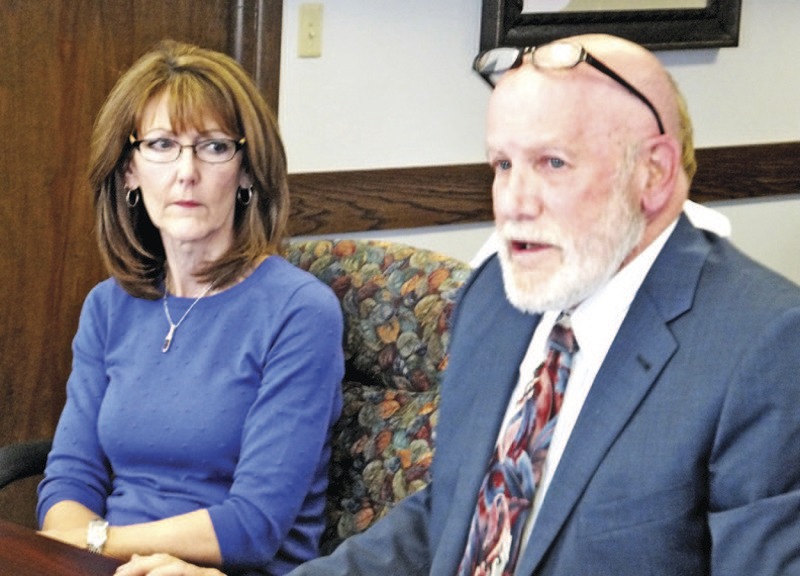
Dennis Michelson gave Geauga County Commissioners an inside view of a small part of the Geauga County Safety Center drug treatment program last Tuesday.
Michelson, a treatment manager with the Lake Geauga Recovery Center, attended the meeting with LGRC CEO Melanie Blasko and CFO Thomas Tuttle to thank the commissioners for helping to fund dependency counselor Christy Kraemer.
Kraemer was hired in the last year to work at the LGRC office in Chardon and counsel female prisoners at the county jail.
The program at the safety center started in 1999 and has really grown in the last four years, Blasko said.
When the county funded Kraemer’s position as a gender-specific counselor through the county’s Heroin Initiative program, they improved the chances of recovering addicts to stay sober after leaving jail, she said.
Continuity of Care Vital for Recovery
Not only does Kraemer’s employment make it possible to offer group and individual counseling for women in the jail, she is available for counseling of recovering addicts as out-patients when they are released, Blasko said.
Continuity of care has been a huge benefit because the addict coming out of jail has a familiar counselor, she said.
“I think it is a really excellent way to improve outcomes and long-term sobriety,” Blasko said.
Because of the growing number of incarcerated addicts, she said she anticipates a need for a second after-care support group and a family group to support addicts in their recovery.
“We are strong advocates of family group services,” Blasko said, adding without the additional support, newly-released prisoners often lose their focus on sobriety.
Outpatient support can help recovering addicts remember Michelson’s advice and stay sober once they are released from jail, she said.
The number of people participating in the treatment program has steadily grown over the past three years, Blasko said, adding there were 104 participants in Fiscal Year 2012 and 138 in 2013.
“At this time, it appears we will keep the same pace with increased admissions for Fiscal Year 2014,” she said.
About 40 percent of the male and 30 percent of the female inmates had a primary diagnosis of opiate addiction, but those figures don’t tell the full story, Blasko said.
“This number does not include those with opiate dependence as their secondary diagnosis. The percentage would likely be higher,” she said, adding that, of those who participated in the program, only about 20 percent have been rearrested.
Best Place for Addicts
The program at Geauga Safety Center is one of the best in Northeast Ohio, Michelson said.
He credited Kraemer with saving his life.
“If we had not had Christy, I probably wouldn’t be sitting here today,” he told commissioners.
He had oe heart attack in jail and doesn’t want another to stop his work there.
A recovering addict himself, Michelson said he understands the addict’s mind.
“The hard-core addict knows he can’t stop until someone stops him,” he said. “The best place in the world (to do that) is in the Geauga County Safety Center.”
It is better than a residential setting because the addict has no freedom and can concentrate on the five-week program.
Having Kraemer there to take on some of the counseling load is a plus, but being able to segregate women into their own counseling groups is a real benefit, he said.
If there is a mix of men and women in a group, no one is totally focused on his or her drug addiction recovery, Michelson said.
Commissioner Blake Rear noted arresting and prosecuting individuals on drug-related charges has been stepped up since the funding of the Heroin Initiative by the commissioners.
He said he has heard recovering addicts are being arrested for making methamphetamine and selling it, even if they are not using it.
“We’ve never had much problem with meth,” he said, adding meth labs are very lucrative in-home businesses.
“The rise in meth use makes heroin look like a Sunday school picnic,” Michelson said. “Heroin is almost pretty compared to the face of meth.”
He said one thing that has kept him sober is the therapeutic value of one addict helping another.
“We’ve lost the war on drugs. Now it’s a war on addiction,” Michelson said
Funding ‘Road Map’ Needed
Rear asked how the commissioners can determine the best place to put future funds.
“I understand there’s a problem here. I need some kind of road map that says ‘This treatment is really effective,'” Rear said.
Blasko said the five-week program should be at least 90 days long to be more successful and it would be a real benefit to have a residential recovery house in the county where recovering addicts could stay for a year while they establish new patterns in their lives.
“It would give them a safe, sober, supportive place to live,” she said, noting there is often misplaced concern in a community that a problem could arise if a recovery house were opened nearby.
Zoning is also a stumbling block, but the advantages of having a local place for recovering addicts to go to are worthwhile, she said.
“It’s a huge missing piece,” Blasko said.
A residential recovery house usually has four to five residents with one counselor. The goal is to give the recovering addicts tools to stay on track and launch themselves back into society, she said.
Another program that helps addicts is Narcotics Anonymous, a free 12-step program like Alcoholics Anonymous, so recovering addicts can attend daily meetings of the support groups that help them stay sober, Michelson said.
Addicts fight the draw of drugs every day, whether heroin or other drugs are available or not, he said.
“If we had a magic wand that would remove substances, it wouldn’t solve the problem,” Michelson said.
From a financial standpoint, Tuttle said the program at the safety center requires continued funding and the county is now paying for 60 percent of Kraemer’s employment, with other organizations helping out.
He asked the commissioners to continue helping with the program into the next fiscal year.


