


When minutes matter, first responders, in risking their lives to help others, are on the ground ready to roll to emergencies.But sometimes, the logistics of…
When minutes matter, first responders, in risking their lives to help others, are on the ground ready to roll to emergencies.
But sometimes, the logistics of critical care call for plans to quickly take flight.
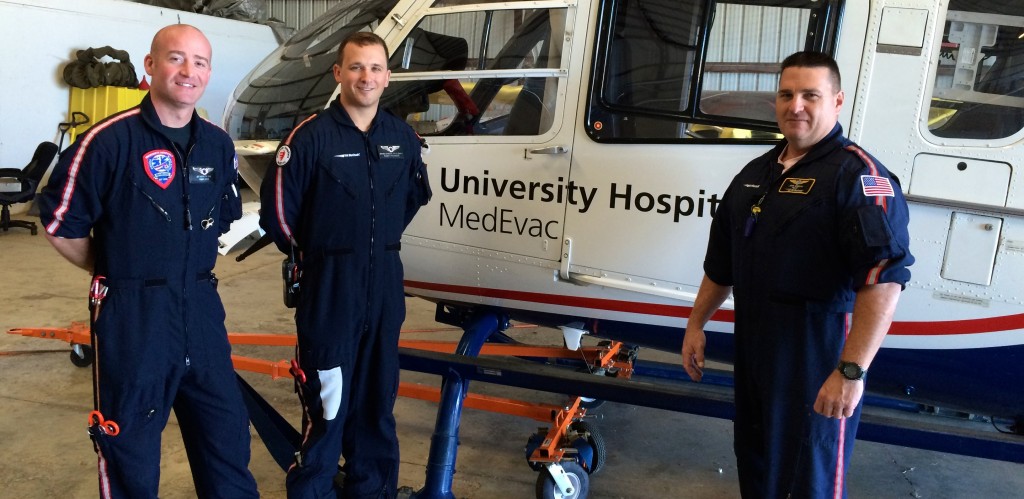
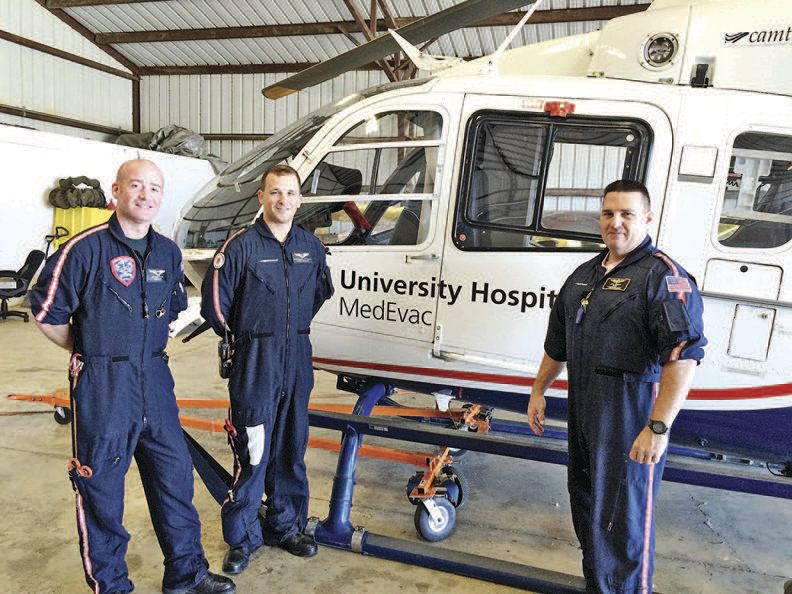
Flight nurse Jeff Morin, flight medic Bryan Swetel and pilot John Arisman are part of University Hospitals MedEvac air transport team, owned and operated by Air Methods Corporation and housed at Geauga County Airport.
“Our job is to take care of people,” Swetel said. “Flying is just the perks of our job.”
MedEvac is the third largest air carrier in the world, and since 1980, has been dedicated to air medical transport with more than 300 bases of operations serving 48 states. The company is based at Centennial Airport in Englewood, Colo., with operations from Alaska to Key West.
Helicopter emergency medical services are a limited and expensive resource, from taking the sickest of the sick to get care from out of the middle of nowhere, moving critical patients to and from healthcare facilities, to life-flighting traumatically injured people from accident scenes.
“We are prepared for everything,” Morin said, adding all medical attention is given in a flying intensive care emergency room about the size of the back of a sport utility vehicle.
“It’s a vital piece of equipment for us, the ability to take someone to a level 1 trauma center,” said Geauga County Chief Deputy Scott Hilden-brand. “It’s a fantastic resource we have in this county.”
Arisman added, “What they are capable of doing in such a small space is astonishing.”
In order to be a flight nurse or medic, a person “must have a strong knowledge base of critical care,” said Swetel, of Concord Township.
“We are in a profession where seconds count and your decision making can make a difference,”?he said. “You must be able to take all the surrounding distractions out and focus on complex multisystem issues.”
“We know what to do in any situation,” Morin added, gathering some materials from his Jeep on the first Sunday morning of the month as the trio busied themselves outside awaiting their first medical mission of the day.
“It’s telepathy,” Arisman said, of the amazing medical teamwork between Morin and Swetel. “They just know what the other one is going to do.”
Swetel added, “We trust ourselves and we trust each other.”
It’s an intense profession where keeping calm and focused can easily mean someone’s life.
Lighthearted banter is welcome in between missions. Flashbacks of the 1986 film “Top Gun” soon surfaced, as nicknames jokingly flew between co-workers.
“We are ready to respond and are up in the air in about five minutes after the phone rings,” Swetel said, adding the operation responds to an average of one to possibly six calls per day, and 400 to 500 calls per year.
“If the weather is good, we are going somewhere,” said Morin, of Shaker Heights.
Crew and patient safety is the single most important factor to be considered when deciding whether to transport a patient by helicopter.
The air ambulance industry has experienced rapid growth.
According to “Flying Magazine,” in 1980, there were fewer than 50 EMS helicopters operating in the United States. Fast forward to about 20 years later and there were more than 650 EMS helicopters flying for more than 200 hospitals and emergency medical service providers across the nation.
Arisman said they fly at night, but don’t fly in thunderstorms, icy conditions or tornadoes.
“When the weather’s nicer, we have more calls,” Morin said, due to people making “bad decisions.”
Arisman has landed near coal mines, power plants, on golf courses and sides of mountains.
“To me, it is safer than being on the road,” Arisman said.
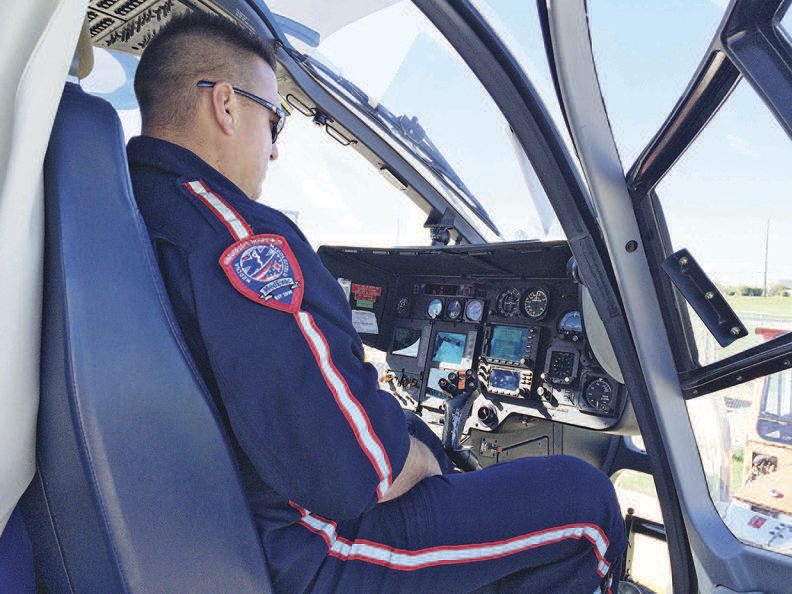
The pilot soon marched outside the hangar into the bright sunlight and to his awaiting helicopter, smiling when he explained his view when he’s up in the sky working.
“There isn’t a day I don’t look forward to it. That is why anybody does it, because it is a passion,” Arisman said. “I fly the aircraft. They take care of the patients.”
Morin added, “We have awesome pilots.”
Swetel, who is originally from Geauga County, where he started his career as a firefighter paramedic, had moved to South Carolina to work for the City of Myrtle Beach Fire.
“I have completed hundreds of hours of training and ended my career as an engineer paramedic,” Swetel said, entering the air medical profession in 2013. “To obtain this position, your application must be accepted with a minimum of five years in a busy 911 system.”
The air medical crew is continually retraining on some level Morin said, adding much of their detailed knowledge is learned on the job as “problem solvers.”
When they are not on a flight call, they review flight calls.
“I couldn’t imagine doing any other profession,” Swetel said. “This is pretty much the only job where I am excited to come to work.”
Hildenbrand added, “They are special people and good at what they do.”
The job is not about “being a hero,” Swetel said.
“You are simply doing a profession and helping people at a bad time in need,” he said. “I chose this profession because I love helping people and what better way to help? We take a small risk, so others can benefit. We are going to do everything we can for someone, that’s the bottom line.”


