


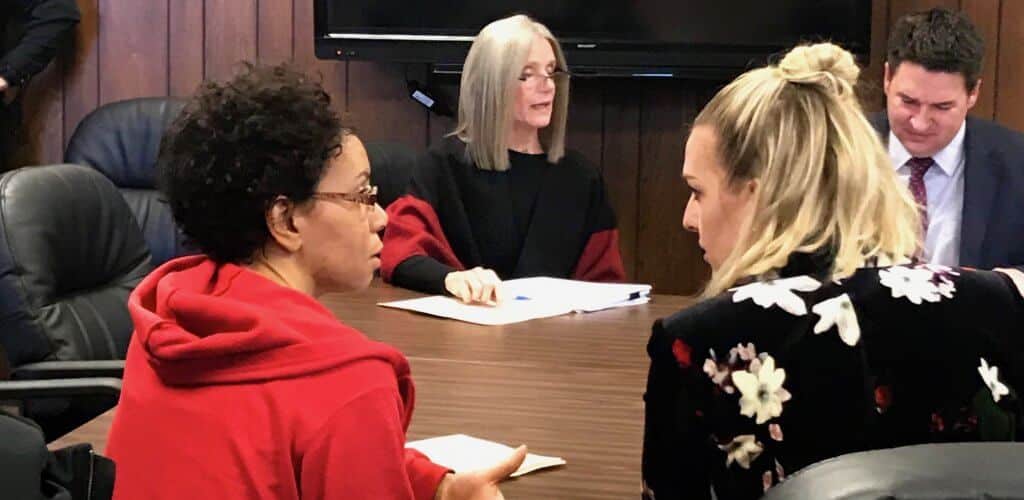
Stephanie Stewart Given 4 Years Probation
“I think we can all agree that Mr. Decatur was the one who organized the scheme. It’s obvious that he conned people from the auditor to this board that oversees the contracts . . . and I agree with attorney Corral that there has to be proportionality in this case.” – Judge Robert Brown
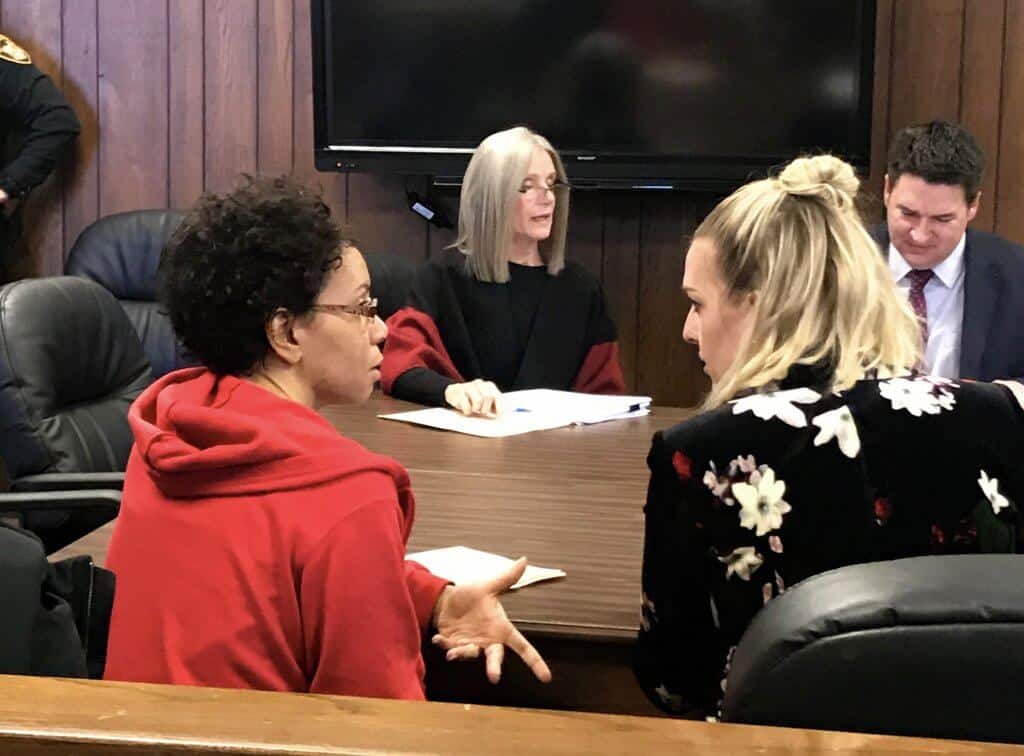
Stephanie Stewart believed she was providing information technology services to Geauga County at the same time her late father, Stephen Decatur, was orchestrating a scheme to embezzle more than $1.8 million from the county over a nearly nine-year span.
“I loved my dad. At one point, he was my best friend,” an emotional Stewart told Geauga County Common Pleas Court Visiting Judge Robert J. Brown.
Decatur, the county’s former chief information officer, taught his daughter how to use computers and write code. She went to school to learn the IT trade.
“My mistake was, looking back, I trusted my dad to not lead me astray. I really did believe he would not do that to me,” the 36-year-old Stewart said. “It took his death before I realized that — and fight with my sister — that my dad was wrong.”
On Jan. 4, Stewart got her wish and was treated the same as other defendants in the case. She received community control in lieu of a prison sentence.
Last January, Stewart, a mother of five who lives in Akron, and Decatur were indicted on 334 counts alleging they engaged in a pattern of corrupt activity and committed aggravated theft from Feb. 1, 2010, through Oct. 25, 2017.
Geauga County Prosecutor Jim Flaiz said Decatur — who died Oct. 1, 2018, as his case was pending — was the primary focus of the prosecution and main beneficiary of the scheme, receiving around $1 million.
Stewart received $481,304 over that timeframe. She told Brown she agreed to work with her father because he assured their arrangement was legal.
“I didn’t Google it. I just believed him; I didn’t look into it,” she said. “All my life I have researched and read, and studied, and I really just didn’t question him. I thought it was OK.”

And until Decatur was arrested in October 2017, Stewart said she thought she was performing honest work.
“I got up early, I would stay up late with Windstream, talking to dispatchers when they couldn’t make phone calls or receive calls,” she said. “I really, I really believed I was doing it. And I’m not a bad person. I just wouldn’t have ever done that to my kids. I would not have put them in a position that would better myself over their own self worth.”
She added, “I would not have left them to deal with some stuff that I started if I was my father, which I’m not. And I’m hoping that is taken into consideration because I’m not him.”
Stewart pleaded guilty Oct. 23 to one count of engaging in a pattern of corrupt activity, a second-degree felony punishable by two to eight years in prison and a maximum fine of $10,000.
She also agreed to pay $481,304 in restitution to the county. The amount represented her share of the embezzled funds, which primarily were used for daily living expenses, she said.
The case against Decatur and Stewart began to unfold in September 2017 when prosecutors were alerted to “irregularities” relating to an IT vendor, SMCS Tech LLC, of Fairlawn, with which the county was doing business. An investigation discovered Decatur was using his daughter’s company for county IT services.
An examination of SMCS’s bank records revealed the company had received dozens of wire transfers from ITERSource, a Woodlands, Texas-based IT company where Decatur once worked.
Investigators learned Decatur had approached ITERSource in 2009 to supply IT services to the county. An arrangement was made whereby ITERSource would bill the county for services, keep a percentage of the money and use Stewart’s company as a subcontractor, giving her a much larger percentage of the funds. Stewart would retain a portion of the money and then transfer a large portion of it to Decatur’s private IT company, ISIS.
ITERSource and its President/CEO Eugene Joseph Krus Jr., 63, and Vice President Administration and Operations William E. Kelly Jr., 73, were indicted in February 2018 on charges of complicity to commit aggravated theft, complicity to commit having an unlawful interest in a public contract and complicity to commit theft in office.

ITERSource and Krus have jury trials scheduled for April 8 before Judge David Ondrey.
Charges against Kelly were dismissed last September because the evidence showed he had started at ITERSource after the business relationship with Geauga County began and, therefore, he lacked the requisite criminal culpability.
Stewart’s lawyer, Kimberly Corral, argued community control sanctions were appropriate, as her client had no prior criminal record and was the least culpable of any of the defendants — none of whom had been sent to prison.
And unlike the others, Stewart actually did work for the county, she said.
“There is no evidence she was trying to hide this,” Corral said, adding Stewart reported the income on her tax returns.
“She continued to participate in this for a period of 10 years, not because she thought she was getting away with something illegal, she thought she was earning a modest income doing work her father had trained her to do,” Corral said.
Corral also emphasized Decatur was the mastermind behind the scheme.
“She didn’t work for the county, she had no fiduciary duty to the county and it was represented to her that it was run by the county and it was lawful,” said Corral. “Everyone involved in this believed that what they were doing was legitimate.”
Corral noted Stewart did not use the funds to live a life of luxury. Instead, she used the money to buy groceries, pay for ballet classes and pay her mortgage on a $128,000 home. She also drove a 15-year-old car.
“This is all representative of she believed this was her income, she believes she was earning it and she spent it the way everyone spends their income supporting their family,” Corral said.
Flaiz conceded there was a “sympathetic factor” in the case for Stewart.
“It’s hard on some fronts not to feel some sympathy for her,” he said. “Stephen Decatur did deceive his family — he deceived his wife, his kids. He convinced them that he had terminal cancer, convinced them that he was employed by (The United States Department of) Homeland Security.”
Flaiz mentioned prosecutors were waiting for a final autopsy report, but the preliminary investigation into Decatur’s death is he took his own life to avoid the consequences of his crimes.
“And now we’re left with just the remaining defendants, including his daughter,” he said.
But Flaiz said Stewart knowingly participated in the scheme, despite her claim she was conned.
“If she didn’t think she was doing anything improper, why did she use the alias Elaine? Why didn’t she have her own login credentials?” he asked. “Stephen Decatur’s first jail phone call after he was arrested was to his wife, telling his wife to tell Ms. Stewart, ‘tell her not to log in.’”
He also said there were “incriminating” text messages showing Stewart knew what she was doing was wrong and that it would be problematic if the county knew her real identity.
Flaiz requested a four-year prison sentence, noting a second-degree felony carried a presumption of prison.
Corral disagreed the text messages showed culpability. Those messages concerned an investigation that already had begun, she said.
She also explained Stewart’s middle name is Elaine.
“So her father is Stephen Decatur. Her name at the time was Stephanie Decatur. She just wanted to differentiate herself from her father in making her own personal and professional reputation,” Corral said. “She used her middle name. She didn’t make up an alias out of thin air.”
Brown sided with Corral and sentenced Stewart to four years of community control.
“I want the record to be clear that this scheme that Ms. Stewart became part of, whether wittingly or unwittingly, happened over a period of nine or 10 years,” he said, adding Stewart did perform some work on behalf of the county and wasn’t taking “exotic vacations or driving an expensive car.”

She also lived in a modest home with a mortgage.
“I just mention those things because this wasn’t a get rich scheme,” Brown said.
Flaiz conceded a forensic accountant the county hired found Stewart spent her money on the daily living expenses of her family.
In addition to his own daughter, Brown said Decatur conned former county Auditor Frank Gliha, members of the county’s Automatic Data Processing Board and allegedly the ITERSource defendants.
“They all were misled and I bring those matters up because, well, if you con them, how are we confident he didn’t con his daughter,” said Brown.
Gliha resigned from office in March 2018 and later pleaded guilty to five counts of dereliction of duty, including four charges related to the Decatur case.
He was fined $1,250, ordered to pay court costs and barred from running for public office for four years. A 90-day jail sentence was suspended.
Flaiz acknowledged Decatur was the focus of the prosecution and the primary defendant in the case.
“I know that had he lived and had he been convicted, the state was going to seek a lengthy prison term, which would have been justified,” Brown said. “The court would have taken a very dim view of his conduct. But, he’s deceased.”
Flaiz said there are proceedings in Cuyahoga County to try to get restitution from Decatur’s estate, and added the county received a fairly significant settlement from the county’s insurance carrier.
“But the county by no means has been made whole at this point,” he said.
“And probably won’t be,” added Brown.
“I think we can all agree that Mr. Decatur was the one who organized the scheme. It’s obvious that he conned people from the auditor to this board that oversees the contracts . . . and I agree with attorney Corral that there has to be proportionality in this case,” he said.
“We can all agree that we had hoped that Mr. Decatur would have come forward, taken responsibility for this,” added Brown. “He was the principal beneficiary of this scheme, of the fraud, and I can see where Ms. Stewart — and I know that the state disagrees with this — but I can see where Ms. Stewart might have believed that what she was doing was legitimate and she was doing work for which she was being paid.”
In addition to the community control sanction, Brown placed Stewart under house arrest for one year and ordered her to pay the cost of the home monitoring equipment. She is also required to pay court costs.
She further is required to perform 400 hours of community service.
The judge did not order Stewart to pay any amount of restitution at this time, although he said that could change after she is off electronic monitoring.
If she violates the terms of her community control, she could receive up to four years in prison.


