


Recently, Geauga County Sheriff’s Office carried out more than 60 checks on convicted sexual offenders living in nearly every community in the county.
Recently, Geauga County Sheriff’s Office carried out more than 60 checks on convicted sexual offenders living in nearly every community in the county.
From Montville to Bainbridge townships and from Chester to Parkman townships, deputies and detectives knocked on doors and made calls to confirm the offenders are living at the listed addresses, said Jeff Powers, GCSO’s Sexual Offender Registration and Notification officer.
By Aug. 5, he reported all offenders were accounted for.
“They’re following the rules. They do not want to get in trouble,” Powers said, adding the department carries out the SORN check about once a year.
“We try to be as proactive as possible and make sure we are current,” he said.
There are far fewer sexual offenders living in Geauga County than in surrounding counties, Powers said.
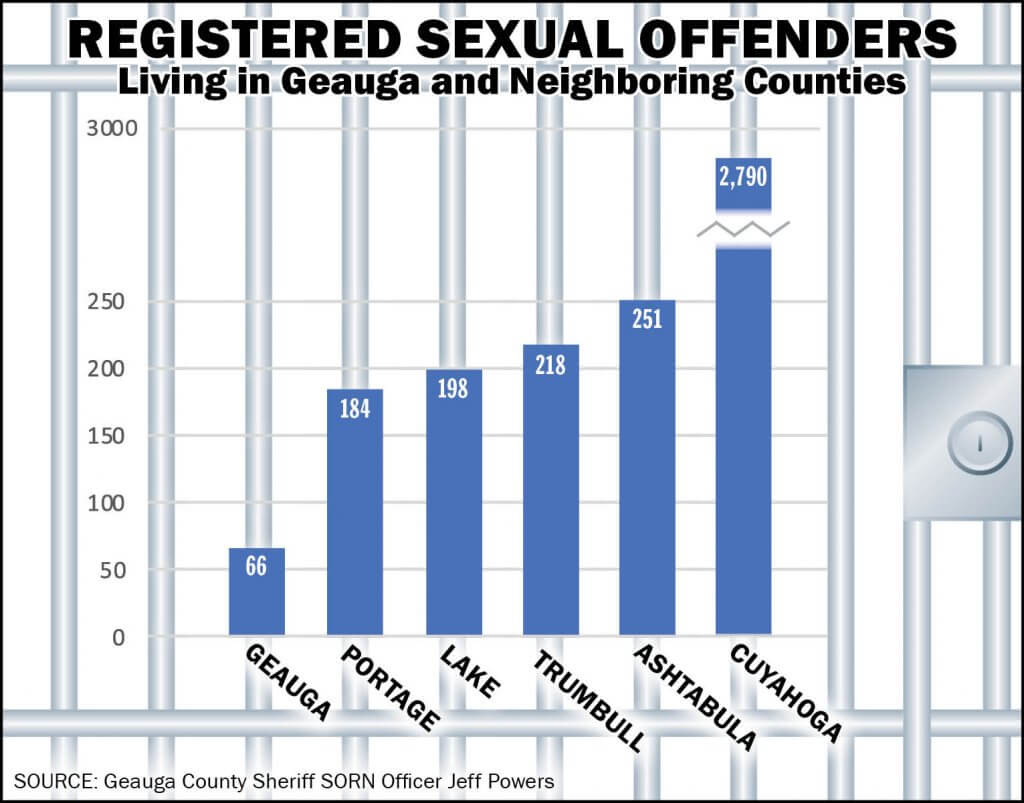
Compared to Geauga’s 66 offenders, Portage County has 184, Lake County has 198, Trumbull County has 218, Ashtabula County has 251 and Cuyahoga County has 2,790.
About 40 secondary registrants spend time in Geauga County for work, school or to volunteer, but do not live here, Powers said.
Sexual offenders come to the attention of law enforcement through a variety of channels, Powers said.
They may be caught performing unlawful sexual acts in person or on the Internet, or be reported by victims or concerned citizens. Frequently, the sheriff’s office will receive information discovered by the FBI or Geauga County Job and Family Services during an investigation, he said.
“Once they are convicted, they have to register here,” Powers said, adding they are subject to a host of rules. For instance, if a registered sexual offender is going to be away from home for more than three days, he has to let the department know. Likewise, if he changes his address, Powers needs to know so the individual’s whereabouts can be posted on the sheriff’s website.

According to Megans.Law.com, the felon must also provide the sheriff with his or her description, photographs, residential address, place of employment, license plate and driver’s license numbers and a description of the offenses of which he or she was convicted.
Juvenile information is not published on the website, Powers said.
Usually a judge will require the offender to participate in a program to help them figure out and, hopefully, control their problems, he said.
If offenders stray outside the restrictions or court orders, they can face felony charges and possible jail time.
“I tell them, ‘If you follow the rules, there won’t be any issues,’” Powers said.
The judge usually requires the offender to find gainful employment, but, since they have to admit on most job applications when they have a felony record, that can be challenging, Powers said.
Depending on the individual, there may be a few employment opportunities, such as temp agencies, he said.
Sexual offenses run the gamut from consensual sex between underage individuals to Internet crimes, to more serious sexual crimes such as rape and gross sexual imposition. The offenders are classified to ensure law enforcement has the ability to keep track of them for the safety of the community.
Under Megan’s Law, passed in 1996, offenders were classified as sexually oriented, habitual or sexual predators. That law was repealed and replaced in 2003 with the Adam Walsh Child Protection and Safety Act. Sexual offenders, starting at the act’s effective date, are now classified as Tier I, II or III.
Geauga County has 13 offenders under Megan’s Law: three sexually-oriented offenders who are on the SORN list for 10 years and 10 sexual predators who have to report to him four times a year for their lifetimes, Powers said.
Under the Adam Walsh Act, Geauga has 22 Tier I offenders who have to report once a year for 15 years, 24 Tier II offenders who have to report twice a year for 25 years and six Tier III offenders who have to report four time a year for their lifetimes, Powers said.
There is also one Tier I felon, who was convicted of abducting a child, he added.
The number of sexual offenders in the system is low enough to be manageable and not growing at a great speed, he said.
In 2010, Geauga had 42 or 43 listed.
Powers said the offenders’ lifestyles span the entire socio-economic range and they often own homes in Geauga communities.
But there are sure to be some who continue to fly below the radar.
“These are the known ones,” Powers pointed to his list. “The ones we don’t know about are the ones who scare me.”


