


Up until the time of John F. Kennedy, the Lincoln funeral was the largest funeral ever held in America, with a procession of 1,700 miles over 20 days. – Ross DeJohn III
When President Abraham Lincoln was assassinated, the bloodiest war in American history had just come to an end. While Lincoln’s funeral was one of the largest in American history, it was also, in a sense, a nationwide mourning for the 660,000 lives lost in that war.
“Up until the time of John F. Kennedy, the Lincoln funeral was the largest funeral ever held in America, with a procession of 1,700 miles over 20 days,” explained Ross DeJohn III, whose family runs DeJohn Funeral Home and Celebrations Center in Chester Township.
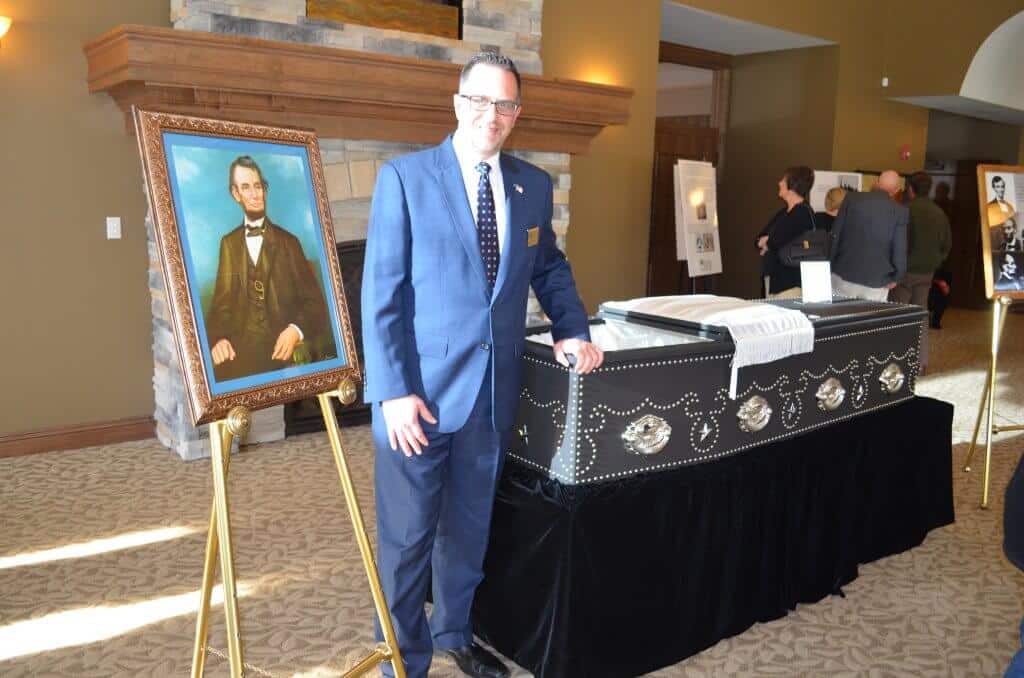
DeJohn and his family invited the public to the funeral home May 10 for a program about the Lincoln funeral of April 18 to May 4, 1865, complete with a replica of Lincoln’s $1,500 coffin, which would be the equivalent of about $22,000 today.
“They called them coffins in those days. We now call them caskets,” DeJohn explained. “The difference is really in the shape. A coffin is narrow at the head and feet and wider at the shoulders. Today the caskets are rectangular.”
Lincoln’s coffin was custom made to fit his 6-foot, 4-inch frame, and was 18 inches wide at the shoulders. It was made of solid oak, lined in lead and covered with expensive broadcloth.
“Today, if someone has a solid wood casket, we don’t cover it up,” DeJohn said.
The coffin was lined in luxurious silk and satin inside, and had four massive, solid silver carrying handles and silver star decorations. The coffin was carried by train from Washington, D.C. , to Springfield, Ill., by way of New York, Pennsylvania, Ohio and Indiana, including a stop in Cleveland.
“Each city tried to outdo the others with the most elaborate hearses and decorations,” DeJohn said.
The body did not deteriorate on the long journey because the practice of embalming had become commonplace during the Civil War and Lincoln had been an early advocate of the practice, which preserves the body by replacing the normal fluids with chemicals.
DeJohn said the Civil War changed funeral practices forever, with the necessity of preserving bodies for shipment home. Cremation was not possible at the time, due to the extreme temperatures needed, he added.
Bodies were either shipped home or buried in national cemeteries established by Lincoln, such as the one immortalized by his famous Gettysburg Address.
DeJohn made a PowerPoint presentation on the assassination, its aftermath, the details of the funeral, and the timeline of the number of times Lincoln’s body had been moved from one burial site to another after thieves in 1876 had tried, almost successfully, to steal the body.
In September of 1901, 36 years after the assassination, Lincoln’s body was finally interred for the last time in 10 feet of concrete at a permanent tomb in Memorial Hall in his hometown of Springfield, Illi. The president had asked his wife, Mary Todd Lincoln, to find a quiet resting place when the time came.
“But for many years, he did not rest in peace,” DeJohn said.
Following the presentation, a Lincoln portrayer answered questions from the audience of about 90 people.
“This program has been given throughout the country as an educational piece of history,” DeJohn’s mother, Patty explained. “When we planned this funeral home, we wanted it to be a place for celebrations and a community event center, too.”
“We’d like to present this program to any group in the area. For clubs, church groups or any organization that would be interested,” Ross DeJohn, Jr., Ross III’s father, explained. “Anyone interested in our doing this program for them should just contact us. Even after 152 years, people still love Abraham Lincoln and are fascinated in learning about him.”


