Kenston Schools may soon face a $900,000 annual revenue loss depending on how things shake out with House Bill 96, which aims to ease property tax burdens for Ohio homeowners.
Kenston Schools may soon face a $900,000 annual revenue loss depending on how things shake out with House Bill 96, which aims to ease property tax burdens for Ohio homeowners.
Treasurer Seth Cales warned that the measure, while offering local relief, could lead to tough financial choices for schools and municipalities across Geauga County.
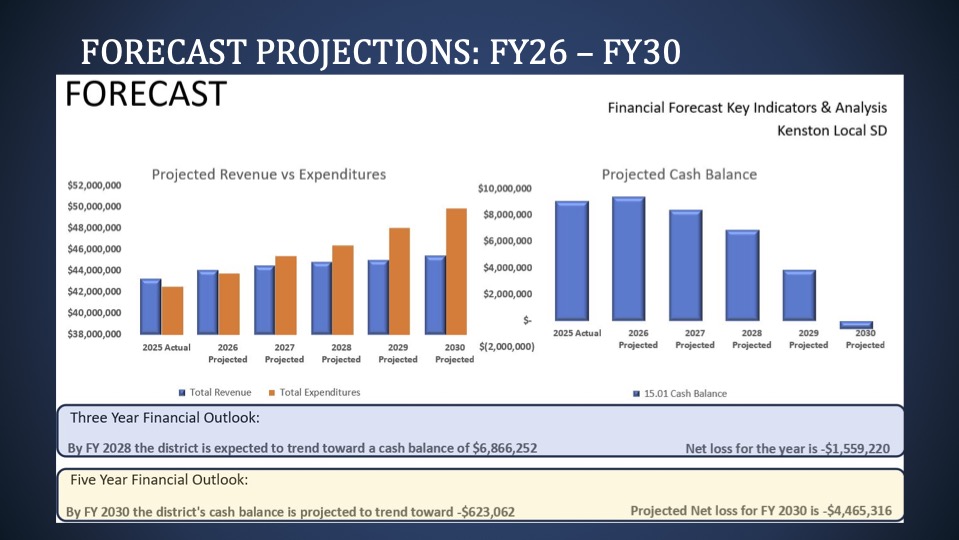
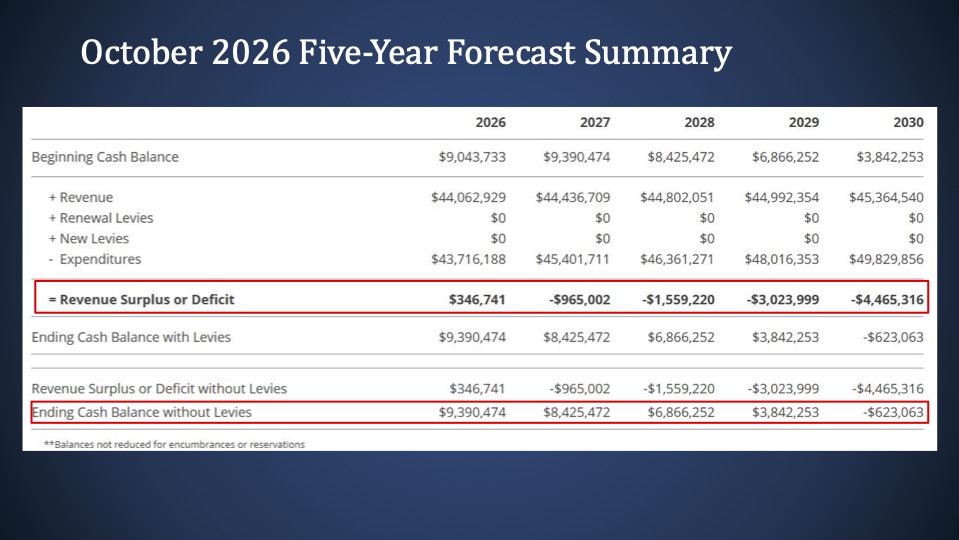
In his five-year forecast, Cales anticipated Kenston’s revenue would be $44 million in fiscal year 2026, $44.4 million for FY 2027, $44.8 million for FY 2028, $44 million for FY 2029 and $44.9 million for FY 2030.
He projected future expenditures to be $43.7 million for FY 2026, $45.4 million for FY 2027, $46.3 million for FY 2028, $48 million for FY 2029 and $45.4 million for FY 2030.
Kenston’s ending cash balance in 2030 is estimated to be $623,062 in the negative, he said in his presentation.
If Geauga County Commissioners approve a piggyback tax exemption tied to HB 96, the Kenston Schools could see a loss of $900,000 in revenue, however, that change is not reflected in the forecast due to its uncertainty, Cales said.
“House Bill 96 includes property tax relief for Ohioans by empowering county leaders to take direct action and enhancing local control over property taxes,” according to a press release from the Ohio House of Representatives. “House Bill 96 allows the board of county commissioners to provide a local owner-occupancy tax credit of up to 2.5% and a local homestead exemption for those who qualify for the state’s homestead exemption.”
The district’s five-year forecast could drastically change based on the decision the commissioners will make next month, he said.

The piggyback tax exemption would not only impact school districts, but also townships, villages, the Geauga Park District and other municipalities, Cales added.
Initially, the district was looking at putting a levy on the ballot in 2028 or 2029, however, that could change based on what commissioners decide on the piggyback tax exemption, he said.
“(The commissioners’) goal is, you know, to provide relief efforts to the community, easing the individual tax burdens,” he said. “I’m a taxpayer, too, so I’m definitely empathetic to that, but that would overall reduce Kenston’s revenues by about $900,000 a year. So, that would force us to potentially start looking at a levy potentially about a year earlier.”
If commissioners pass the exemption, Cales would likely need to update the five-year forecast to reflect those changes, he said.
“(The commission) said, ‘Well, we’re looking at maybe giving back some money to the taxpayers to help alleviate their burden of paying these higher taxes,’” Cales said. “So, we gotta kind of say, ‘Okay, well, now we got to tweak what we’re doing.’ And that could lead to difficult decisions for school districts, for municipalities as far as what they want to do, potential program reductions or service adjustments that affect how we provide services, or how that entity provides services.”
Cales said he understands the appeal of reducing the “strain” on taxpayers.
“We totally get that, we just want to make sure there’s no unintended consequences of reducing some of these revenues,” he said.
As far as enrollment trends in the five-year forecast, Cales predicted enrollment to continue to go down for Kenston, he said.
However, with the building of the new apartments, VC Park at Geauga Lake in Bainbridge Township, he hopes for an uptick in enrollment with new students living there.
Enrollment is trending down across the state, Cales said, adding birth rates are down overall.
“(It’s) really important to know background enrollment history throughout the state of Ohio, not just Kenston,” he said. “This is the state of Ohio. Please know that enrollments are going down, birth rates are down right throughout the state.”