



"There's only so many ways you can cut a pie." Julie Ramos
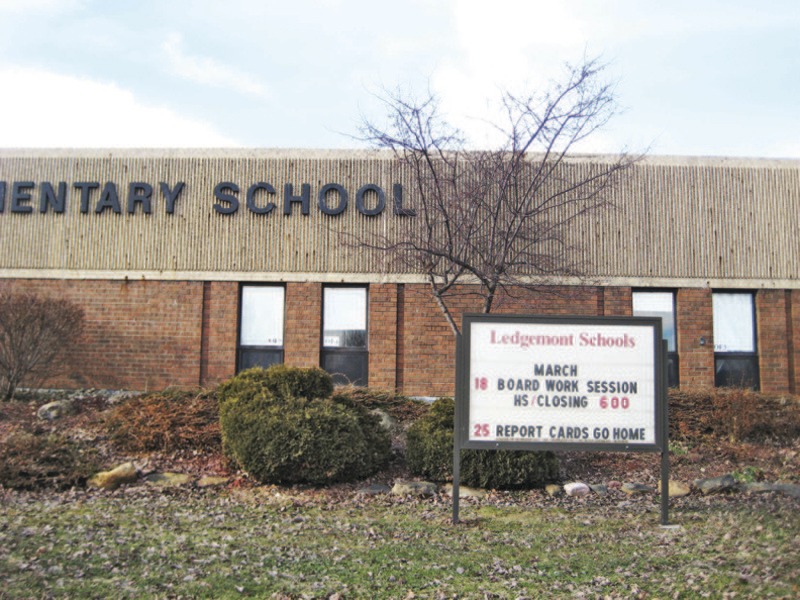

Say goodbye to Ledgemont High.
At 8:23 p.m. on Tuesday, March 18, 2014, more than 59 years of history came to a close in Thompson Township.
After a 125-minute work session and an 18-minute regular monthly school board meeting, the Ledgemont Schools Board of Education voted 3-2 to move students out of Ledgemont High School at the end of the school year.
More than 100 residents, teachers and staff attended the session, held in the Ledgemont Elementary cafeteria.
The school, at 16700 Thompson Road, began operation in 1955.
And now, at the end of 2014, its 227 students will transfer to the current elementary-middle school building at 16200 Burrows Road, which can hold up to 580 students.
After a long debate, the status of the current gymnasium at Ledgemont High School was left in limbo and the board will figure out what to do with the gym next, said Superintendent Julie Ramos.
“I’m running out of options, but we must keep the kids the focus,” Ramos said, adding the district’s enrollment, now at 480 students, could drop to 450 next year.
Treasurer Belinda Grassi said the cessation of education operations at the high school — along with an unprecedented move of inside millage — will help free up funds to get the beleaguered district out of debt and into the black.
Currently, the district owes about $2.6 million to the state, in the form of three solvency assistance payments.
Grassi also said the school board is working with the Ledgemont Financial Planning and Supervision Commission, a fiscal oversight board, on solving the district’s financial issues.
Most residents had questions about the move, such as whether or not a smaller gym at the elementary school would support varsity athletics such as basketball and whether or not the district was saving money by removing students, but keeping the high school gym open.
The residents also had questions about sewer-tie in costs and program cuts and restoration.
Ramos said the district has current advantages: It is a 1:1 school, meaning it is one of the few regional districts that has a 1:1 ratio of students to computer devices.
The district received a windfall after a local author, Frances Spatz Leighton, bequeathed funds to help purchase Google Chromebooks and upgrade the district’s library.
Despite its recent struggles, Ledgemont has also instituted preschool, every-day, all-day kindergarten and latchkey programs, Ramos said.
Board member Rick Loveland moved to table the decision to vote on closing the high school.
“My heart is racing now,” he said, adding he wished the board could have more time to look at the issue before its next board meeting in two weeks.
But the measure failed, 3-2, and the board then voted on closing the school.
Residents Speak, Board Members Respond
Ledgemont board members kicked off the work session with two hours of questions and answers prior to the regular school board meeting.
District resident Matt Davis suggested the high school gym be kept open and the space be used in other ways.
He also said, despite increased class sizes due to the movement of students into one building, that larger class sizes do not make a difference past third grade.
“There’s talk about how large class sizes are detrimental, but there’s no empirical data to support that,” Davis said, adding schools in suburban Washington, D.C., have large class sizes, but succeed academically.
“At high school, you should be prepared for college and when you go to college, the class sizes are large,”?he said.
Ramos projected preliminary estimates of 34 and 36 students for the elementary and high schools, respectively.
Grassi estimated the cost to repair the high school roof at $340,000, but noted her figure was “a bit on the low side.”
More residents asked about whether or not the district would have to pay annual costs to the county for sewer tie-ins from the high school, but she said direct costs of the tie-ins were not finalized and would be looked at.
“Also, we don’t have a permanent improvement fund, like other districts,” Grassi said.
The board’s vote Tuesday will help her formulate the state-mandated, five-year forecast by May, she said.
She also explained moving inside millage — approved by the county budget commission, albeit state approval is pending — will free up general fund monies to help get the district in the black.
Her forecast will be prepared based on the assumption of state approval.
“We’re taking a multi-pronged approach,” she said. “It’s not just closing the high school or moving inside millage. It’s a combination of these different paths we are taking that will ensure our success.”
The treasurer said moving students to one school building would save the district about $300,000 to $400,000, depending on whether or not athletics are continued and how unemployment benefits factor in.
‘I’ll Do Anything to Keep Ledgemont Open’
Thompson Township resident Ashleigh Jarrett, a Ledgemont graduate, said the community’s network of volunteers and experience with trade-based jobs could help defray labor costs or provide general assistance to the school district.
“I’ll do anything to keep Ledgemont open. I’ll volunteer my dad all day long,” she said, to thunderous applause.
Ledgemont Lady Redskins head basketball coach Pat Sidley said he supported the school district and understood the board had to make a “tough decision.”
Keeping the gym open was important, as the 84-foot width of the current basketball court was a requirement at the high school level and practice space is at a premium even in the current situation, he said.
“Please keep the gym open until we find out a better option,” Sidley said.
Several residents, including Davis, asked how the district would proceed after getting out of debt, assuming all goes well with debt repayment and the state approves its efforts.
“I’m not saying that getting out of debt isn’t the most important priority right now, which it is,” Davis said. “But what do we do once we get out of debt?”
Board members said the district would approach each array of problems on a year-to-year basis.
“We should grow what we have here,” said resident Robin Stanley, adding the current elementary-middle school building was built on a property that featured future room for growth.
The board’s next course of action is to work with Grassi, Ramos and the fiscal oversight commission at the next school board meeting on how to proceed with the gym issue.
Logistics, such as staffing, transportation and operations, will be looked at in-depth, Ramos said. Even though cuts have been made, the district is at a crossroads.
“There’s only so many ways you can cut a pie,” Ramos said. “I wish we had an option B, C and D to go to.”


