


We should never have lost focus on what we started with. Mervin Miller
Since taking over operations at Marsh Valley Forest Products Ltd. in 1998, Mervin Miller has run through the gamut of business highs and lows.
Mervin was just 19 when his father offered him Will Mill Forest Product on state Route 608 north of Middlefield Village, he said Friday during a presentation to the Geauga Growth Partnership.
Mervin said he had been working at the plant and as a carpenter since he graduated from the local Amish school at age 14, so he thought he knew the business. Over the next few years, the family built a 6,500-square-foot production floor, office and showroom and changed the business name.
Today, Mervin operates the business with his brother, Sam, providing a wide variety of home construction wood products from baseboards to wainscot to beams and siding for carpenters in Northeast Ohio.
In the beginning, they focused on filling trim orders for builders. Within a few years, a new opportunity presented itself and they started supplying a Middlefield company cabinet doors and similar products, causing an exciting boost in profit and growth, Mervin said.
The buyer represented 60 to 70 percent of Marsh Valley’s business and Mervin said he realizes, looking back, he had “too many eggs in one basket.”
When the housing market was booming in 2003 and 2004, the demand for kitchen and bathroom cabinets was strong and he expanded on that wave, but once the effects of the recession became apparent, Mervin knew he had to do something to save the business.
“The first 10 years were easy,” he told the crowd of about 50 at the early morning meeting, which was held in the wood-paneled loft of the former horse barn near the production buildings.
He had invested in equipment in 2008 to meet the one customer’s needs more efficiently. But by 2009, that demand evaporated, leaving him with debt and much less income.
Like many other small businesses at the time, Marsh Valley had to recreate itself.
“It was a real challenge from there,” Mervin said.
Sam had gone to work in the industry when he graduated. When he had the opportunity to go to Marsh Valley in 2006, he debated the wisdom of joining the family business.
“I didn’t know if it was gonna be good or bad,” he said of his decision. “The business was strong.”
He shifted into sales and safety at Marsh Valley, gaining experience over the next couple of years.
When reality hit, Mervin realized the business had been steaming ahead in a large part on the strength of the economy. Knowing he needed to find a way to save the business, he tried a new strategy.
“I really didn’t understand my costs until I had to make ends meet,” he recalled. “I went to a seminar and dug into my P and L (profit and loss) numbers.”
He met someone at the seminar who helped him establish a better business structure and figure out his man-hour costs, Mervin said. After some serious soul searching, he realized where he had gone wrong.
“We should never have lost focus on what we started with,” he said.
Marsh Valley had been founded on supplying carpenters, architects and builders with hardwood and plywood products and tools, and that is where Mervin returned.
Rebuilding a customer base was vital to his efforts and, again, he went back to Marsh Valley’s roots.
“The most successful way to get customers was through the carpenters, so we service them really well,” he said.
He put his state-of-the-art molder in his additional 10,000 square feet of floor space to good use, custom-cutting moldings for carpenters.
When the housing market tanked, homeowners started renovating their older residences and Marsh Valley was in a position to customize mold patterns for baseboards, casings and crowns, Mervin said.
If a carpenter or builder brings him a piece of molding, his shop can duplicate it, creating tooling he called “knives” to cut it. The tooling can be inventoried at Marsh Valley in case it is needed again, Mervin said.
The moldings are drawn on Autocad and the company has about 1,500 profiles available, Mervin said.
“Designers and architects are doing more and more moldings” to update older buildings and dress up new ones, he said.
Gradually, Marsh Valley recovered, including more hardware in its inventory and specializing in consulting and providing free onsite measuring, estimates and delivery.
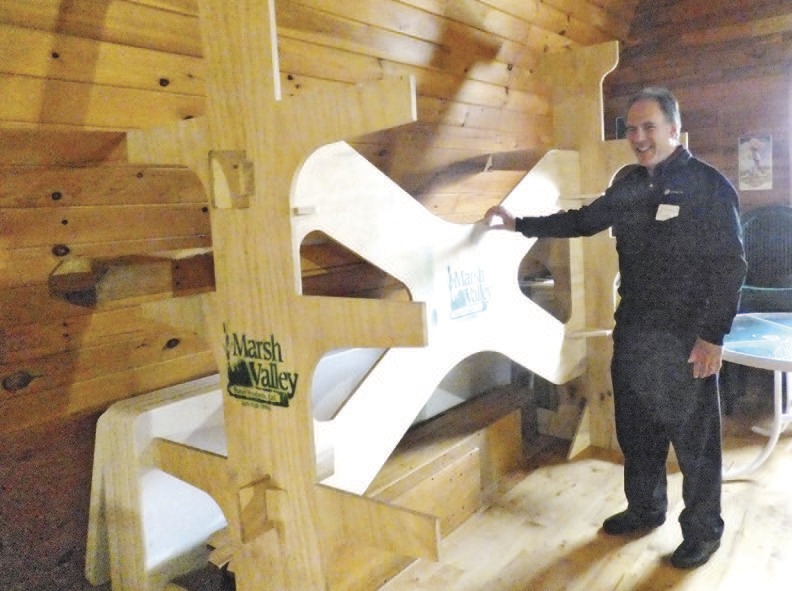
Three to four years ago, they began using trim racks at projects where Marsh Valley trim packages are being installed. The racks are made at the plant and help the builders keep their materials organized and accounted for.
“We never expected (our rack) to do what it did,” Mervin said, adding the plywood racks can be put together with a hammer at each site and easily moved around.
When asked if Marsh Valley would sell the trim racks, Mervin considered the idea for a minute before saying “Yeah, sure.”
Another economy-related challenge includes fuel costs for the engines the Amish business needs to drive its equipment.
Mervin said they switched one of two diesel engines for a natural gas engine at a cost of about $85,000, adding in the first six months, it saved the company enough to know it was the right decision.
When he has a problem he and Sam can’t work out, Mervin said he takes it to Dave Kraninger, a business consultant who volunteers his years of experience in industry to help GGP members.
“He’s been a tremendous help. He really stressed we need to focus on our value-added products, not on resale items,” Mervin said.


