


Ohio Ranks 4th in Human Trafficking
Harriet Tubman Movement in Geauga Helps Victims
Victims do not typically reach out to law enforcement first for fear of self-incrimination or personal recrimination. Victim advocates can often get more information first and more easily because the victim is looking for protection and safe housing. Our investigation proceeds from there and we work collaboratively with other counties, especially Cuyahoga County. – Robin Taylor
When you think about Geauga County and surrounding areas, the terms rural, picturesque, quaint and community-oriented might come to mind.
The words “human trafficking” likely do not.
However, Ohio ranks fourth in the nation of reported human trafficking cases, with neighboring Mahoning and Trumbull counties among several hotspots, according to Laura Bartchak, founder and director of the Harriet Tubman Movement in Geauga County.
“Certainly, people need to know this is happening in our country. They have no idea. Prevention (comes from) a lot of working with younger people starting quite young, protecting them from people online and providing safe adults for them to talk to and to be alert of online grooming,” Bartchak said. “Organizations work in between a traffic victim being identified and helping them connect with everything they would need for long-term restoration.”
Those At Risk
According to the National Human Trafficking Hotline, Ohio had 450 documented cases of human trafficking in 2019 and the Ohio Task Force states 3,000 Ohio children are at risk and 1,000 of these will likely end up in the sex trades.
Human trafficking involves “the use of force, fraud or coercion to obtain some type of labor or commercial sex act. Every year, millions of men, women and children are trafficked worldwide,” according to the Office of Homeland Security’s Blue Campaign, which is designed to identify the victims and aid in education.
Geauga County had four human trafficking cases in 2020, said Geauga County Sheriff’s Office Deputy Robin Taylor, who manages the county’s Sexual Assault Response Team Program.
Taylor said the numbers are not high because the victim is often taken to another city.
“Victims do not typically reach out to law enforcement first for fear of self-incrimination or personal recrimination,” she said. “Victim advocates can often get more information first and more easily because the victim is looking for protection and safe housing. Our investigation proceeds from there and we work collaboratively with other counties, especially Cuyahoga County.”
Led by the Ohio Attorney General’s Office, the Ohio Organized Crime Investigation Commission operated three task forces in 2020, one in each of Cuyahoga County, Mahoning County and Central Ohio. Despite the presence of COVID-19 as an obstacle, their 2020 annual report tallied they collectively rescued 103 human trafficking victims and referred almost 216 to other services.
Data from 2020 found white females ages 21 to 29 were most commonly identified as victims with well over 98% of those driven into sex trafficking.
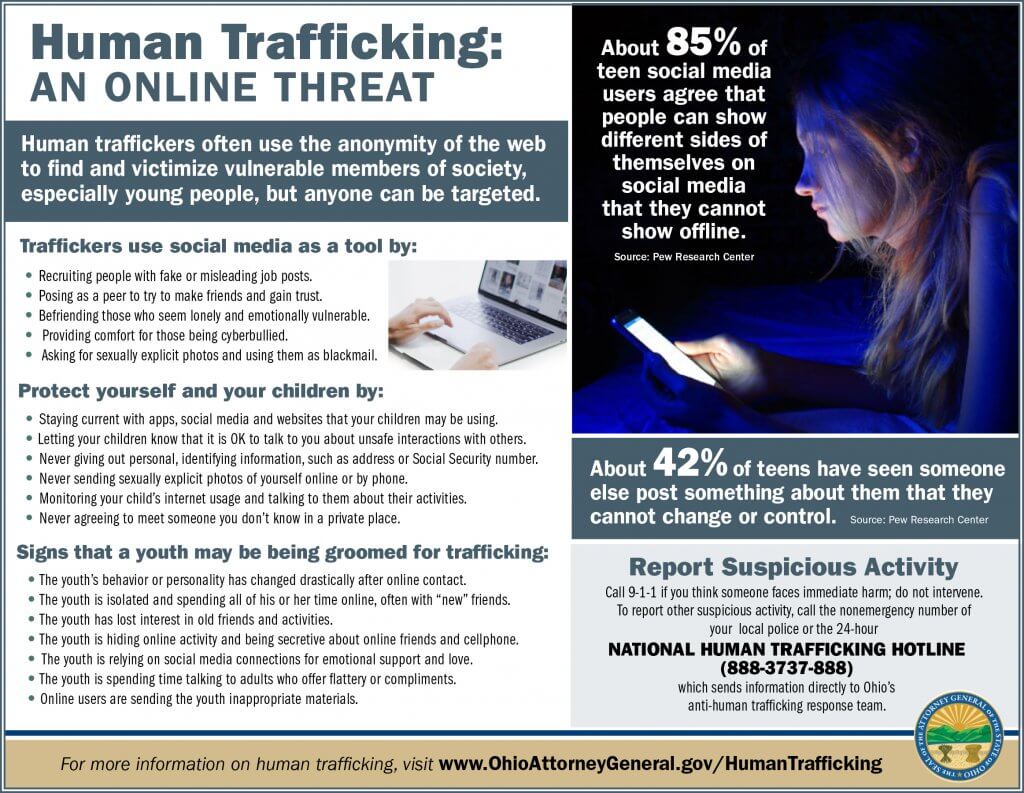
Traffickers look for those who are susceptible emotionally, the vulnerable, those experiencing economic hardship, those lacking a social safety net or are unstable in their lifestyle, according to the blue campaign.
Runaways are at the greatest risk and statistics say they will be approached by an exploiter within 48 hours of leaving home. In addition to children, women, men and transgender individuals are at serious risk.

The Movement
The Harriet Tubman Movement was developed to offer human trafficking intervention in Geauga, Ashtabula, Lake and Mahoning counties.
Bartchak established the movement five years ago to create a network of freedom and social justice in the region. It was named after the brave “conductor” of the Underground Railroad, Harriet Tubman, who made her first trip escorting slaves to freedom in the north in 1850. She was responsible for freeing over 300 slaves in her many trips north, without regard to her own personal safety.
There are four pillars to resolving the human trafficking problem, Bartchak said. They are:
- Prevention and awareness to protect the vulnerable from predators;
- Rescue – generally performed by law enforcement;
- Victim identification;
- Long-term restoration.
Identifying the victims and getting them into a long-term program for rehabilitation is the primary work of the HTM, Bartchak said.
Victims are brought forth by law enforcement, social service agencies, hospitals, shelters (like WomenSafe) and churches locally, she said, adding she only works with adults 18-62 in her program. Children are dealt with at the law enforcement level.
Taylor said her team works directly with Ohio Attorney General Dave Yost’s office and the Harriet Tubman Movement is their “go-to” agency for restorative help to victims.
She is currently working on a project for 2021 that involves training for first responders on identifying trafficking for labor or sex. The Ohio State Highway Patrol is engaged as a front-line defense during traffic stops.

How Trafficking Begins
When asked how does human trafficking begin, Bartchak said many contributing factors include trauma, drug addiction, domestic abuse or a family member using control for life decisions.
Some victims are struggling with abuse they faced as a child, she said, adding sometimes a trafficker will promise an escape from a bad past, a romance or even marriage to entice his victims to run away with him.
In the Geauga County area, few are subjected to kidnapping, but it can still happen, Bartchak said.
She told the story of “Sandy,” a 16-year-old who came from a broken home in a local suburb. She was on social media where she began an online relationship with “Dan.” He promised to love her, marry her and provide an idyllic home life. He arranged a trip for the two to go to Washington D.C., unknown to her mother at the time. Upon arrival at their hotel room, Sandy found herself thrown into a room with five other women, all destined for a life of prostitution.
After two years, the FBI found Sandy, who was now addicted to the drugs Dan also sold and she was brought back to the area.
Faced with Stockholm Syndrome, which is a feeling of trust or protection toward a captor, Sandy resisted help or sobriety and tried to run back to him repeatedly. The HTM worked with her to provide the long-term support and restoration she needed to change her life, separate her feelings toward her captor and become free of addiction.
Bartchak says they have helped over 150 victims in their five-year history. The HTM staff and other collaborative agencies are there each step of the way, helping them through court proceedings if necessary and protecting them.
Trauma-bonding, which causes a victim to rely on and cling to their captor, is common, Bartchak said, adding despite helpful agencies asking the victim for their trust, it often seems easier to run back to the damaged life they knew of prostitution, false hopes and drug addiction.
The restoration process is hard and often lonely, and the HTM aids in that separation and looks for a shelter facility that would be the best fit, she said.

Prevention
Taylor said she advises parents to always have good communication with their children.
“Ask to see their phones to determine what sites they visit, what apps they use and what videos are they viewing,” she said. “Be proactive and do not worry about violating your child’s privacy. Develop trust and mutual respect. You have to be a big part of your child’s life.”
Taylor cautions that apps like TikToc offer recruiting by strips clubs, showcasing how much money can be made.
“The internet is a scary place,” Taylor said. “And they do not reveal what is done to make the money.”
Bartchak works with a trained staff of volunteers, including licensed social workers, occupational therapists, physical therapists, nurses and chaplains.
The HTM is a faith-based organization, but faith is not required for a client. Theirs is an outreach of love, grace, compassion and Christian values, she said.
Bartchak echoed Taylor in parents needing to better monitor children’s exposure to online life.
Gaming with strangers can become dangerous since the gamer a child is playing with can be anyone — a 15-year-old or a 45-year-old posing as a youth. Allowing online activity unsupervised is a danger, she said, adding social proclivity, dating sites, sexting and pornography can lead to danger.
“We live in a hypersexualized society — our media, clothing choices, music and actions can attract predators,” Bartchak said. “Prostitution today is as easy as ordering a pizza and no man, woman or child is safe from being caught up.”
Bartchak has worked with Jomal Aird, director of victim services of the Human Trafficking Initiative in the attorney general’s office. Aird said the old concept of teaching “stranger danger” that instructs a child not to get in a car with or take candy from a stranger is no longer enough.
Parents need to become educated to the new dangers, he said, adding understanding the risks of behaviors is highly important.
The HTM is currently raising money for a short-term emergency house for victims called the Harriet Tubman House. Donations can be made on their website, www.harriettubmanmovement.org, or by calling 408-909-SAFE.
Helpful Resources:
- Polaris Project www.polarisproject.org
- Shared Hope International www.sharedhope.org
- International Justice Mission www.ijm.org
- The U.S. Department of State www.state,gov
- Araminta Freedom Initiative www.aramintafreedom.org.
- The Harriet Tubman Movement www.harriettubmanmovement.org


