Townships Warn of Steep Losses, City & Villages Consider New Taxes
This is the second of a three-part series aimed at breaking down how property taxes work, why they exist, as well as examining property tax reform, what has prompted a state-wide movement to abolish them and the potential impact that could have on various entities in the county.
While some taxpayers are pushing to eliminate property taxes, local officials warn doing so could dismantle the primary funding source for townships and significantly reduce services across Geauga County.
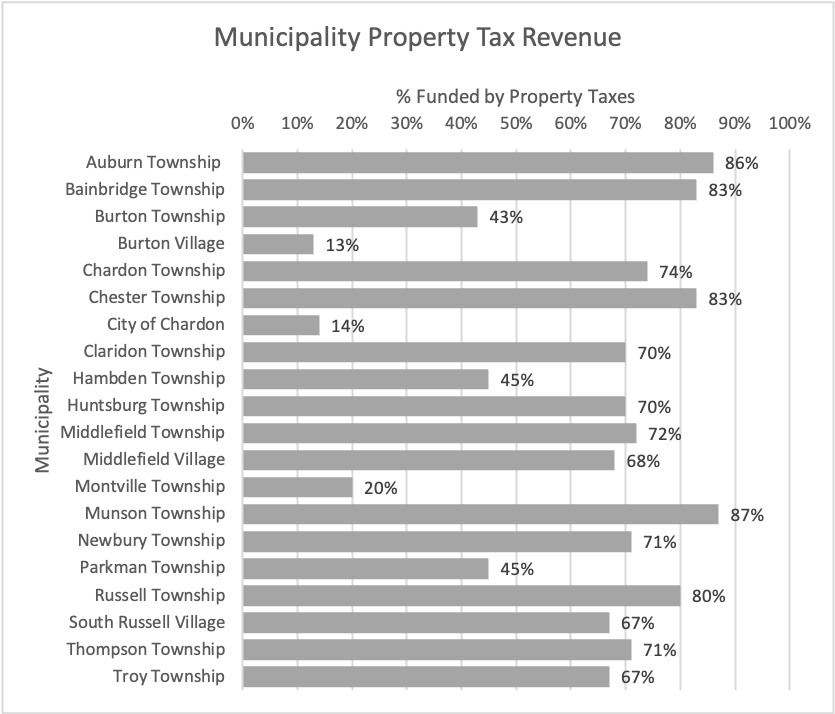
Property taxes make up a significant portion of local government funding, particularly for townships, which rely on them more than other types of municipalities.
While cities can draw from income taxes and other sources, township officials said eliminating property taxes would jeopardize essential services — from road maintenance to emergency response — and could fundamentally reshape grassroots government.
Property Taxes Drive Local Budgets
Cities, townships and villages provide residents with services such as road maintenance, parks, cemeteries, police, fire and EMS protection, and zoning regulations, as outlined in the Ohio Revised Code.
Brian Massie, leader of the “Axe the Tax” campaign, said too much pressure is placed on residents to fund police and fire services.
“They’re relying on the local communities to pay for their police and fire on the backs of increased property taxes and/or income taxes,” he said.
When asked how police and fire services would be funded alternatively, Massie suggested municipalities bill residents directly.
“Come up with a way that you can send me a bill and if I don’t pay it, then you put a lien just like any other creditor would,” Massie said. “Just don’t tie it to my house. Nothing should be tied to my house.”
In Geauga County, townships rely primarily on property taxes as their main source of revenue, according to the Geauga County Auditor’s Office.
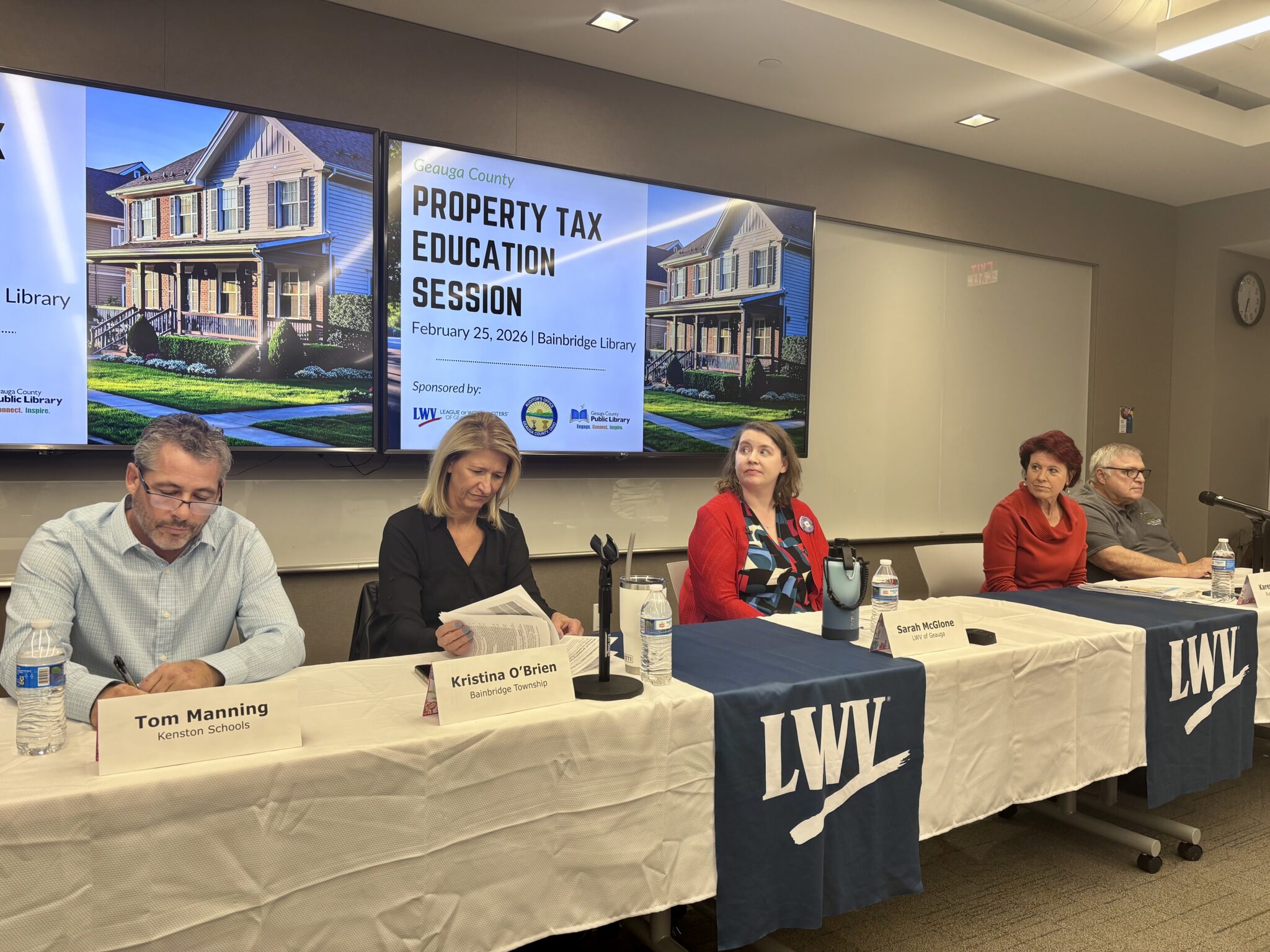
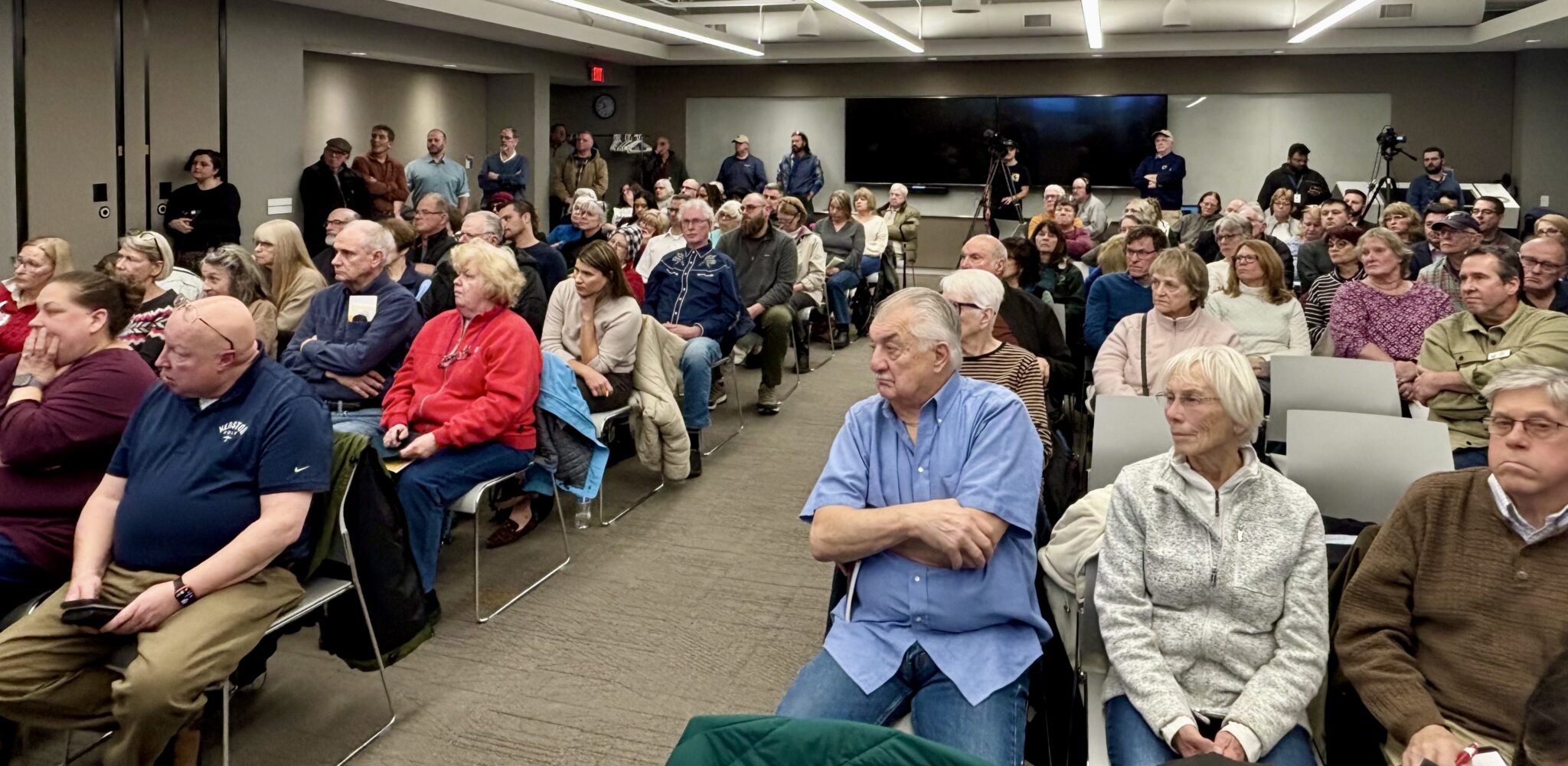
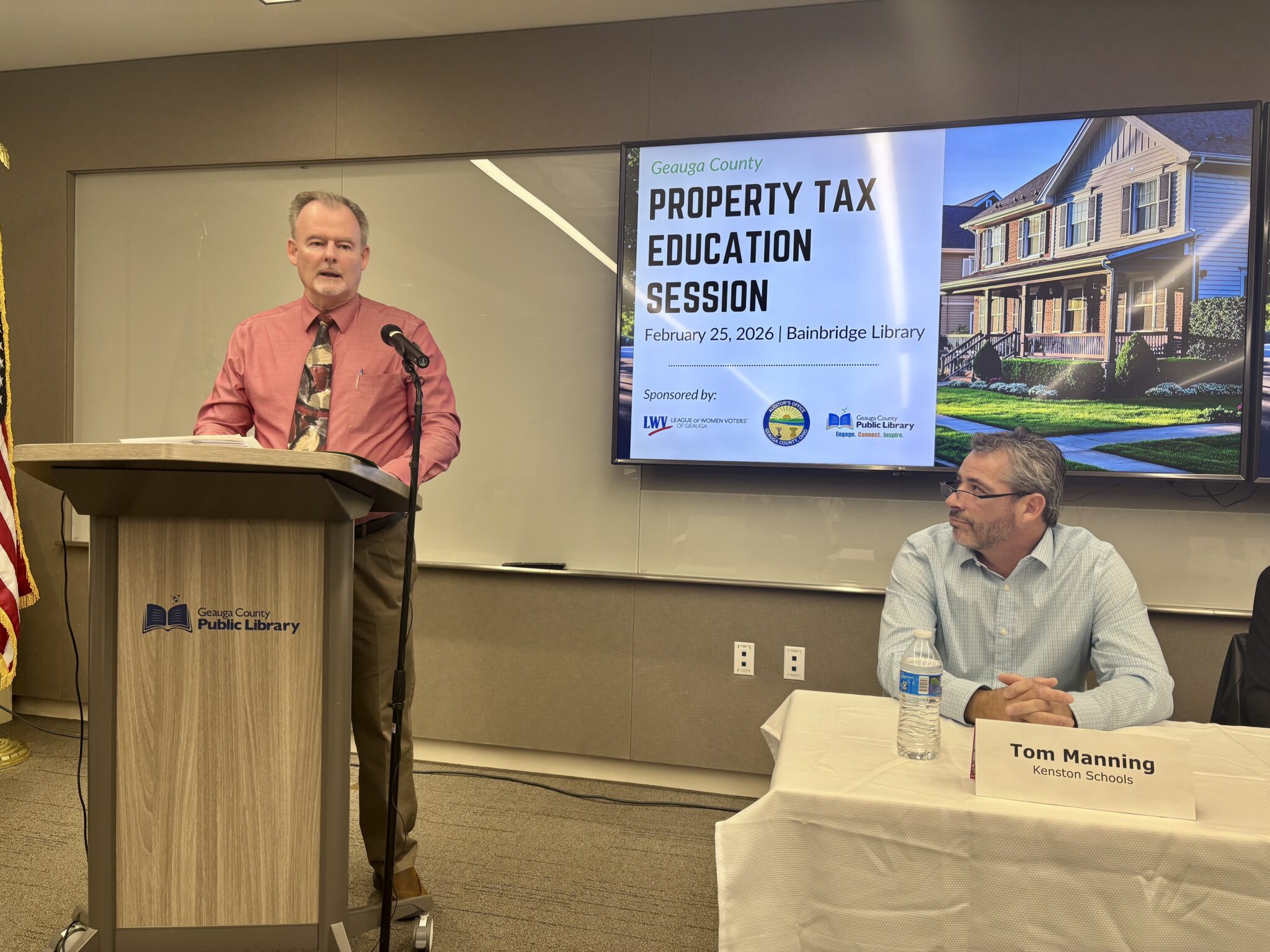
Several township officials discussed their reliance on property tax revenue during a Feb. 25 forum hosted by the Geauga County Public Library, the auditor’s office and the League of Women Voters of Geauga.
“A township is the most grassroots form of governing and we truly rely on real estate taxes,” Bainbridge Township Trustee Kristina O’Brien said at the forum.
Auburn Township Fiscal Officer Dan Matsko said they recently spent $1.1 million on a road project, which townships are required to maintain.
“After time, 26, 30 years, the road tends to fall apart and needs complete reconstruction,” he said. “The cost today for a resurfacing is roughly $350,000 a mile. The cost to reconstruct a road — and we just went through this in our Moreland subdivision in Auburn — was $1.1 million and that really taxed our road and bridge budget.”
By comparison, in Chardon, about 14% of revenue comes from property taxes, City Manager Ben Young said, noting the city’s primary revenue source is income taxes.
Cities can levy taxes beyond property taxes, while townships cannot, Young added.
“Most municipal services are funded through income tax, not property taxes,” he said.
Similarly, in Middlefield Village, property taxes account for only a small portion of revenue, Fiscal Officer Nick Giardina said.
“We’re very fortunate that for us, it wouldn’t be a cataclysmic event,” he said. “I mean, would it hurt our budget? Of course.”
The majority of the village’s budget comes from income tax, Giardina said.

Weighing the Consequences
Although cities rely less on property taxes than townships, they still depend on them, Young said.
“For the city of Chardon in particular, it would be a $3 million annual loss in lost revenue and that’s primarily for inside millage, which helps fund core government services,” he explained.
If property taxes were eliminated, municipalities would be forced to reduce services, Young said.
“(This) doesn’t mean service quality won’t decrease. I mean, $3 million out of a $23 million budget is a huge hit to the city’s ability to provide services for our residents,” Young said.
Governments would likely seek alternative revenue sources, he said.
“I’ve never known government to be at a loss for coming up with a way to tax people, whether the sales or income tax, or the marijuana tax, the lottery tax,” Massie added.
Middlefield Village, with its strong business base, could potentially offset losses over time, Giardina said.
“In the long run, could it help propel businesses locally here having that money put back in their pocket to hire more employees and do expansions here in the village and cover that loss over time? Probably,” he said. “So yeah, for us again, would it hurt? Yes, in the short term. Would it absolutely destroy the village of Middlefield? No. Would we have to tweak our budget a little bit? Yes.”
However, eliminating property taxes would affect funds tied to levies, he said.
“If those things couldn’t be collected anymore, it would affect the ambulance fund, it would affect our police fund and our general fund,” Giardina added. “There’s going to be unexpected positive and negative consequences from this that you and I can’t even predict. I mean, there is going to be fallout from this. Some things may be good, some may be bad.”

Townships Face the Greatest Risk
Townships, which rely heavily on property taxes, could face the most severe consequences.
“Township government, though, I mean, zero, gone, wiped out,” said Frank Antenucci Feb. 19. “Everybody else would have some sort of funding mechanism, even if it would not be enough to survive. Townships would be wiped out immediately. Nobody is going to get hit as hard as the most local of all governments.”
Antenucci, chief deputy of the Geauga County Automatic Data Processing board, noted townships would still be required to provide services such as road maintenance and cemetery resources.
“They all have a statutory responsibility, but no money to do it,” he said.
Massie disputed that claim.
“No matter what we say, people say, ‘Well, that’ll never work, we’ve tried that before.’ Then, we say, OK, then we’re going to put it right on the legislators … (to) solve the problem,” Massie said. “We’re just saying, as taxpayers, we’ve had — we’re taxed enough already. We are not going to accept it.”
He added home values should not determine how much residents pay for services like police protection.
Some township officials said they might consider becoming cities if the amendment passes, though not all would meet the 5,000-resident requirement.
“Unfortunately, we can’t be a city because we’re not big enough,” said Thompson Township Fiscal Officer Cindy Lausin.
Bainbridge Township, however, has around 12,000 residents and could potentially qualify, O’Brien said at the recent forum.
“(Bainbridge is) a great place, but it’s still semi-rural. It’s what we want to keep,” she said. “So again, while we all recognize there is some relief that’s needed, if it all goes away tomorrow with this hammer and no alternate funding, I mean, you become a city, okay? Cities still get real estate taxes, so do you just hike up the income tax? I’m just giving my answer as a 10-year trustee, knowing our budgets, knowing the funds that come in, knowing the services we provide as a township, (that) the next step may be a city.”
Townships offer a smaller, more personal form of government, O’Brien said, adding she moved to Bainbridge for the rural appeal.
“If you don’t have a local grassroots organization, you don’t have that person … that board that you can talk to that is responsive, that recognizes you. (You) don’t want that headless monster,” she said.
Russell Township Fiscal Officer Karen Walder said she also values the township’s rural character.
“From a personal standpoint, I didn’t choose to move to Russell because I wanted to live in a city,” Karen said. “If I wanted to live in a city, I had other options for that. But I didn’t want to live in the city, I wanted to live somewhere where there’s lots of open space. So, the question is, if that’s the option available to us, you’ve got to ask yourself, ‘Is that what you want? Is that what you moved here for?’”
In Auburn Township, facilities such as the community room could close due to insufficient funding, Matsko said.
“We rent those facilities out and hopefully, we make enough money on the rentals to cover those costs, but in the event (that) this would pass, not only would we lose … the money to maintain the buildings, but we’d lose the revenue that they’re currently generating because we’d have to close the facility,” he said.
Matsko added the township would only have three months of reserves if property taxes were eliminated.
“The county budget commission makes sure we’re not carrying over exorbitant amounts of money. Thankfully, (Geauga County Auditor) Chuck Walder monitors that very closely,” he said. “So, we would probably have three or four months and then we would just run out of funds.”

Officials Warn of Tough Tradeoffs
As municipalities consider the potential loss of property tax revenue, officials said options for alternative income sources are limited.
“(As) far as I know, there are no options,” Matsko explained. “All of our funding comes from property taxes and … we’re not allowed to levy an income tax, at least townships (are not). So far as I know, the state of Ohio controls our sources of revenue unless they change the law.”
For Chardon, one option would be raising income taxes.
“Unfortunately, our most viable backup option is seeking a quarter of a percent income tax increase that would roughly equal our fire department operating levy, which is our biggest loss,” Young said.
He added the city would likely cancel projects and eliminate programs, such as the sidewalk and shade tree programs.
“So, there would be real cuts to service,” Young said.
When asked if he would support an income tax hike, Massie said the state needs to reduce its spending first and share its revenue stream with local governments.
Chuck said municipalities could increase fees for services such as facility rentals, cemetery plots, ambulance transport and trash collection.
“I think the other taxes that we take for granted in the form of fees, those are going to go crazy, they’re going to skyrocket because that’s the easiest money to get because you just change your rate,” he said.
Cemetery plot fees could increase from $100 to $1,000, Chuck added.
In addition to fee hikes, townships like Russell would also face the challenge of paying for road maintenance, Karen said.
“The costs for paving (roads) are incredible,” she said. “That would be based simply on the gas tax, the license plate tax, and those taxes and the paving schedules would have to be obviously adjusted.”
Township officials would likely have to consider consolidating some services with nearby entities, and selling equipment or property for additional revenue, she added.
“Just like in your home when you have a shortfall of revenue, you have to look at your assets and say, ‘Geez, do we need that building? Can we sell it? Do we need that piece of equipment? Can we sell it? Do we need that vehicle? Can we sell it?’” she said.
Munson Township Fiscal Officer Todd Ray reiterated fee adjustments would be significant in Munson.
“The fees would be absurdly high in order to recover the kind of money that they’re losing if their real estate taxes go away,” Ray said.
He said 84.3% of Munson Township’s fire department budget comes from real estate taxes.
“If the real estate taxes are eliminated and you wipe out 84% of (the fire department’s) budget, you aren’t going to have an EMS billing revenue stream,” he said.
Townships lack authority to impose alternative taxes, he added.
“Townships do not have the option of having an income tax,” Ray said. “We don’t have the authority to put income taxes before voters or anything like that — that’s reserved for villages and municipalities. And we don’t have any control over retail sales tax. So, we’re at the mercy of, really, the state legislature.”
While trustees could proactively set aside money, it would be difficult, he said.
“The trustees could opt to pare back on what they’re spending now to try to store some more revenue for the following year, but that’s a very questionable strategy because … it would mean cutting back services now that residents expect,” Ray said. “To do that on a guess that this possible referendum might possibly pass, those are just too many ‘ifs’ or conditions to try to strategize around.”
Similarly, Lausin has struggled to prepare Thompson for the unknown.
“It’s just hard to fathom, I guess,” she said. “I asked the auditor the other day, I said, ‘How do I prepare my budgets for next year?’ He says, ‘Well, you just gonna go at it and (act as if it’s) not happening currently.’”

Efforts to Ease the Tax Burden
The push to abolish property taxes was not always broad, Massie said, adding he initially focused on easing the burden for seniors 65 and older.
“We had a campaign. We called it SOS SOS Save Our Seniors (to try) to get (legislators) to eliminate property taxes for seniors when they’re 65 years of age. Then, we were quickly told that they don’t believe in giving carve outs for seniors,” he said. “We find it objectionable where our legislators are saying … ‘If the seniors cannot afford their property taxes, they should sell their home and move into an apartment.’ That is cold and immoral.”
Seniors may rely more on EMS services than younger residents, but they would support those services, Massie said.
“The seniors aren’t saying, ‘I’m not going to pay for police and fire.’ They’re just saying, ‘Don’t tie it to my house and don’t arbitrarily keep increasing my property taxes that I don’t vote on,’” he said.
County officials have acknowledged concerns about residents being overtaxed, particularly seniors, O’Brien said.
“That is a problem, of course, so that would be something you can scalpel,” she said.
Some municipalities are already working to reduce costs.
Chardon reduced its shade tree assessment, Young said.
“We felt we could provide the service at a lower cost,” he explained.
Other property tax rates are largely outside city control, he said.
“The police operating levies were both set in the ‘80s and the city has never sought an increase to those levies,” Young explained. “Similarly, the inside property tax village split that the city receives was set many, many decades ago, and the city has never sought an increase.”
In Auburn Township, officials are currently working to create a full-time fire department without putting a new levy on the ballot, Matsko said.
“We’re looking at alternatives to putting on a levy and charging the taxpayers more,” he said. “Right now it’s in the infancy stage, but that’s the one thing we’re doing when it comes to taxpayer funds.”
Some officials suggested tightening levy approval standards.
“I think we’ve made it much too easy to go to the voters for additional money,” Karen said. “My view (is that) going to the voters should be the last resort, not the first step.”
Chuck echoed that sentiment.
“Our job is to protect the taxpayer,” he said. “The budget commission’s overarching role is we are the last remaining voice of the taxpayer before they get taxed, and if there is not a demonstration of need, we are required by law to not take that money.”
Ultimately, while municipalities are attempting to prepare, officials said there is no clear roadmap for replacing property tax revenue or maintaining current service levels if it is eliminated.
Part three of this series will take a look at how property taxes currently fund school districts in the county and how officials have been preparing for the potential impacts of eliminating them.