


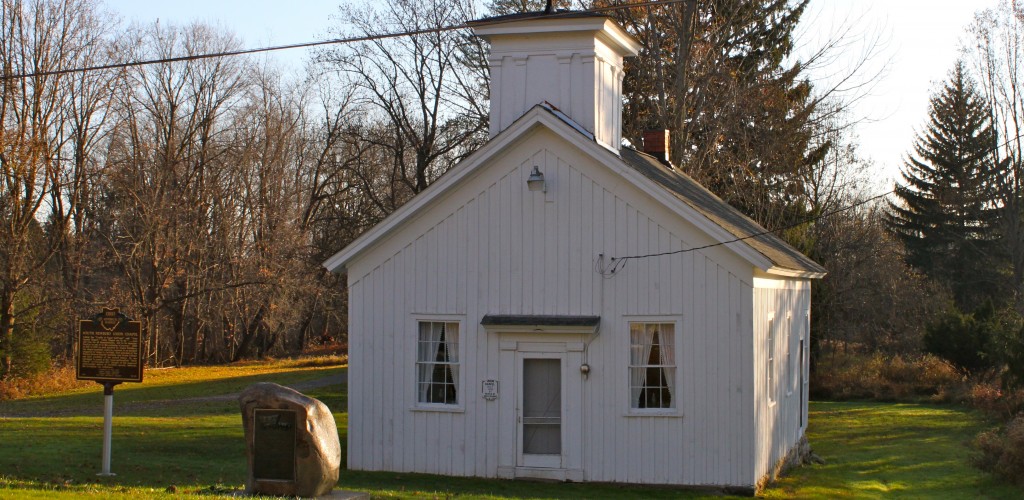
The small white frame building, noticeably old and slightly askew, sits quietly close to busy Ravenna Road in Newbury Township, but its unassuming exterior hides the fact that it once played a major role in giving full citizenship and the vote to American women.
The small white frame building, noticeably old and slightly askew, sits quietly close to busy Ravenna Road in Newbury Township, but its unassuming exterior hides the fact that it once played a major role in giving full citizenship and the vote to American women.
Union Chapel finally received official recognition this year for its role in establishing free speech and women’s suffrage when the National Park Service recently placed it on the National Register of Historic Places.
Geauga County Park District officials teamed with the building’s three trustees Wednesday to place a plaque on the building — the third historic plaque on the site — that shows its recognition on the National Register, a move that many consider long overdue.
“We went to Columbus where we met with a committee who screens the applicants and says yes or no whether it goes on to Washington,” said Mike Fath, one of three trustees who maintain the building, which is owned by the people of Newbury Township.
“Four groups were there to make their presentations and the committee asked them lots of questions,” Fath said. “But when it came our turn, when they read about all the history that happened here, there were no questions. One guy just raised his hand and said, ‘I move to accept this.’”
The little building is seldom open to the public.
The interior has antique wallpaper, hand-hewn tables and benches, a small stage, an elaborate oil chandelier and a host of historic artifacts.
The walls are lined with hand-sewn samplers and portraits of the 19th century celebrities that students today study in history books — James A. Garfield, Susan B. Anthony, Louisa May Alcott and Lucy Stone, among many others.
Although it is called a chapel and has pews, the building never served as a church.
It was built in about 1858 by the people of Newbury, who hauled lumber and building materials to the site and organized volunteers to construct the building, serving the community as a tribute to free speech.
South Newbury was a bustling community in the mid 1800s, with a tannery, cheese factory, gristmill and general store, among many other businesses.
In 1857, a young preacher from nearby Western Eclectic College, now Hiram College, had been invited to talk at a Congregational Church in South Newbury.
James A. Garfield’s speech was to include remarks on hot topics of the day, such as abolition and baptism by immersion.
“But the church elders decided that the talk would be too controversial, so they disinvited him,” Fath said. “The people were outraged.”
Garfield gave his speech at a nearby local tavern and to commemorate the event, store owner Anson Matthews donated land to the town, directly across the road from the church, for a building that would be dedicated to free speech, so no speaker would ever again be turned away.
During the 1870s, the building housed one of the first kindergartens in the state and served as a gathering place for picnics, community suppers, plays and other social events.
But it also became the headquarters for feminist activity, led by several Newbury women including Ellen Munn, who shocked many in the community by advocating daily baths and wearing trousers instead of cumbersome hoop skirts.
Munn and several women created a temperance society and organized many activities centered around the chapel.
In 1876, the women organized a celebration of the American Centennial, planting a commemorative oak tree across the road from the chapel.
The tree still stands today on private property.
In 1871, a dozen determined Newbury women marched to Union Chapel and demanded to vote, which was unheard of at the time.
“Unfortunately their votes got lost on the way to be counted,” Fath said. “In the 1872 election, even more showed up. The men had some older kids sitting here all day, smoking cigars and pipes to discourage the women. It was said that the kids were too sick from all the smoking to eat their dinner that night.”
Fath added, “By 1878, the women did succeed in voting here in a municipal election.”
Women officially won the vote nationwide in 1920.
During the mid to late 1800s, the chapel was the scene of speeches by nationally renowned orators, which Fath described as the rock stars of their day.
“Can you just imagine Susan B. Anthony putting together her (speaking) itinerary from her home in New York and writing ‘South Newbury, Ohio’ on the list,” Fath said. “We had the very famous orators of the day here.”
Park district supporter Bill Ginn said, “Think of what these women endured. They were second class citizens who did not have the right to vote and did not have the right to own property.”
Ginn pointed out how in the news right now, people are still trying to suppress other people from voting.
He added he believes that women will determine the outcome of the upcoming presidential election.
Although the people of Newbury own the chapel and an acre around it, the Geauga Park District owns the surrounding land and works with the chapel’s trustees to maintain the building.
The district has published a brochure about the chapel and Fath has prepared a PowerPoint presentation that he said he would give to groups.
“We’re very proud to be partners with the Union Chapel trustees and all they’ve done to preserve the history of this historic structure,” Park District Deputy Director Keith McClintock said. “We have plans to make this building more accessible to the public in the future.”


