


“The case against Chad South is not impossible. It is, however, for a great number of reasons, highly implausible.” – Francisco Luttecke

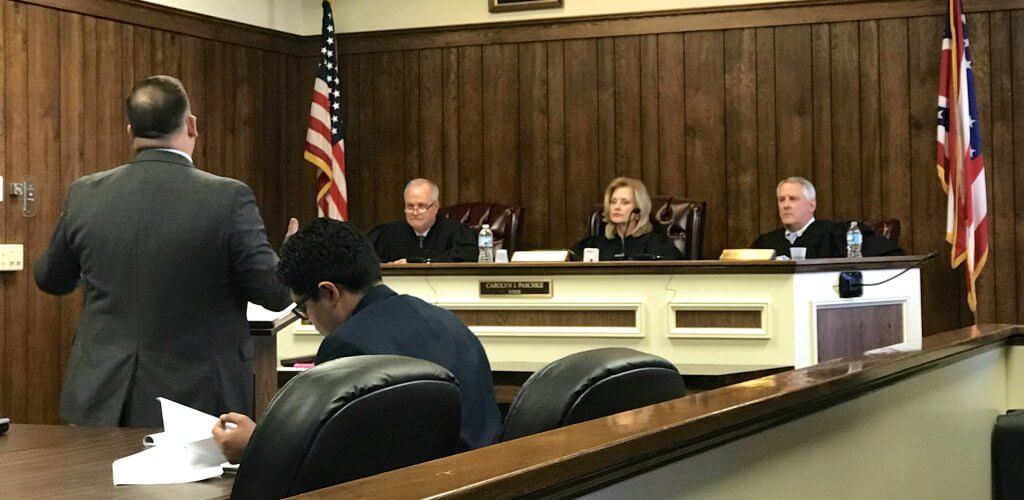
A three-judge panel of the 11th District Court of Appeals heard oral arguments April 18 in the case of the man convicted of murdering a Burton Township man in a botched murder-for-hire plot.
Following a four-day bench trial, on May 2, 2016, Geauga County Common Pleas Court Judge Forrest Burt found Chad South guilty of kidnapping and killing 31-year-old Daniel E. Ott inside his Claridon-Troy Road home the morning of May 26, 2006. South also was found guilty of kidnapping Ott’s then-girlfriend, Maryann Ricker.
Burt later sentenced the 47-year-old Moraine, Ohio, man to 28 years to life in prison.
“The case against Chad South is not impossible. It is, however, for a great number of reasons, highly implausible,” Francisco Luttecke of Office of Ohio Public Defender told judges Thomas R. Wright, Cynthia Westcott Rice and Timothy P. Cannon.

Luttecke argued there was a “distinct possibility” that Burt “lost his way” when he convicted South.
He said the entire case could be reduced to two theories put forth by two witnesses: Jason Harvey and Richard Carter.
Harvey was South employer in May 2006 and testified on the record that South and a former co-worker, Chad Malay, were working for him on a roofing job in the Dayton area the morning Ott was killed.
Although Harvey did not see South at work that day, Luttecke argued Harvey could infer South was there because Malay would have told him if he wasn’t.
Luttecke characterized Carter — prosecutors’ key witness — as a compensated informant who changed his story over the course of seven interviews with a Logan County Sheriff’s Office detective.
“And it’s frankly an incredibly story; it’s an implausible story,” Luttecke said, contending all disinterested witnesses contradicted Carter’s story, including Ricker and an Amish farmer Eli Yoder, who Luttecke said supposedly saw South on the side of the road shortly after Ott’s murder.
“Among all of the witnesses, all of the convoluted facts in the case, these are really the core, polar opposites that the court was asked to believe,” Luttecke contended.
Wright interjected that Carter explained his story to the detective changed based upon what South told him.
“He relayed what (South) told him. If (South) changed his story, then he changed what (South) told him,” Wright said. “It’s not that he (Carter) was making up the facts and changing them.”
Luttecke conceded that was Carter’s explanation, but suggested Carter gave “huge corroborative facts” in his final two interviews, after South had been released from prison for an unrelated crime.
But Wright noted Carter explained he remembered additional things in those final interviews that South had told him before he got out.
“How did Richard Carter know to tell the detective all of the things he told him then?” asked Wright. “How did he know about the murder even in Geauga County? How did he know a woman was in the car? How did he know whoever perpetrated this taped the wrists of the decedent? How did he know all that? That was all corroborated.”
Luttecke disagreed all those facts were corroborated, but claimed anything Carter knew came from one of two informants who were working with law enforcement in Logan County on unrelated investigations involving Joseph Rosebrook, the Logan County man convicted of masterminding the Ott murder-for-hire plot.
He reiterated the disinterested witnesses contradict the only parts of Carter’s story that could be corroborated.
But Wright got Luttecke to concede the Logan County detective didn’t know anything about Yoder — whose testimony Burt found to be of “limited value.”
“Mr. Yoder is a living, breathing person. He did come to testify that he saw these things,” Wright said, noting none of the informants would have learned about Yoder from police. “This is a fact that was unknown to anybody.”
Ohio Assistant Attorney General Paul Scarsella pointed out Ricker corroborated some important facts; namely, the intruder ducted taped Ott and then attempted to leave the home after he realized he had the wrong Dan Ott.
She also testified Ott got up, went after the intruder and she heard a gunshot.
“What’s important about that is what Richard Carter also testified to, which is the crux of what the court’s final decision was,” Scarsella said.
South told Carter the man inside the home was not the Dan Ott he had been sent to kill.
“And that’s the testimony from Richard Carter, was that the guy came after him with a lamp or something and that’s when Chad shot him,” Scarsella said. “And that’s what (Ricker) testified to. That is the key piece of evidence the judge found to be compelling.”
Scarsella also noted there were two ongoing investigations involving Rosebrook at the time — one in Logan County involving unrelated homicides and the other in Geauga County.
The idea that Logan County law enforcement was feeding information about the Ott case to their informants, who in turn gave the information to Carter, didn’t make sense, Scarsella argued, because the detectives were not sharing information.
“So those facts that Richard Carter is providing to (the Logan County detective) are coming from someone who is aware of the case, but not from law enforcement,” he contended.
The trial court record is clear that Carter’s testimony, coupled with the other witnesses, was sufficient for Burt to have found South guilty of murder, Scarsella said.
And, while Harvey did not testify at trial, because he claimed Geauga County Sheriff’s Office detectives intimidated him, Scarsella noted Harvey did testify at another hearing held in the trial court. Burt listened to audio recordings of interviews between Harvey and the detectives, and concluded there was no intimidation.

In addition, Scarsella disputed South was denied a fair trial because Malay, another potential alibi witness, did not testify at trial.
Scarsella explained it was only after an investigator from the state public defender’s office interviewed Malay and Harvey that Malay was reluctant to be involved.
“No one from the state had actually interviewed Chad Malay,” he said, adding there was no evidence sheriff’s office detectives played any part in Malay’s unwillingness or unavailability to testify at trial.
In his rebuttal, Luttecke said Ricker did not testify she saw Ott go after South with a lamp or something in his hand.
But Wright said she heard Ott go after South and thus could corroborate an aspect of Carter’s testimony.
Wright also challenged Luttecke’s claim that detectives intimidated Malay, thereby violating South’s right to due process.
“What did the detectives do to intimidate Malay, directly. Please answer that question,” asked Wright.
Luttecke tried to explain Malay had an outstanding warrant and didn’t want to be involved in the case.
“Well, that’s not intimidation,” Wright said. “So, you don’t have anything you can point to that’s intimidation of Malay, but you argue that in your brief.”
Luttecke also conceded there was no evidence Mindie Mock Stanifer, the woman in the car with South, was intimidated into not testifying at trial.
“So, Harvey is the only one you actually claim was intimidated, but he testified at the dismissal hearing, and he gave his whole version, and the trial court said since he won’t testify at trial, I’m just going to use his dismissal (hearing) testimony,” Wright noted. “So all the evidence came in?”
“Arguably, yes,” Luttecke conceded.


