


"Women are caretakers by nature. If we can't take care of ourselves, how can we take care of others?" Nancy McArthur
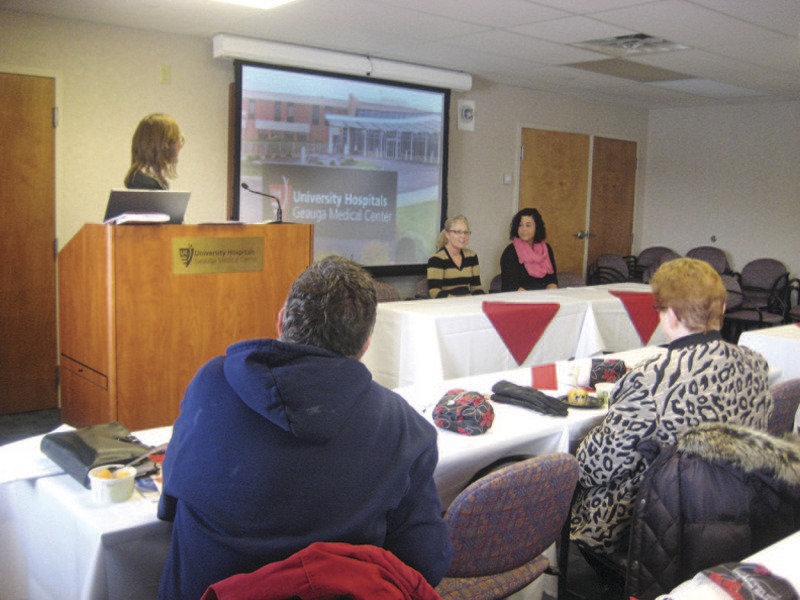
Several women sat at tables in University Hospitals Geauga Medical Center, their colorful clothing a contrast to the grey Geauga day outside.
Bags of health-related items rested at their places.
While the roughly 40 women grabbed muffins and drank coffee, they also received advice on improving their health and on the various services offered by hospital staff last Tuesday morning.
The women were present as part of a local business network, The Red Key Network. UH put together a panel of women’s health professionals to answer any questions they might have had.
The panel included doctors and specialists in areas related to bariatric surgery, cancer treatments and medical stabilization for addiction withdrawal, said Community Outreach Nursing Coordinator Julie Bogdan.
“It’s just a way for women to connect and focus on their health and wellness with other women,” Bogdan said. “We share a passion for supporting each other.”
The women in the panel included Tithi Biswas, a clinical associate professor in radiation oncology at Case Western Reserve University School of Medicine; Renee Klaric, a licensed professional counselor who runs the stabilization service; and Katie Miskulin, a UH Geauga nurse who lost 110 pounds after undergoing bariatric surgery.
Cancer? UH Has Options to Help Women
Biswas spoke first and discussed various radiation therapies offered by UH Geauga. She said one of the key misconceptions about radiation used in cancer treatment is that it burns people and does more harm.
Radiation used in cancer treatment provides significant benefits in various cancers. Just like any other therapy, it has side effects, which are mostly manageable in the hands of an experienced radiation oncologist.
“It’s not the same,” she said. “Unlike an uncontrolled nuclear explosion, radiation used in cancer treatments is very controlled, limiting harmful or life threatening damage.”
Biswas said for breast cancer, women can either have a traditional mastectomy or a lumpectomy, followed by radiation.
Older women can even forego the radiation, depending on their clinical situation, she added.
Bogdan said the university also has a program called “Look Good, Feel Better,” in which a team of cosmetologists works with the cancer patient to deal with various cosmetic issues related to the affliction.
Women with breast cancer also must rely on surgery, chemotherapy and radiation as deemed appropriate. Chemotherapy alone does not provide local control of the cancer, Biswas said.
“With local therapy, we want to make sure the cancer does not come back locally,” she said. “If breast cancer is discovered at an early stage, it is curable.”
She added the breast cancer risk is one in every eight women.
Biswas encouraged women to continue with annual mammograms. She also encouraged women to speak with their primary care physicians about various screening tools for certain cancers.
Medical Stabilization Helps Patients with Withdrawal
Klaric, who is experienced in mental and drug and alcohol treatment, next talked about the stabilization service offered by UH Geauga.
The service began as a partnership with New Vision — a program from a nationally recognized medical stabilization provider, SpecialCare Hospital Management Corporation — to develop plans that address the county’s growing recreational and prescription substance abuse epidemic, Klaric said.
She is the New Vision service coordinator and works alongside Dr. Lisa Brown, the service’s medical director. Brown is also a pain intervention specialist with a practice at UH Geauga.
New Vision services are executed through a management contract between SpecialCare and are tailored for the needs of the individual hospital.
The stabilization service is the first of its kind and is only offered at UH Geauga. It provides a three-day inpatient hospital stay that focuses on clinically treating the symptoms of acute withdrawal, especially from alcohol and opioids, she said, adding it is not a detoxification program.
Klaric said the service helps patients transition from hospital care into post-stabilization life. The stabilization service links patients to treatment programs, based on individual needs and the programs’ proximity to where the patient lives.
It empowers patients to begin the healing process, starting with the first phone call to the service.
It is hard and sometimes life-threatening for those who are abusing opiates and alcohol to go through withdrawal, Klaric said, adding addiction often runs in families.
‘I Lost 110 Pounds in a Year’
In 2011, running a 5K and dancing a polka was out of the question for Miskulin.
She was overweight, but wanted to do something about it.
In 2012, she attended an informational session on bariatric surgery at the hospital. After a two-day Roux-en-Y gastric bypass surgery that July, she went home to recover.
In 2013, less than a year later, she had lost 110 pounds.
Audience members gasped as the screen showed “before” and “after” photos of Miskulin, who discussed the procedure.
She also said the surgery has helped those with diabetes. Doctors have seen either complete resolution, or at the very least, a dramatic reduction in illnesses directly related to obesity, such as diabetes, high blood pressure and high cholesterol.
The hospital utilizes a LINX procedure to treat chronic gastro-esophageal reflux disease. The doctor, Leena Khaitan, is one of the only doctors in the region performing the LINX procedure, the nurse said.
As the women filed out of the room, they reflected on what they had learned.
City of Chardon Councilwoman Nancy McArthur said the importance of a healthy lifestyle should not be ignored, especially for women.
“Women are caretakers by nature,” she said. “If we can’t take care of ourselves, how can we take care of others?”


