“When I was a boy and I would see scary things in the news, my mother would say to me, ‘Look for the helpers. You will always find people who are helping,’” Mister Rogers famously said on the show “Mister Roger’s Neighborhood.”
“When I was a boy and I would see scary things in the news, my mother would say to me, ‘Look for the helpers. You will always find people who are helping,’” Mister Rogers famously said on the show “Mister Roger’s Neighborhood.”
Sue Juhasz, president of the Geauga Hunger Task Force, recalled this quote in a phone interview June 4 as she spoke of how “helpers” throughout Geauga County have come together during the novel coronavirus pandemic.
“Here in Geauga County, boy, they’re really there,” Juhasz said.
While the state’s response to COVID-19 had temporarily shut down many entities throughout Ohio, it did not shutter the services of the GHTF, Geauga County Department on Aging, Geauga County Department of Jobs and Family Services, the Veteran Food Pantry and the Lake-Geauga Recovery Centers.
Each organization has adapted their services to limit in-person contact and preserve the health of their clients and employees.
Socially Distant Services
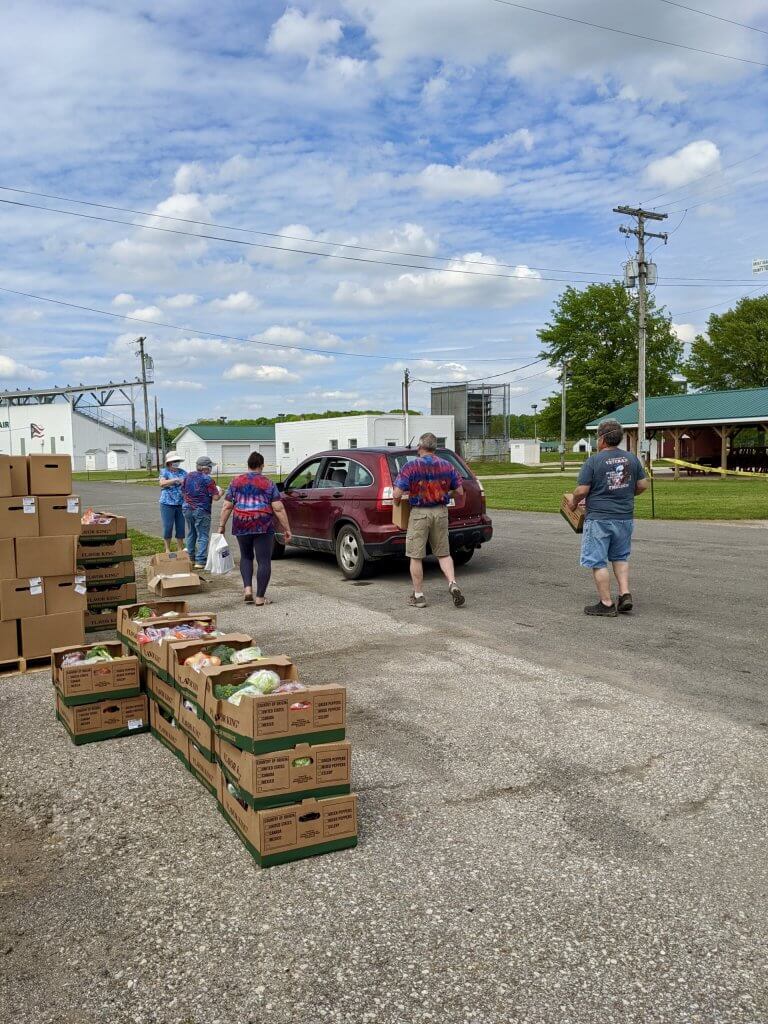
Many food pantries have adapted their services to curbside pick-up and delivery. The GHTF even offers drive-thru food distribution.
“It is the coolest thing,” Juhasz said.
At the Geauga County Fairgrounds on Wednesdays from 4-6 p.m., people can pick up a produce and dairy box in a “touchless food distribution.” To receive food, you only need to register online at www.wefeedgeauga.org or call 211, drive to the fairgrounds and pop your trunk.
Juhasz emphasized individuals who may not have qualified for aid, but suffered an income loss due to COVID-19 can receive help.
“We’re not asking anybody to prove anything and we’re not turning anybody away, even if they have not registered,” Juhasz said. “Hopefully, we don’t have to do that anytime in the future.”
For the third week of distributions, 167 households and 501 individuals were served. The service is planned to continue throughout the summer.
While drive-thru, curbside or delivery services mitigate the danger of physical contact, they do not necessarily provide the same socialization of traditional pantry operations.

“What the guys miss most of all of this is the social area,” said Veteran Food Pantry Director Lynn Algeri. “Part of the vision when I started this 11 years ago was to have a place where veterans can just come and talk.”
The social area includes coffee and pastries provided by volunteers, Algeri said, adding the pantry is unique in that everyone is related to a veteran in some way, which creates a welcoming and safe space for veterans.
“We even have veterans that don’t actually make use of the pantry, but they come to talk because everybody here is a veteran. They get it,” Algeri said. “It’s a comfortable place for them to be and that was always part of the vision.”
The GCJFS has also noticed the impact of in-person limitations on services, said Executive Director Craig Swenson.
Without schools and counselors being able to meet in person, referrals to GJFS have gone down.
“One of the things that’s kind of been eerie to us is actually how quiet it’s been from getting referrals because people are home,” Swenson said in a phone interview June 3. “That’s kind of been a little eerie for us to cope with because we just want to make sure people are okay. Especially with the concern that substance abuse is up.”
However, for GCJFS itself, Swenson said the staff and community have responded well to coronavirus prevention measures and his staff has remained healthy.
“I’m amazed at my staff and amazed at how the community has responded. It’s been amazing how the social distancing and the being able to work from home and all that has enabled my staff to remain healthy and go above and beyond,” Swenson said.
During the projected peak of COVID-19, Lake-Geauga Recovery Centers also moved in-person services to video and telehealth therapy. Those services, while necessary, have drawbacks said Melanie Blasko, president of Lake-Geauga Recovery Centers.
“I’m a firm believer that the best predictors of successful treatment outcomes is the relationship between a client and their counselor,” Blasko said in a phone interview June 2. “As good as telehealth is and video therapy, you lose a bit of that when you aren’t face-to-face with a client and a counselor.”
Blasko said admissions to residential treatment were limited for about a month. Residential treatment facilities also set up quarantine rooms.
While senior centers closed, the GCDA continued to serve the elderly with curbside meal pick-up, food delivery and a food pantry. Programs for seniors have also moved online, though they are limited, said Jessica Boalt, director of the GCDA.
“Oftentimes, when you’re dealing with clients, you like to be able to demonstrate, show and assist,” Boalt explained. “We’ve not been able to do those things.”

A “New” Normal
The GHTF typically has a benefit choir concert twice per year put on by a choir that meets at Notre Dame Cathedral Latin School. However, due to COVID-19, the church has been sequestered to protect a vulnerable population, Juhasz said.
Juhasz said while a concert could be put on in December with accommodations due to COVID-19, there isn’t a pressing financial need to have it.
The two concerts raise about $15,000, said Juhasz.
“The money that we would normally raise, we’ve already received it in donations from the community,” she said.
The Veteran Food Pantry opened for patrons to walk-in June 12. Algeri said one veteran is allowed in the pantry at a time. The social area has also reopened, but it has been moved outside.
For the entire process, masks and hand sanitizer are required.
In the social area, pastries are now individually wrapped and a volunteer serves coffee to the veterans.
“Anybody that comes here, even if it’s for coffee and conversation, they still need this. We want to keep this going,” Algeri said.
Before COVID-19, the Veteran Food Pantry served between 70-100 veterans in a week, their family members and dependents, Algeri said. She anticipates about 60 clients will be served in-person, with others receiving food through home delivery.
Swenson said typically with difficult economic times, individuals utilize GCJFS services more.
“When people lose their jobs and they fall into economic hard times, that’s when our services go up and how busy we are,” Swenson said.
He also said there is a fear of the unknown, when will there be a vaccine and will there be a spike, which is creating a lot of anxiety throughout the community and his staff.
“(Isolation) weighs on people,” Swenson said.
LGRC are using a phased approach to return to in-person interaction and counseling.
For phase one, walk-in intakes were made available at outpatient offices and staff scheduling was staggered. For phase two, which began June 3, all intakes and assessments returned to in-person, however group therapy is still done through video call.
“Our business is face-to-face. So many different industries can work remotely and maybe many of them will continue to, but so much of our work, it’s critical, that contact the client has with their counselor,” Blasko said.
LGRC are down about 20 percent for outpatient admission, but they are picking up, Blasko said., adding after the coronavirus pandemic is deemed “over,” she anticipates a surge in behavioral health cases.
As the GCDA begins to reinstate in-person services, Boalt said there will be adjustments to face-to-face appointments and senior center operations to maintain the safety of clients and staff.
“Our goal is to maintain a safe environment for our staff and the seniors that we serve at all times. As we learn more and as we get more direction from the state, we know that things will look different,” Boalt said. “We do ask for everyone’s support and patience as we try to do what’s best for everyone.”
The GDA update posted June 2 said walk-in and routine office appointments are still postponed, and the senior centers and adult daycares will remain closed through June. However, cancelled tax and legal services appointments are being rescheduled, as well as trash pick-up.

How to Help
If individuals wish to volunteer for the GHTF, they can contact the United Way Services of Geauga County office.
Currently, the task force’s biggest need is to keep individuals informed about services, which it regularly posts about on its Facebook page and website.
The Veteran Food Pantry could use donations, Algeri said, adding it has been difficult for her to buy in bulk.
She suggested donations of meat, such as chicken and hamburgers in one-pound packages. Algeri also suggested nonperishable items, such as canned fruit – especially peaches – and shelf-stable milk. Cash donations are also welcome.
“Please let veterans know. If there’s a veteran member in your family, let them know about this pantry,” Algeri said. “We want the word to get out to our veterans.”
For GCJFS, Swenson wants the public to know “that we’re still here and we’re able to respond.”
GCJFS continues to provide public assistance programs, food assistance, child and adult protective services. If an individual is in need of any service, Swenson encourages them to contact GCJFS.
Blasko said LGRC could use donations of hand sanitizer, paper towels and sanitary wipes. She also said individuals could participate in the two fundraisers the centers have planned for August, as she is worried they — a golf outing in Lake County and a bike ride in Geauga County — may not perform as well as in the past.
As August approaches, Blasko said precautions will be made for the fundraisers if needed and the golf outing is typically scheduled for June but has been moved to August.
Boalt regularly updates the GCDA Facebook page with current needs. Individuals looking to donate to the GCDA food pantry can find a detailed list of needed nonperishable items on the page.