


No Trial Date Set, Oral Arguments on Motions to Dismiss Scheduled for Late April
Oral arguments over two motions to dismiss the case against Nicholas Iacampo will be heard April 26, retired Portage County Common Pleas Court Judge John A. Enlow ordered during a Feb. 21 pretrial hearing.
Oral arguments over two motions to dismiss the case against Nicholas Iacampo will be heard April 26, retired Portage County Common Pleas Court Judge John A. Enlow ordered during a Feb. 21 pretrial hearing.
Iacampo, 29, who lives in Painesville with his wife, is a former Chester Township police officer and West Geauga Schools Resource Officer who pled not guilty in December to charges of felony sexual battery and unruliness or delinquency of a child, a misdemeanor, for an alleged Aug. 6 incident with a 16-year-old girl.
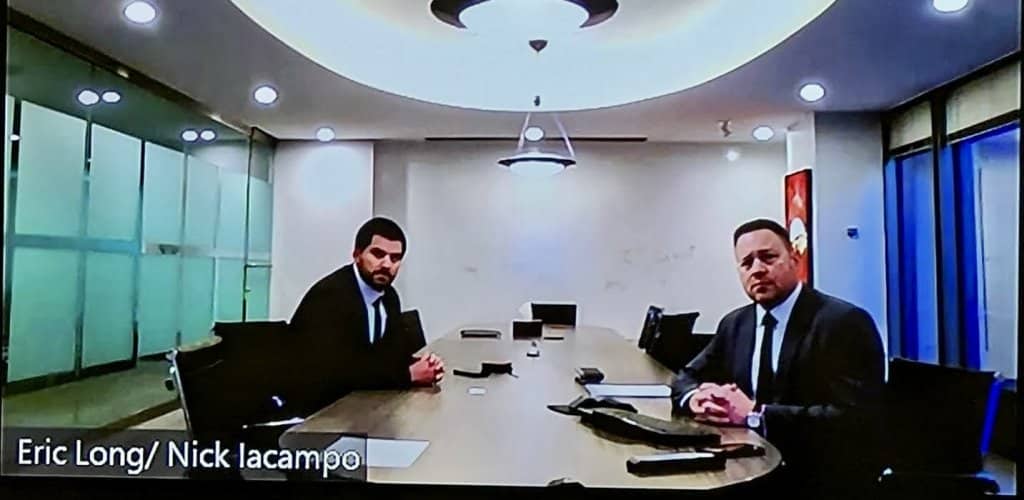
Iacampo appeared via video with defense counsel Eric Long and Madelyn Grant, of the Cleveland-based law firm Friedman, Nemecek & Long LLC. His attorney, Ian Friedman, was in court for another case, Grant said.
Lake County Assistant Prosecutor Adam Downing appeared on behalf of the state.
The attorneys and Enlow hammered out a schedule for the next several weeks, with Downing promising the defense a copy of the grand jury deliberations that led to the charges against Iacampo once a court reporter completes it.
Enlow gave the defense team until April 5 to examine the transcript and supplement any motions filed based on the information contained in the document, which he ordered sealed, as it contains information relating to a minor.
A trial date was not set, with defense attorneys asking instead to present oral arguments in front of Enlow on the motions to dismiss the case against Iacampo, whose indictment accused him of violating a state law that prohibits engaging in sexual conduct when the offender is a teacher, administrator, coach or other person in authority employed by or serving in a school.

In stating their case to dismiss the charges, his defense attorneys said Iacampo was no longer employed as an SRO by the time the alleged offense occurred. And, even if he had been, the criminal code under which his case is being prosecuted only prohibits sexual contact between a student and a person in authority, the motion said.
“Iacampo was not a teacher, coach or administrator at West Geauga High School. Rather, he was appointed to serve as the interim SRO. And, as confirmed by Superintendent (Richard) Markwardt, the SRO is not considered an employee of West Geauga High School,” the motion said, adding Iacampo can, therefore, only be charged under the named statute if he qualifies as an “other person in authority.”
However, the “other person in authority” provision of the law explicitly refers only to a “teacher, administrator or coach,” his lawyers said.
“The fact that SROs perform their law enforcement duties on school property is not sufficient, in and of itself, to qualify them as (an) ‘other person in authority,’” the motion said.
Iacampo’s defense team filed another motion to dismiss, this one based on a legal case involving a New Jersey police officer named Edward Garrity, who, in 1961, was questioned over “fixing” traffic tickets. Garrity and five other officers were interrogated and told refusal to answer would be cause for removal from their posts.
In 1967, the U.S. Supreme Court ruled on the case, concluding that employees of the state cannot be compelled to incriminate themselves under threat of termination. Along with the Miranda warning, suspects in internal investigations are issued a Garrity warning to alert them to their right not to speak without jeopardizing their employment.
In later cases, the court expanded those protections to include the collection of evidence. His defense attorneys argue data from Iacampo’s iPhone, which he turned over to investigators, and a DNA swab fall under those protections.
In their motion, defense attorneys for Iacampo said when he was interrogated by Lake County Sheriff’s Office deputies, he was told to “keep in mind that this isn’t voluntary now.”
“(I)t is clear that Iacampo reasonably believed that his refusal to cooperate with the investigation would result in the immediate termination of his employment. Because Iacampo was presented with a choice between submitting to an interrogation or having his employment terminated, the protections of Garrity apply to his statements,” the motion said — asserting that should be reason enough to dismiss the case.
The prosecution will be given until April 19 to respond to any further motions filed by the defense.
Oral arguments over whether to dismiss the case will be held at 1 p.m. April 24.


