


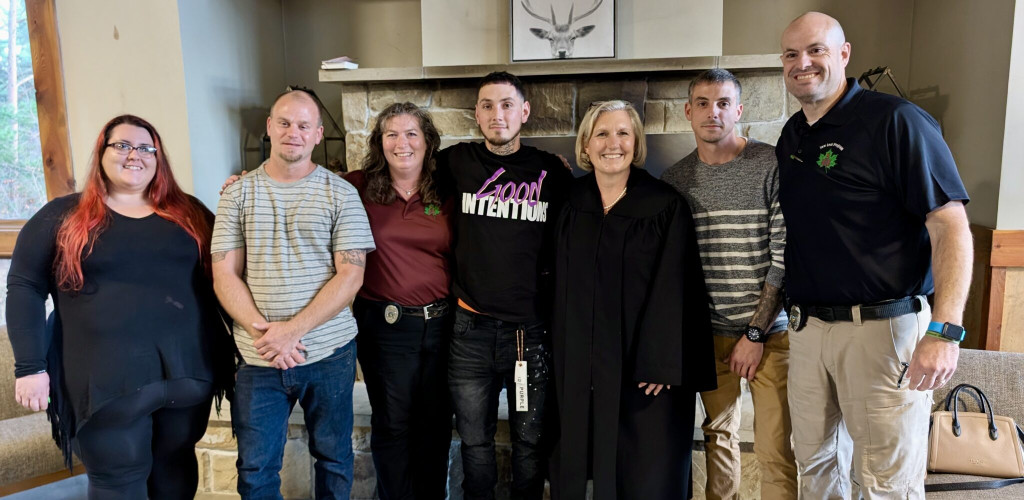
While a chilly breeze whipped around outside the lodge at Claridon Woodlands, over 100 people inside kept warm with the joy and fellowship of a New Leaf Program five-member graduating class.

While a chilly breeze whipped around outside the lodge at Claridon Woodlands, over 100 people inside kept warm with the joy and fellowship of a New Leaf Program five-member graduating class.
The specialized docket operated through Geauga County Court of Common Pleas Judge Carolyn Paschke’s courtroom offers an alternative to incarceration for drug charges by giving people facing addiction an alternate path.
The program currently serves about two dozen participants, who interact daily with a treatment team made up of local law enforcement and probation officers, mental health counselors and reentry and job training specialists. Twenty have already graduated since the docket opened in 2019.
Geauga County Commissioner Jim Dvorak, whose daughter, Jamie, died in 2017 after struggling with opiate addiction, opened the event with a prayer.
“Thank you, Lord, for the New Leaf Program, an answered prayer,” he said in closing.
Paschke introduced each of the program’s five graduates, beginning with Anthony Square, who came to the program with felony drug possession cases and hadn’t seen success in the Cuyahoga County drug court program.
While he struggled at first, after attending a program at NEOCAP and then stepping down through residential treatment and a sober living home, something clicked for him, the judge said.
When he came to the program, he was thin and gaunt, but now, after finding confidence in his abilities, Square even looks healthier, she said.
In return, he thanked the treatment team for their help with the program.

Square now works at Ravenwood Health and Christine Lakomiak, executive director of the Geauga County Board of Mental Health and Recovery Services, stepped up to the mic to thank him for his help.
Square is helping work on a project to expand her department’s building, she said, adding he participates in weekly meetings with the architect and contractor and is always helping.
“I just wanted the folks to see what you’ve been helping build,” an emotional Lakomiak told Square, while holding up a posterboard of the concept plans for the expansion. “I just wanted to thank you for all you do for us.”
Julie Finnerty came to the program with use and possession charges, having lost custody of her daughter, but turned a corner after attending inpatient treatment programs.
“She worked really hard to pay off her court costs and she’s worked hard to pay off a lot of her other obligations, and she’s working on building her credit,” Paschke said.
Finnerty’s daughter now has a “healthy, involved, present mom” and is very active in Alcoholics Anonymous, with a goal of becoming a peer supporter, the judge added.
Finnerty told the assembled crowd the five-year anniversary of having her daughter taken is coming up soon.
“(It’s) something that reminds me of how far I’ve come. And I wouldn’t be here without all of you,” she said.
Ryan Murton came to the program about halfway through a roughly 13-year prison sentence for multiple crimes.
Although he first applied to the program in 2021, Paschke said his record at prison — which included getting caught with drugs in prison and tampering with a drug test sample — led her to decline that application.
She told Murton, however, she would reconsider if he demonstrated a commitment to improving himself.
When he filed another application in March 2022, Paschke said he’d completed his GED and comments from the instructors included that Murton had shown great improvement in his education.
“(He has) shown hard work and dedication. Was a model student. Attends every class. He’s shown desire and ability that was not shown in 2021. His attitude has changed greatly. Proud of this young man,” Pashcke read from the instructors’ comments. “That’s what I was looking for. So, I took a chance on Ryan.”
His transformation since being released from prison in November 2022 has been remarkable, she said.

“Brian is reliable, he’s present for his family. He’s working two jobs, earning money to meet his goals,” Paschke said. “Something else that I’ve noticed about Ryan is that he’s happy.”
Murton is also on track to work in peer support and has been featured on the court’s website and social media during National Re-Entry Week, which recognizes people coming back into society after incarceration.
Probation Officer Greg Potts said Murton’s graduation is emotional for the whole team, considering he was sentenced to more than 10 years in prison when he was only 19.
To transition out of prison, people need to be equipped with certain tools, he said.
“An individual who was, right at 19 years old, going in prison does not have those tools and they don’t always acquire or get those tools when they go in,” he said, adding, however, the New Leaf program is an opportunity to instill those tools and skills.
“So, that is not just somebody that goes out, does their thing and goes back (to prison),” Potts said.
Paschke said the order ending Murton’s probation is one that usually has meaning for graduates, but with his history, it has even more.
“That means that he can, I think, officially turn the page on that chapter,” she said.
Bob Claypool came to the program with a two-decade criminal history and previous time served, Paschke said.
But, through successful rehab and treatment in the program, he and his wife have regained custody of their five children.
Claypool set a goal to be a master plumber, Paschke said, adding he worked very hard to pass the required testing.
The drug court treatment team helped clear barriers related to his previous record, the judge said.
“Bob has been working and I know that he’s very active with his church. … He is also active in his children’s lives … and those children are blessed to have sober, healthy and involved parents,” Paschke said.
The final graduate, Amanda, who did not wish to be identified by her last name, came to the court with possession charges, but was arrested while pregnant and caught tampering with a urine sample. She also lost her husband to an overdose.
After escaping from the hospital, where she was being held on furlough from jail during her pregnancy, Amanda was on track to being placed back in prison and losing her child after its birth.
But, Paschke said Geauga County Prosecutor Jim Flaiz reached out and asked for a resentencing to allow Amanda to stay in a program where she could keep custody of her daughter.
“I have to tell you, I’m really proud of our county because I don’t think this would have happened in another county,” Paschke said. “I don’t think that level of communication and cooperation would have occurred.”
Amanda’s mother tearfully read a note of thanks to the treatment team.
“(The program) is a beautiful reminder that recovery is not just a solitary journey — it is a collective effort fueled by compassion and understanding,” she said.
More information on the program can be found at courts.geauga.oh.gov/new-leaf-program.


