


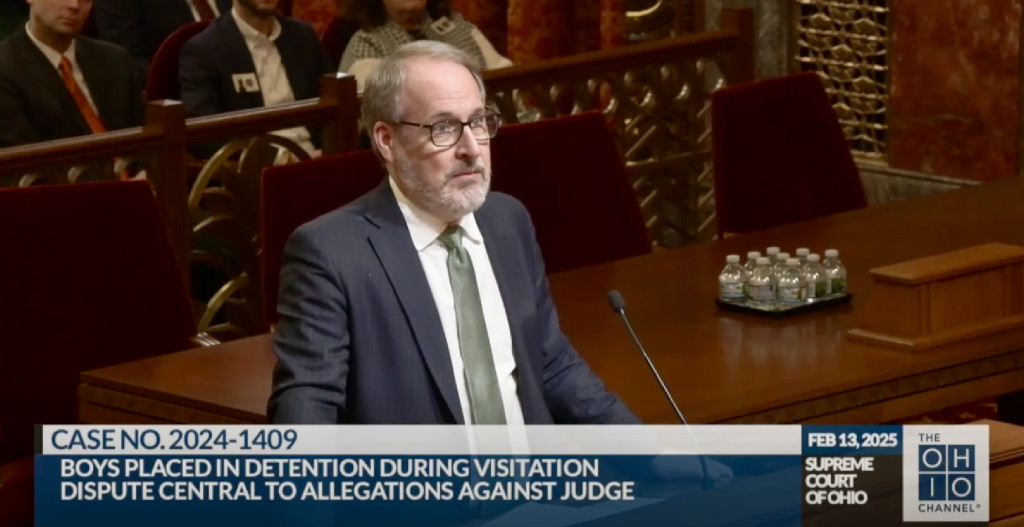
Last September, the Ohio Board of Professional Conduct recommended Geauga Probate and Juvenile Court Judge Tim Grendell be suspended from the practice of law for 18 months due to alleged misconduct in a case where he ordered two teenage boys to be detained after they refused to see their father.

Last September, the Ohio Board of Professional Conduct recommended Geauga Probate and Juvenile Court Judge Tim Grendell be suspended from the practice of law for 18 months due to alleged misconduct in a case where he ordered two teenage boys to be detained after they refused to see their father.
Grendell appealed the ruling, bringing it before the Ohio Supreme Court, which held oral arguments Feb. 13.
Each side highlighted key points and answered questions from the justices.
The juvenile case is not the only disci- plinary matter the board ruled on. They also found ethical violations regarding a dispute Grendell had with the Geauga County Au- ditor’s Office and his testifying in favor of Ohio House Bill 624, of which his wife, Diane Grendell, was the primary sponsor.
Attorney Stephen Funk, representing Grendell, began by emphasizing why Grendell deserves a ruling in his favor regarding his House bill testimony.
The court has previously held that content-based restrictions on speech must be narrowly tailored to permit judges to speak on disputed legal and political issues, he said, adding it is clear Grendell had a First Amendment right to testify about the bill.
Justice Patrick DeWine questioned if Grendell’s speech being protected conduct had been raised during the investigation. Funk said it had been numerous times and the board of professional conduct said it was not up to them to decide.
When it came to the incident involving the two boys, Funk said the case is only one of thousands Grendell has handled over his career and he had no prior incidents.
“I know there’s a lot of disagreement by the board vehemently disagreeing with the decision to detain the two individuals. And I can understand that,” Funk said. “But the reality is, is that the law permits a juvenile court judge to detain, temporarily, juveniles on unruly charges.”
It is not a willful failure to follow the law, but a disagreement in its application, Funk said, adding the Ohio Supreme Court has also previously held the failure to follow law in and of itself cannot give rise to a disciplinary violation.

There must be a pattern of willful failure to follow the law, he said.
DeWine asked Funk what he thought appropriate sanctions would be if the court thinks there was conduct that violated disciplinary rules in the brothers’ detainment. Funk replied a public reprimand or fully stayed suspension would be the minimum appropriate.
One instance in a long career is not grounds to suspend a license, he added, noting Grendell’s term will expire in 2027.
There is no real opportunity for this to occur again, he said.
“First, I ask the court to rule in Judge Grendell’s favor that there were no disciplinary violations, but if to the extent there were, (for) either a public reprimand or fully staged suspension,” Funk concluded before returning to his seat.
Joseph Caligiuri, representing the disciplinary counsel, was next to take the stand.
“Mr. Funk wants to paint a picture that this was simply legal error, but if you look in the board’s 88 page report, 50 of which dealt with count one, you can see how the board came to its conclusions that the respondent actually created, orchestrated and fabricated trumped up unruly charges as a method to illegally detain these boys solely so he could force them into visiting with their father, whom they hadn’t seen in three years and whom Judge Grendell knew that they legitimately feared,” he began.
They know about the manipulation due to phone records showing the chronology of events, he said, adding that everyone involved in the case said the brothers had not been unruly, including Grendell.
The brothers had been dropped off as instructed and had said they were scared and didn’t want to see their father, at which point Grendell had been called and ordered them to be detained, Caligiuri said.
Their mother had then been called to tell them to visit their father.
“The judge knew, well he felt, that the mother wasn’t gonna do that. He was playing a game. He wanted to set her up for a contempt charge,” Caligiuri said, adding the mother had, as a result, encouraged the brothers to go.
This is a judge manipulating the system of justice to incarcerate two children, something completely antithetical to what Ohio asks of its judges, he said.
Returning to the topic of Grendell’s testimony on HB 624, DeWine questioned if the disciplinary counsel had made any inquiry into his speech being constitutionally protected.
The First Amendment claims were dubious, he said, asking why counsel had brought them.
The counsel consulted with constitutional experts before proceeding, Caligiuri said.
“Our position on this would be that the subject matter of the testimony, which was the way the (U.S.) Department of Health reports COVID statistics, had nothing to do with the law, the legal system or the administration of justice,” he said.

It was also an abuse of the prestige of Grendell’s office to advance his wife’s interest, he added.
In terms of sanctions, Caligiuri believed suspension for 18 months from the practice of law with six months stayed to be just.
“We expect judges to follow the law. When you’re going to take someone’s liberty away from them willfully and illegally, you deserve a stiff sanction,” he said.
Upon his return to the stand, Funk noted Caligiuri’s statement “illegal detention” and his discussion of errors of law. There is case law supporting each of Grendell’s decisions, he said.
“With respect to the argument about manipulating and fabricating charges, this all happened very quickly in real time,” he said.
There had been a court order visitation and a call that the children were refusing to go, Funk recapped. The mother had been called to persuade the children, but the children still refused.
“That is unruly behavior and we cited multiple cases that say that that’s unruly behavior, so under the statutes, they can be detained based upon alleged unruly behavior,” Funk said.
The situation had been an agreed judgement entry, he said — the parents had already agreed it was in the best interest of the kids to visit their father, something he said had been explicitly based upon a report.
Judges have to make decisions about incarceration every day, Funk continued, adding an automatic suspension would have a chilling effect on those kinds of proceedings.
The decision now rests in the hands of the Ohio Supreme Court.


