


More than a dozen Colony Lane residents attended the Burton Village Planning Commission meeting April 4 to passionately argue against rezoning a 5.5-acre parcel on their road from residential to industrial use.
More than a dozen Colony Lane residents attended the Burton Village Planning Commission meeting April 4 to passionately argue against rezoning a 5.5-acre parcel on their road from residential to industrial use.
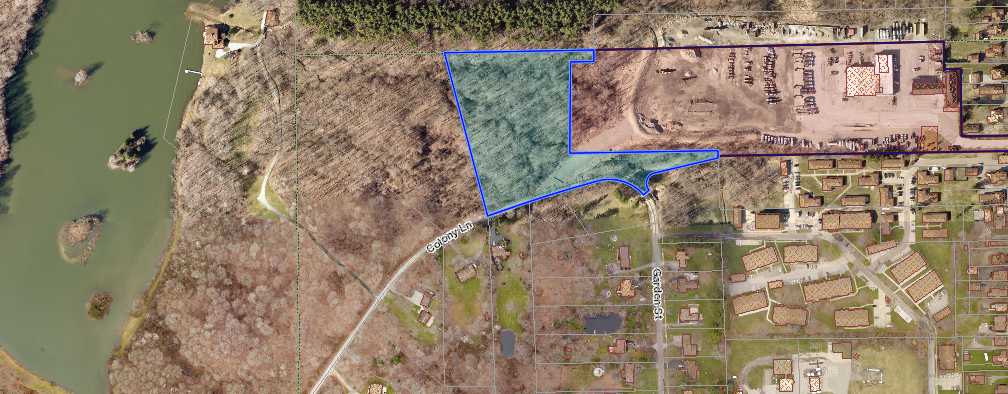
East Walden Properties LLC, a.k.a. Ronyak Bros. Paving, submitted the rezoning petition. Ronyak owns the asphalt and concrete facility on 12.74 acres at 14376 North Cheshire Street, which is described as a commercial property on the Geauga County Auditor’s Office website.
The company also owns the irregularly-shaped, residential-zoned parcel to the south and west of the yard with about 500 feet of frontage along the north side of Colony Lane.
The section of Colony in the village is paved and the section in Burton Township is gravel. Colony intersects Kinsman Road at a sharp angle on the township end.
Ronyak created a wide driveway across its smaller parcel from its yard for access to Colony Lane in 2016, but the village issued a cease and desist order and did not issue a driveway permit. The exit from Ronyak’s yard is blocked from traffic.
During the public hearing last Friday, Colony Lane resident Mike Lester cited safety as one of his concerns.
“There are a lot of children and dogs — people walk it every day. The road is a treasure in Burton,” he said. “I don’t understand where a place for an asphalt company would be on a road like that.”
Lester also said rain and snow run-off from the gravel driveway is a concern and the nature conservancy on the west side of the 5.5-acre parcel might suffer, as well.
Dave Ronyak, company CEO, said the driveway would benefit the company economically, citing the cost of diesel fuel, and reduce traffic problems on North Cheshire, which runs from Berkshire Schools’ campus in Burton Township to the village square.
“We have huge safety concerns, as well. It would eliminate hauling around the square,” he said, noting vehicle and pedestrian traffic around Burton Village Square is heavy, especially during special events.

“I’m trying to help the village,” he said.
Arthur Straniero, who owns property on Colony, said he is concerned about Ronyak piling up blacktop on the smaller acreage if it is zoned industrial.
“The road is not in good shape,” he said, noting the dust from the township end of Colony would be a problem for residents and he is opposed to Ronyak being able to store blacktop near the road.
Ken Moses, who lives at the intersection of Colony and Garden Street in the village, read a statement opposing the rezoning proposal, listing increased traffic and safety risks, noise pollution, air quality and health concerns, water pollution, decreased property values, quality of life and community impact, and the long-term environmental impact as immediate concerns.
“This is Colony Lane. It’s barely passable for two cars,” he said.
The pavement, which measures about 20 feet wide, has deep ditches on either side on the gravel end.
If heavy trucks travel the road from 6 a.m. to 10 p.m. — which is when residents can hear grinding, loading and dumping at the yard — Colony Lane would require significant public resources for maintenance, Moses said.
Pete McDonald, director of land stewardship at the Western Reserve Land Conservancy based in Moreland Hills, said the conservancy has about 300 acres west of the 5.5-acre parcel, including about 100 acres of category three wetlands.
The area has about 900 feet of forested streams and a 30-acre lake, he said, adding runoff from the Ronyak property could drain directly into the lake and degrade natural habitats in the area.
Dennis Ibold, attorney for Ronyak, said any development would be dependent on several government environmental agencies’ approvals.
“Essentially, you are not allowed to change where water runs off,” he said. “We have multiple agencies who get involved if property is developed. (Ronyak) would have to come up with a development plan … before they put a shovel in the ground.”
Other residents said their property values would decrease dramatically if the acreage across Colony Lane becomes industrial and the trucks hauling asphalt from the Ronyak yard are hard on the state and village roads.
“Their trucks damage and damage and damage these roads,” said village resident Ed Klingensmith, who asked if the village would benefit if the zoning of the 5.5 acre changed from residential to industrial.

Village Mayor Ruth Spanos, who sits on the planning commission, said land value affects tax revenue.
“I can’t predict tax revenue from an individual zoning change. A business within the community being more successful provides us with higher tax revenue,” she said, adding if the residential properties along Colony Lane see a value decrease, their property taxes could also decrease.
Joe Walkos, a Burton Township resident of Colony Lane, said there are seven homes that could be impacted ranging in value from $500,000 to $800,000 and there would be legal consequences if the village approves a zoning change.
“I built my house on a residential street,” he said, adding if the village allows the land to become industrial, he would “come after the village for damages.”
He also suggested there is legal precedent whereby the part of Colony Lane in the township could be disconnected from the part in the village, in which case, Ronyak’s trucks exiting from the driveway would have to go out Garden Street in the village.
Planning commission member Curt Johnson asked Dave Ronyak what he plans to do with the 5.5 acres other than use it as a back entrance to their yard.
“Currently, we have no plans to develop the five acres,” Dave Ronyak said.
Commission member Cory Brown, who also sits on village council, said he would like to see an alternative proposal that would be more palatable to residents.
Village legal counsel Todd Hicks said if the acreage is rezoned to industrial use, the owners are only limited by the M2 industrial regulations.
“Going forward, they (could) do anything industrial,” he said.
One alternative would be for Ronyak to seek a use variance for the driveway.
If the board of zoning appeals granted that variance, the property would remain residential, but trucks could use the driveway, Hicks said.
Spanos clarified the commission’s decision is only a recommendation to the village council, which would ultimately decide if it would rezone the 5.5 acres, following at least one public hearing on the matter.
Friday, the commission had the choice to recommend for the rezoning, recommend against the rezoning or table the petition, she said.
The commission voted against recommending the rezoning of the 5.5 acres from residential to industrial use.
After the meeting, Jerrod Ronyak, company president, said he was not surprised at the commission’s vote.


