


Chardon Superintendent Warns of Impact
Chardon Schools Superintendent Mike Hanlon and Treasurer Deb Armbruster appeared before Chardon City Council June 12 with grave concern about Ohio House Bill 335.
Chardon Schools Superintendent Mike Hanlon and Treasurer Deb Armbruster appeared before Chardon City Council June 12 with grave concern about Ohio House Bill 335.
HB 335 has recently been introduced in the state and is billed as property tax relief, Hanlon explained.
“It will have some serious implications for Chardon Schools, really all the school districts across the state, as well as other public entities like the city and other taxing authorities that rely on property taxes as a component of funding they receive to support the services in their particular areas,” he said.
The community has been supportive of Chardon Schools and in return, the district has attempted to be good stewards of the dollar and have stretched resources as far as possible, Hanlon said.
“(HB 335) captures some of the other tax reform legislation that is being proposed right now either through the budget bill or independently,” Hanlon said. “There are over a dozen pieces of property tax reform legislation that are making their way through the legislature at this time.”
Per the presentation, language in HB 335 includes language from House Bill 129, House Bill 186 and House Bill 309.
HB 335 removes the ability of schools, villages and cities to levy current inside millage, Hanlon explained.
“Essentially, it eliminates inside millage,” he said. “The bill as drafted would allow townships to keep their current inside millage as they have no other taxing authority.”
If approved, HB 335 would mean an annual reduction of $4.3 million in property tax revenue to the school district, Hanlon said.
To the city, it would be an annual reduction of $624,000, he added.

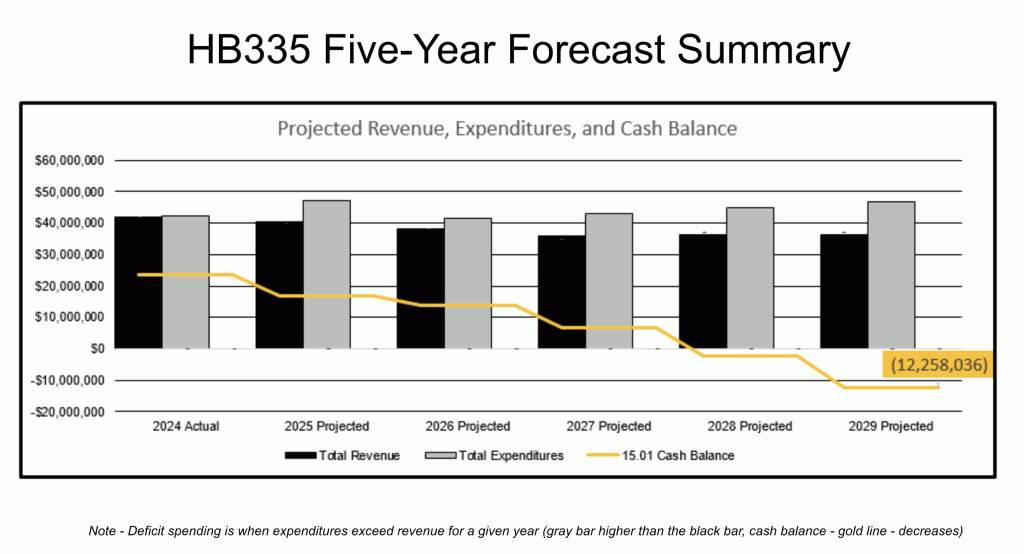
Armbruster compared the actual May 2025 financial forecast with a hypothetical one adjusted for HB 335.
She said 68% of the district’s revenue comes from property tax of some sort, 22% from the state and 10% from other revenue and noted 10% is high because of interest and is projected to come down.
Per her presentation, of the 68%, 61.73% is from real estate tax.
“Our property taxes are pretty flat. We have a very small increase in inside (millage),” she explained. “Because of House Bill 920, as property values go up, the tax rates come down, where you pay pretty much the same amount as you did before, except for that inside millage.”
In the simulation, total revenue drops by about 10%, Armbruster said, noting a 14% decrease in tax revenue.
“We would have to cut our expenses by 21.83% to balance our budget,” she said.
That would mean a cut of 20 teachers by 2028 and another hundred by 2029, she said, emphasizing that is an example and not an action the school would actually take.
“By way of background, I’ve been integrally working on school funding in the state of Ohio for eight years now as part of the Fair School Funding workgroup, regularly involved with legislators on school funding issues. I understand that property tax reform is something we need to take a look at,” Hanlon said. “But, what (HB) 335 does is essentially cuts out the main source of support for school districts without providing a suitable replacement or alternative for those other than saying, ‘You need to go find other sources of revenue.’”
Voters would have to approve an income tax to make up the revenue, which is not guaranteed, he said.
Chardon Schools is not at the 20-mill floor, meaning the millage rates for existing tax levies are reduced to generate the same revenue they did before the 2023 reappraisal, Hanlon said.
“It’s not a matter of, my property values went up by 26% so my taxes went up by 26%,” he said, adding the only inflationary increase had been to the 4.5 mills of inside millage.
The school has since eliminated all fees to students, returning approximately $1.3 million to taxpayers, he said.
As the state budget bill is slated to enter conference committee, there is concern a bill like this may get rolled into it as a method to resolve differences between the house and Ohio Senate, Hanlon noted.
The Chardon Schools Board of Education will be considering a resolution June 23 opposing the bill, Hanlon said, asking the city to consider doing the same.
“As I sit here today, without more data and information on how to replace those funds, I can’t support this measure in any way, shape or form,” Chardon Mayor Chris Grau said.
As the city has multiple special meetings coming up, they may be able to pass a resolution quickly, he noted.
School board member Todd Albright encouraged people to contact Gov. Mike DeWine and ask him to veto bills like these.
“Education is like a huge ship, it’s hard to turn and once it starts to turn, it’s hard to stop,” he said. “The problems are going to be collateral and really, frankly, possibly generational in the direction things are going.”


