County Seeks Court to Dismiss Grendell Lawsuit
Geauga County officials are asking the Eleventh District Court of Appeals to dismiss Tim Grendell’s petition asking the county to pay his legal fees, according to court filings.
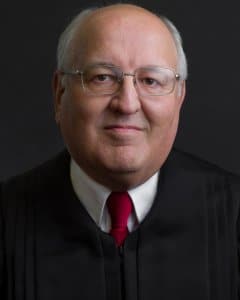
Geauga County officials are asking the Eleventh District Court of Appeals to dismiss Tim Grendell’s petition asking the county to pay his legal fees, according to court filings.
In September, the Ohio Board of Professional Conduct recommended the Geauga County juvenile/probate court judge be suspended from the practice of law for 18 months due to alleged misconduct in a juvenile case involving two brothers. Grendell appealed, with oral arguments taking place in February.
The matter is currently in the hands of the Ohio Supreme Court.
Grendell came before Geauga County Commissioners in November to request they appropriate $300,000 to pay fees related to the disciplinary case. He also asked them to appoint law firm Roetzel & Andress to assist in his appeal at a rate not to exceed $300 per hour.
In January, commissioners denied those requests in a split vote, with Commissioner Ralph Spidalieri abstaining.
In July, Grendell filed a petition asking the court to order commissioners to pay his legal fees and appoint outside counsel.
“Timothy Grendell’s mandamus action arises out of his effort to compel the respondents to authorize payment of his legal fees for defending his personal law license in a disciplinary proceeding after he had already chosen his counsel and incurred the vast majority of fees without prior approval under the governing statutes,” said Frank Scialdone, counsel for commissioners and Geauga County Prosecutor Jim Flaiz, in the motion to dismiss.
There are two primary issues before the court: That the Ohio Supreme Court has held a judge is not entitled to have attorney fees paid when the judge did not follow the process to procure counsel outlined in the Ohio Revised Code, and that disciplinary action against a judge does not meet the mandatory duty to provide private counsel, Scialdone said.
Grendell did not ask commissioners nor Flaiz for counsel in his disciplinary proceedings with the OBPC until after retaining counsel of his choice, incurring fees and after the proceedings had concluded, Scialdone said.
The Ohio Supreme Court has held that a judge is not entitled to have attorney fees paid when that judge did not follow the process to procure counsel outlined in the ORC, he said.
Grendell did not follow the statutory process and commissioners could not review the judge’s choice of counsel, evaluate attorney fee rates or negotiate a discount, as the fees had already occurred. And Grendell does not have a clear legal right to appoint counsel, Scialdone said.
“A disciplinary action against a judge is not ‘public business coming before the county officer,’ and a judge defending his law license is not an ‘interest in his official capacity’ under ORC 305.14(A),” Scialdone said, calling Grendell’s petition “meritless.”

In July, Jay Crook, Grendell’s attorney, filed a petition stating, among other claims, that commissioners and Flaiz paid the legal fees of 13 individuals who were to testify as witnesses against Grendell.
Scialdone pushed back on that argument in his petition.
Whether those individuals were provided counsel is irrelevant to Grendell’s request, he said.
The disciplinary counsel had asked those officials to testify. They were not the subject of the hearing, as Grendell was, Scialdone said.
Those officials also requested counsel during the disciplinary hearings and before expenses could be incurred, unlike Grendell, he added.
Grendell’s petition makes reference to the Equal Protection Clause of the 14th Amendment, saying it “prohibits discrimination by government which either burdens a fundamental right, targets a suspect class or intentionally treats one differently than others similarly situated without any rational basis for the difference.”
Grendell’s equal protection rights were not violated, Scialdone said, calling it “another effort to divert attention from the primary issues.”
“Grendell repeatedly argues that the disciplinary counsel’s witnesses who were county employees and two former county employees should not have been granted counsel upon their request. Unlike … Grendell, who is accused of serious ethical violations that threaten his personal law license, these witnesses were being called to testify about the factual background related to the asserted ethical violations against (Grendell,)” he said.
None of Grendell’s witnesses requested legal counsel, he added.
If Grendell truly believes there was an equal protection violation, he can take action “under Section 1983 to raise constitutional claims,” Scialdone said.
Grendell has not established a clear legal right or duty to compel the county to pay his legal fees in this case, Scialdone concluded, adding the method Grendell is seeking, mandamus, is only issued with great caution and with clear and convincing evidence.
This is not a burden Grendell can meet, he said.
The judge’s request relates to an investigation against him for ethical violations in a profession held to higher standards of behavior than others, Scialdone said, adding the punishments Grendell faces do not have a direct impact on the public — rather, they impact his license and practice.
“Ultimately, this is a private matter where … Grendell is seeking public funding to defend his law license for ethical issues resulting from his professional conduct,” he said. “It is his own personal law license that is in jeopardy and his conduct in relation to his profession is in question.”
Despite commissioners rebuking the arguments, Grendell doubled down on his points in a follow-up interview Oct. 3.
One of his counts was dismissed following significant legal defense expenses that were necessarily incurred, he said, adding the other two charges are doubtful in light of an OSC proposed rule regarding free speech protections for judges.
“The commissioners’ motion flies in the face of Ohio law, is a waste of taxpayers’ money and is discriminatory and in violation of my Constitutional rights,” he said. “The commissioners paid for an attorney for all of the witnesses who testified against me, including some who were not even county employees — and none of the county employees who testified on my behalf — while refusing to provide for my legal defense, to which I was entitled under Ohio law,” he said.