


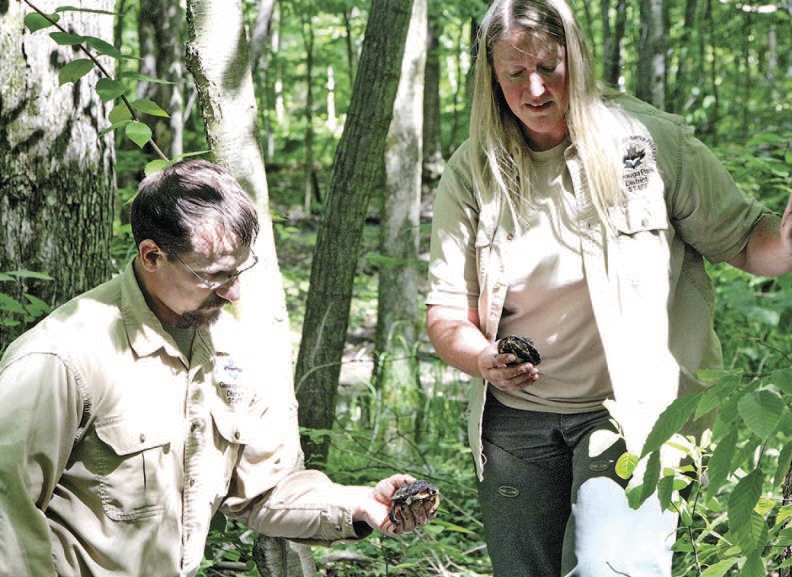
Geauga Park District has the feather in the cap of being the very first one with these guys. Paul Pira
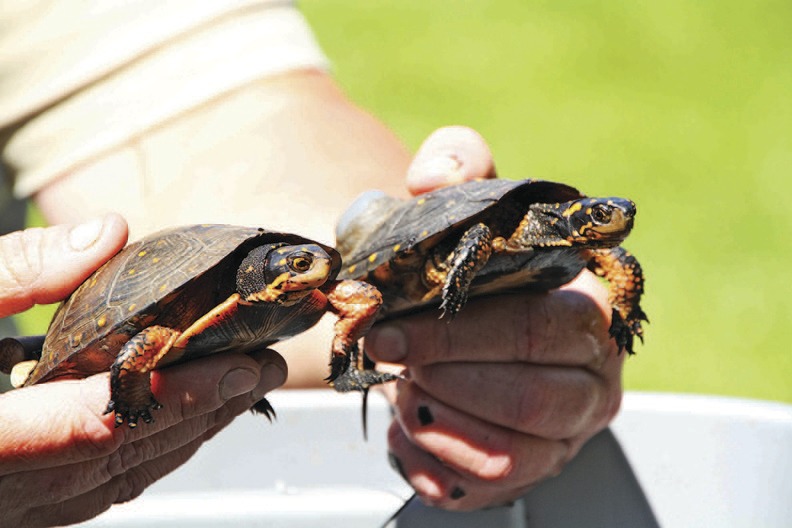
Every spring, Geauga Park District research assistant Tami Gingrich goes out into the wetlands of one of the county parks in search of a little reptile, the spotted turtle.
If she finds a female, she attaches a transmitter to its carapace, or top shell.
“That way, when it comes time for egg laying, I can go out and find them and we can take them to the zoo and have them checked (X-rayed) for eggs,” Gingrich said
This spring, not only did she find a 15-year-old male turtle that had eluded her for years, she and park district biologist Paul Pira released two female hatchlings into the wild.
The June 2 event was a milestone for the park district. It was the first repatriation of spotted turtles since the park district initiated its reintroduction program four years ago.
“It was the very first release of any captive-bred animals,” Pira said. “Geauga Park District has the feather in the cap of being the very first one with these guys.”
The spotted turtle is protected in the state of Ohio. Populations of the small — less than six inches — black turtle with distinctive yellow spots on its carapace have declined greatly throughout Ohio as people continue to destroy its natural habitat by altering wetlands.
Also, because these handsome turtles are so rare, they are “hot commodities” on black market for endangered species, Pira said, often fetching $300 to $400 per turtle.
Fortunately, Geauga County has a spotted turtle population in one of its parks and through the efforts of Pira, a reintroduction program was initiated in 2011 to save the threatened turtle.
“You basically capture wild adult female turtles and you induce them and extract the eggs, and raise the eggs in captivity,” he explained.
Pira recounted how he had visited the Cleveland Metroparks Zoo several years earlier in connection with the park district’s successful brook trout reintroduction program.
“I had mentioned to the zoo people if they had ever considered doing something with these special turtles that we have,” said Pira.
After a year of pestering them, the zoo finally agreed.
Today, Summit Metroparks, Cleveland Museum of Natural History, Cleveland Aquarium, Cleveland Metro-parks and Cleveland Metroparks Zoo are other organizations that have their own spotted turtle reintroduction program.
“They’re basically endangered in Ohio and we’re lucky to have this population here,” Pira said, estimating the population has fluctuated between 12 and 14 turtles over the past several years.
“It’s one of only a handful of populations around this area,”?he said.
Gingrich added, “Most of the population has disappeared in the last few years, some of the older ones that we originally caught when we purchased the property.”
Cars have run over some of them in the parking lot, they said.
The two hatchings came from eggs that were collected in 2012 from females within the park district population.
In the wild, spotted turtle females lay very few eggs, Gingrich said.
“That’s what makes them so susceptible to their population diving down,” she explained. “Three is the most we’ve ever gotten out of an adult.”
They also are victims of predators, especially raccoons.
One of the fascinating things about the reproductive biology of turtles, Gingrich said, is the sex is dependent on the temperature at which the eggs develop in the wild or are incubated in captivity.
“We put in an order for females with the zoo when they extracted the eggs,” she said. “We felt having a few more females here right off the bat would be more beneficial.”
Incubated and raised by the zoo until 3 years of age in a biosecure facility protected from pathogens — a process called “headstarting” — each hatchling has a Passive Integrated Transponder (PIT) tag implanted under the skin that allows park district staff to identify each turtle based on a unique number.
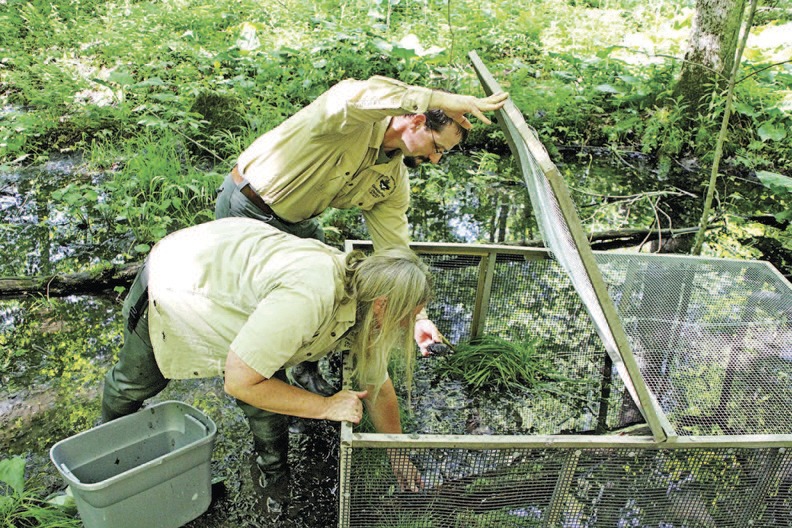
The hatchlings were released into a cage, where they will spend about three weeks adjusting to their environment.
“We want them to acclimate to the chemicals in the water here and the surrounding habitat,” Gingrich said.
“When they’re super small, they’re like candy for raccoons,” Pira added, explaining predation of eggs while in the nest is a big problem.
“The point of the whole program is to bolster the population here with naturally occurring genetics and the same material that’s here,” he said.
The cage is stocked with leaves and other microorganisms found in vernal pools that they will eat, added Gingrich.
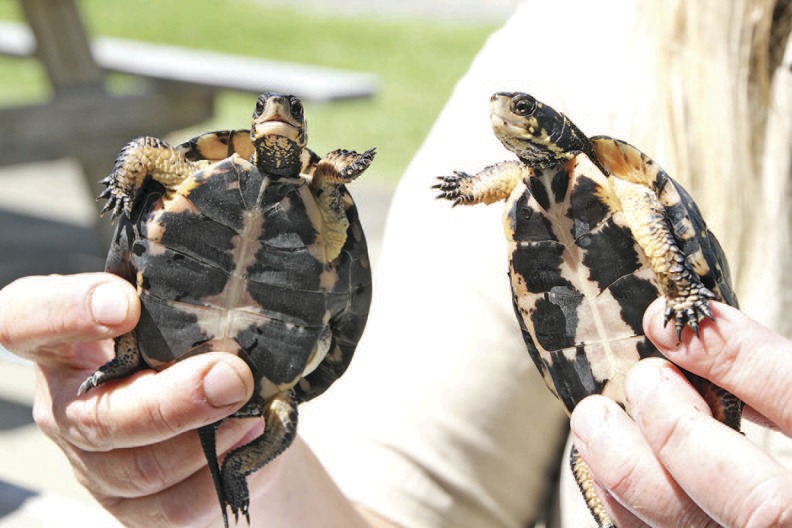
“Over the years, I’ve caught a number of turtles here and this is how I keep track of them,” Gingrich said, explaining each spotted turtle has its own unique spot pattern on its carapace and plastron, or bottom shell.
She keeps photographs of each turtle in a binder to make identification easy.
Once hatchlings are removed from the protective cage, transmitters will be attached to their carapace so they can be tracked.
“We can keep track of what kind of territories they have, how far they move, where they’re going, where they’re spending a lot of their time as babies compared to where the adults spend their time,” Gingrich said. “This is going to be really kind of neat because this is information no one really knows.”


