


People ask me how long it took to build the airplane, and a quick answer is it took a mortgage, two kids, two university educations, five surgeries and six job changes. George Stage
At first glance, you might be forgiven for not thinking of George Stage as a dreamer.
Quiet and thoughtful, the longtime Kirtland resident looks like the electrical engineer he is — practical, with feet planted firmly on the ground.
Then you glimpse the airplane he built by hand and you realize this is no ordinary man.
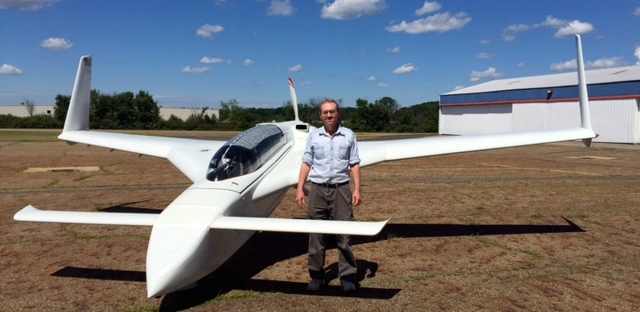
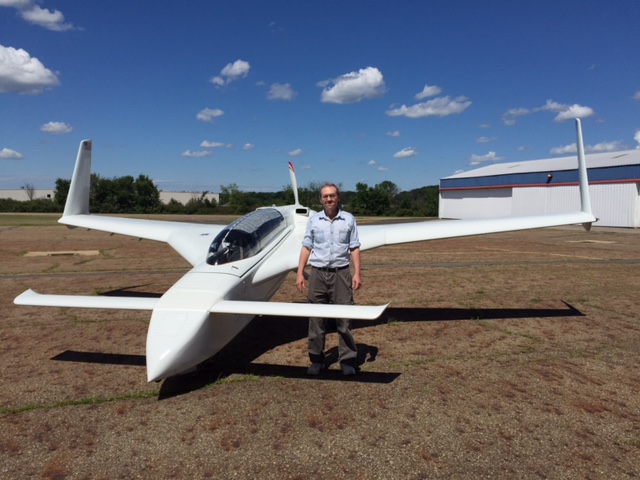
A pilot since the late 1970s, Stage spent more than two decades painstakingly building an airplane from scratch. Long, sleek and stark white, his experimental Rutan Long-EZ aircraft looks like something out of this world.
“I tend not to quit projects,” he said modestly, describing the 25 years’ worth of work he has invested into his experimental plane.
The word “experimental” is something of a misnomer. The term can apply to unproven, developmental aerospace technologies as well as aircraft flown with an experimental category “airworthiness certificate” issued by the Federal Aviation Administration. The latter category encompasses home-built planes like the Rutan Long-EZ Stage constructed.
Made for the homebuilt aircraft market, the Long-EZ is the successor plane to the original VariEze, a high-performance canard aircraft. As its name suggests, the Long-EZ is longer and bigger than its predecessor.
“The designer, Burt Rutan, named it that because it’s supposedly very easy to build,” Stage chuckled from a lawn chair perched in the doorway of the Geauga County Airport hangar that houses his plane.
But building it was far from easy. Unlike “kit” planes, which come with all the thousands of parts needed to build a plane, the Long-EZ is sold as a set of plans — and nothing else.
“It’s a set of instructions and diagrams,” Stage explained, gesturing to the plane. “You not only have to make all the parts yourself, you have to make all the jigs yourself.”
The jigs serve as a model for the various parts that go into the aircraft’s construction. Because every experimental plane is slightly different, each experimental pilot must create his own jigs out of particle board. From there, the pilot literally molds and shapes each part of the airplane.
“You buy gallons of epoxy, yards of fiberglass cloth and foam,” Stage said. When he started out, he assembled all the raw materials in his basement and got to work.
For each piece, Stage shaped the part out of foam, then overlaid it with fiberglass, cloth and epoxy. The result is an extremely strong plane that can withstand G-forces higher than a Cessna single-engine piston.
Stage’s two sons, who were in diapers when he started building the plane, were young men by the time he finished it.
“People ask me how long it took to build the airplane,” Stage said. “And a quick answer is it took a mortgage, two kids, two university educations, five surgeries and six job changes. The reason I say that is so much intervenes when you’re trying to build something like this. It’s a massive project.”
Looking at the glossy white aircraft, it’s hard to imagine it was constructed in Stage’s basement, let alone fabricated piece by piece, part by part, using nothing more than a set of instructions.
“You’ve got to do everything,” Stage said, describing the building process. “I designed my own electrical system. That meant I drew up my own schematics. I built a big harness jig on a table to be able to do all the wires to go from point to point, and then I picked up that whole jig and snapped it into the airplane. And there are a lot of small parts that aren’t detailed in the plans. There’s a lot to think about.”
Stage got the idea to build his own plane while attending an airshow with a friend, where an unusual-looking airplane was flying a pattern across the sky.
“It was a Rutan VariEze, the smaller version of that one,” Stage said, jerking a thumb toward the plane behind him. As he watched it at the airshow that day, an idea began to take shape.
“My friend kept saying, ‘You oughta build one of those!’ At first I thought, no way, who knows how safe those things are,” Stage laughed, remembering the day he laid eyes on the striking airplane.
Despite his initial misgivings, however, he eventually tracked down another pilot who had built his own Rutan Long-EZ aircraft. As Stage walked around the plane, his doubt turned to longing.
“As soon as (the other pilot) flipped on the switch and the panel came alive, there was that instant when I said, ‘I gotta have one of these,'”?he recalled.
The plane’s space age look is a stark contrast to the rolling hills and sleepy landscape of Middlefield’s Amish Country, where small planes fly in and out of the Geauga County Airport.
With its unassuming collection of small hangars and stretch of runway bordered by dandelions and wildflowers, the little airport is an ideal, if surprising, setting for the elegant plane. The airport also serves as the base for approximately 70 members of Chapter 5 of the Experimental Aircraft Association — a global organization of pilots who build unique aircrafts from kits and plans.
Stage moved the finished Long-EZ to the airport in 2010, on a flatbed trailer in the middle of winter. A photo taken on the day of the move shows the futuristic-looking plane passing a black, two-wheeled Amish buggy on its journey from Kirtland to Middlefield.
The airplane reaches speeds of 200 miles per hour, and some Long-EZ models have been known to reach altitudes of 35,000 feet. Although Long-EZ plans are no longer sold, the plane is a favorite among homebuilt aircraft pilots, who are drawn to it despite the dedication, skill and effort required to build it.
“On average, it takes most people between eight to 10 years to build one,” Stage said. “I knew of one guy who quit his job and built one in two years by working on it every day.”
Two FAA inspectors looked over the airplane and signed off before Stage was allowed to fly it. In the beginning, pilots of experimental aircraft are restricted to flying in a small territory, during which they’re tasked with performing in-flight tests to ensure their aircraft is safe.
Nose dipping gracefully toward the ground, the airplane resembles a drone with its elegant wings and rear propeller.
“When I first got it to the airport, I’d come out here in the mornings before work and take it up for a half hour or hour. There were people who called (Geauga County Airport Manager) Patty Fulop wanting to know why they were flying drones out of the airport.”
Once people described what they saw, it was clear they were talking about Stage’s plane. Even in the hangar, it’s an eye-catching sight.
These days, the plane makes short work of trips that would take hours by car.
“A week ago, my wife and I took it down to Columbus for a trip to the zoo,” Stage said. “We tied the airplane down about four miles from the zoo, spent the day there and flew back the next morning. It’s an hour trip for me from here to Columbus.”
When asked if he was nervous the first time he took the plane into the sky, Stage smiled and shook his head.
“By that time, I’d been all over this airplane,”?he said. “I was certain it was going to fly just fine.”


