


When Doretta Scheffield left home the morning of Dec. 27, 2011, she claims her husband, Randy Scheffield, was asleep in his bed . . .
When Doretta Scheffield left home the morning of Dec. 27, 2011, she claims her husband, Randy Scheffield, was asleep in his bed in their Newbury Township home.
Gina Battaglia claims she was nowhere near the Scheffield’s Ravenna Road home between 7:30-9:30 a.m., the two-hour window during which prosecutors allege Randy was shot in the back of his head and murdered. Instead, she told investigators she might have been with a girlfriend at the time.
Doretta maintains she left her home around 9:30 a.m. that morning and did not return until 4 p.m. She spent at least four hours of her day with Gina — the mother of her grandchild — getting her hair done. Battaglia shares a home with Doretta’s son, David “Tigg” Rowles, in Newbury.
In September, a Geauga County jury unanimously convicted Doretta of aggravated murder for killing her husband and, in October, she was sentenced to 25 years to life.
Prosecutors have now turned their attention to Battaglia, who in March was charged, along with Rowles, as a co-conspirator in Randy’s murder.
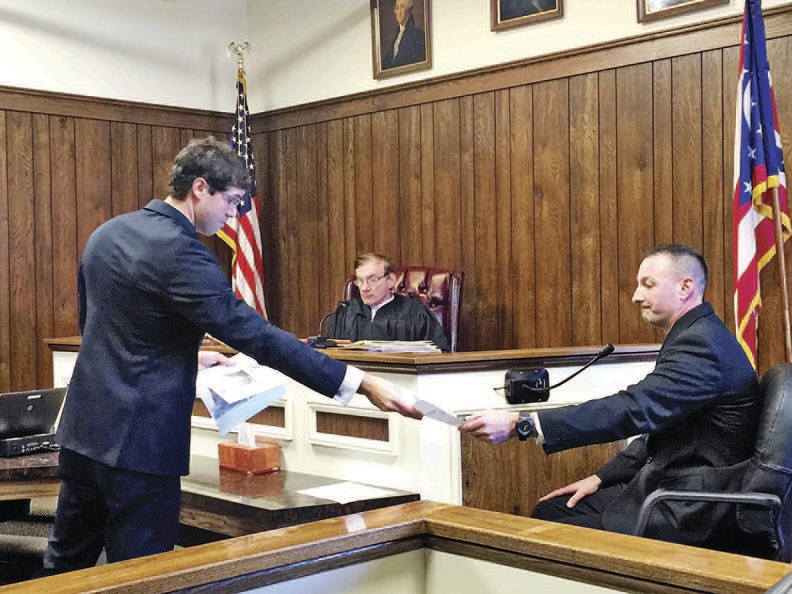
On Dec. 16, prosecutors presented evidence against Battaglia as a co-conspirator in hopes Geauga County Common Pleas Court Judge David Fuhry will allow it to be introduced at her January trial. At Doretta’s trial, Fuhry precluded prosecutors from arguing the existence of a conspiracy involving Doretta, Battaglia and Rowles.
The day before Doretta’s trial was to begin, however, a Geauga County Sheriff’s Office detective interviewed a jailhouse informant, Shannon Badalamenti, who prosecutors contend provided independent proof that Doretta and Battaglia conspired to kill Randy and cover up his death.
That evidence did not exist at time of Fuhry’s ruling in Doretta’s case and prosecutors need to be able to introduce Badalamenti’s information at Battaglia’s trial in order to argue she was a co-conspirator in Randy’s death.
While other evidence pointed to the existence of a conspiracy, Geauga County Assistant Prosecutor Chris Joyce told Fuhry last week its existence was confirmed by statements Doretta made to Badalamenti.
“Her (Badalamenti) truthfulness, I think, is evidenced by the fact that she was aware of details of this case that certainly weren’t released to the public,” Joyce said. “That type of knowledge suggests that she has a source that’s giving her the information. The only explainable source is Doretta Scheffield herself.”
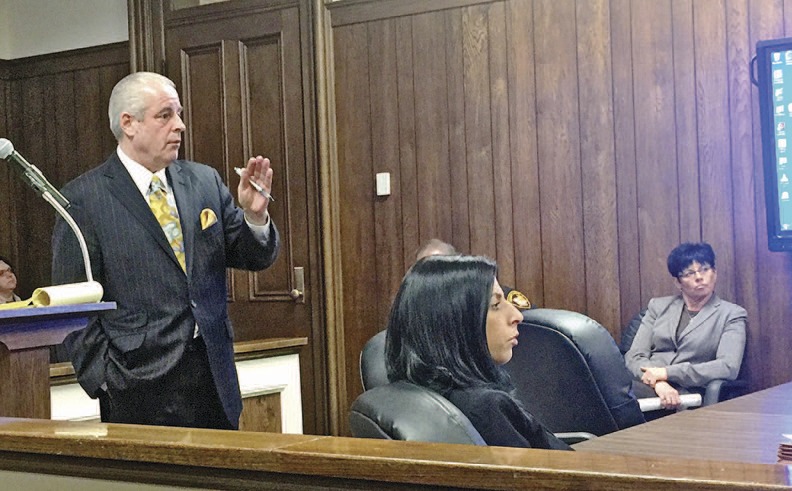
But defense attorney David Grant argued any statements Doretta made to Badalamenti — almost four years after Randy’s death — simply described events that occurred in 2011 and were not made to evade prosecution for a conspiracy that had long been completed.
He added any statements Doretta made to Badalamenti concerning Battaglia’s involvement lacked trustworthiness and should not be considered to establish any conspiracy.
Detective Tom Lombardo testified at the Dec. 16 hearing that he interviewed Badalamenti on Sept. 15. Joyce played a nearly 42-minute audio-recording of a portion of that interview during which Badalamenti said Doretta told her she wondered whether they could blame Randy’s murder on one of his friends. Badalamenti also said Doretta asked her if she knew anyone who could kill the friend and wanted his death to be painful.
Doretta also suggested a former employee could have killed Randy.
“That’s the thing, she wasn’t like, ‘I’m going to blame them.’ She’s like trying to come up with ways that she could convince a jury that someone else would have did it,” Badalamenti told Lombardo, adding Doretta also said she played the role of a grieving wife well when detectives interviewed her in 2011.
Badalamenti said Doretta told her she hated guns, but when she realized Doretta shot guns with her new boyfriend, Doretta told Badalamenti she meant handguns.
“So, that’s what the attorney is going to pull, I guess,” Badalamenti told the detective, adding Doretta also told her the gun would never be found.
Doretta told Badalamenti she was mad at Battaglia because a cell tower traced her cell phone back to the Scheffield home, and she had made ever effort not to leave any trails.
“It was definitely about the money,” Badalamenti said, although Doretta did mention another man being in the picture.
According to Badalamenti, Doretta also would get “real paranoid” and asked if Battaglia was talking.
Asked whether Doretta ever told her whose idea it was to kill Randy, Badalamenti said Doretta confessed to being the mastermind.
Grant argued Doretta simply was describing to Badalamenti events that had occurred almost four years ago, in 2011, and any statements she made were not in furtherance of any conspiracy.
Absent Badalamenti’s statement, Fuhry called the rest of the prosecution’s evidence of a conspiracy “ambiguous.” That evidence includes data from a cell phone tower that places Battaglia in or near the Scheffield home that fateful morning. It also includes videocamera footage taken from the BP gas station at the corner of state routes 87 and 44 that shows a vehicle matching Battaglia’s traveling through the intersection around 7:30 a.m. and headed in the direction of the Scheffield home.
“That information is in direct contradiction to her own statement that she never left her home that morning,” Joyce told Fuhry, adding when confronted with the data, Battaglia could not offer a plausible explanation.
Instead, Joyce said Battaglia offered a lie, suggesting she was with a friend, Jessica Chaky.
But sheriff’s office Det. Juanita Vetter interviewed Chaky — three and a half years after Randy’s murder — who denied being with Battaglia at the time.
Chaky also told Vetter that, prior to Randy’s death, Battaglia had made troubling remarks to her about Randy and how he treated Rowles — who worked for Randy’s landscaping business — and how things would be better off without him.
A plan was beginning to form to “off” Randy, Joyce told Fuhry, arguing Badalamenti’s statement confirmed that plan.
Grant countered Battaglia’s remarks were subject to many different interpretations other than she wanted him dead.
Joyce also pointed out the “artfully constructed alibi” that Doretta and Battaglia created and frequently repeated.
The largest portion of that alibi placed Battaglia and Doretta together for four hours, enabling them to back up each other’s story. Within hours of their visit, there were three phone calls between them.
“There were also a series of text messages sent by (Battaglia) that demonstrated that she had knowledge of the cause of Randy’s death even before police released that information to the family,” Joyce said. “The text message indicated she was aware there was a gun and she knew police were either looking for it or were going to be looking for it.”
Prosecutors contend another message from Battaglia showed she was spreading misinformation by suggesting Randy died of an aneurysm, which conflicted with her earlier message regarding the existence of a gun.
“I would note and argue there is a lack of text messages expressing confusion as to why police would be overturning her house when she believed Mr. Scheffield had died of natural causes,” added Joyce.
Grant pointed out the absence of any text messages, emails or recorded telephone calls between Battaglia and Doretta discussing any sort of alibi or homicide, or witnesses who overheard any conversation between the two of them regarding those issues.
He also argued the cell tower data was not a “reliable indicator” of where Battaglia was the morning of Dec. 27. As for the text messages, Grant said there was conversation about the existence of a gun early on, so the fact Battaglia mentioned a gun in her text did not raise “red flags.”
In addition, there was evidence Battaglia turned over potentially incriminating evidence against Doretta and complained to police about her, Grant added.
“These are hardly the actions of someone who is conspiring with another individual to conceal a homicide,” he said.
Battaglia is scheduled to go to trial on Jan. 12.


