


The programs and planetarium here are wonderful, thanks in part to Chris, Ohio's own Carl Sagan. Richard BurnsChris has evoked excitement for astronomy in my children that I am forever grateful for. Meredith Gajda
Saving earth from asteroids might be an exciting science fiction read or latest Hollywood blockbuster movie draw, but astronomy-enthusiasts of all ages gathered inside the Robert McCullough Science Center last Friday night to hear how they could become real asteroid hunters.
“Anybody with an Internet connection can contribute to the effort, thanks to an initiative called Asteroid Zoo,” said Geauga Park District Naturalist Chris Mentrek, program presenter. “It’s a Citizen Science project wherein volunteers search images taken by the Catalina Sky Survey from an observatory in Arizona. By comparing multiple images, folks can spot an object that moves relative to the distant stars and it might turn out to be an undiscovered asteroid.”
GPD’s free event kicked off one of two March “Searching for Killer Asteroids” programs at Observatory Park in Montville Township.
“We wanted to highlight how astronomers search for, track and monitor asteroids, including those that might impact the Earth,” Mentrek said. “It’s trickier than most people imagine.”
He added, “‘Killer asteroids'” aren’t something I’d encourage people to panic about, but I think it’s good for every earthling to have a healthy curiosity about how humans are keeping an eye out for potentially hazardous asteroids.”
An asteroid is a small rocky body orbiting the sun. Many range from around 600 miles in diameter to dust particles, and are especially found between the orbits of Mars and Jupiter, some having more eccentric orbits, and a few passing close to Earth or entering the atmosphere as meteors.
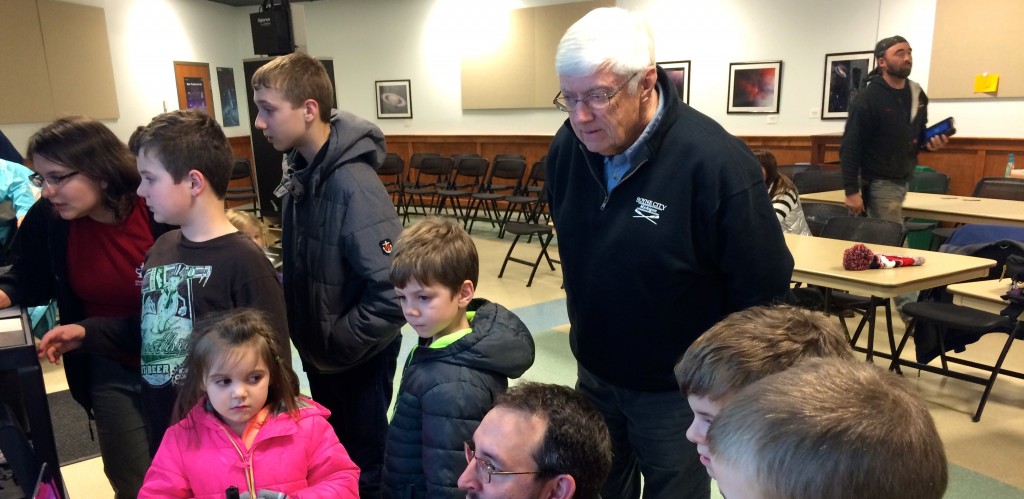
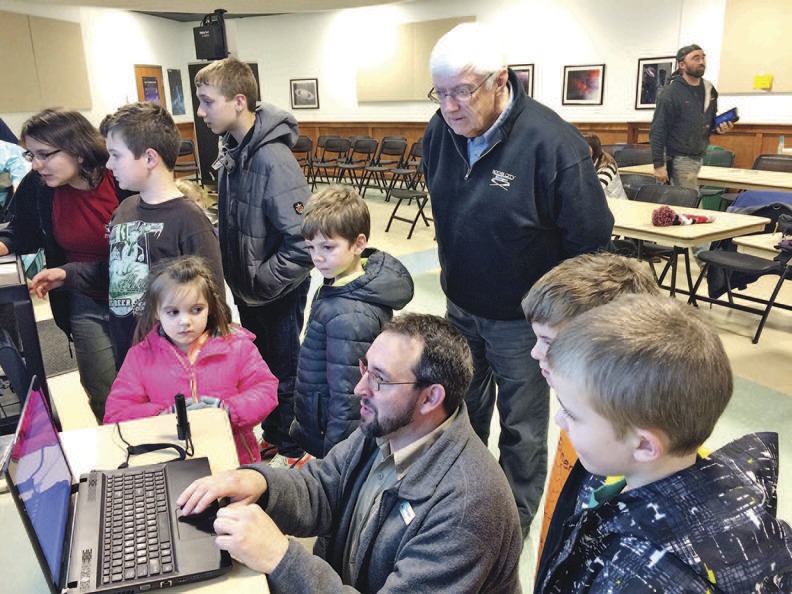
Program-goers trickled inside on the brisk evening, filling seats behind a scattering of laptops as Mentrek greeted all with his trademark smile.
“My husband (Steve) and I feel it is important to encourage scientific curiosity in our children,” said Meredith Gajda, of Chardon, who was joined by her children, Lucas, Bryce and Quinn. “Our oldest son is fascinated with space and recently saw Neil DeGrasse Tyson downtown.”
Gajda said she felt incredibly fortunate to have Observatory Park so close to home.
“We have been to several of the programs Chris Mentrek has presented and love the enthusiasm he brings to science,” she added. “We feel as though we have our own local Neil DeGrasse Tyson making space exploration both entertaining and relevant to the community.”
Mentrek said the possibility of the Earth being hit by a devastating meteorite used to be something that people didn’t dare to imagine and there was a lot of resistance for decades.
“However, since the spectacle of the meteor explosion over Chelyabinsk, Russia, in February of 2013, a lot of people have taken the issue more seriously,” he said.
“Closer to home, there’s even been a growing collection of evidence in recent years that a large meteorite impacted southwestern Ohio millions of years ago,” Mentrek added.
Chelyabinsk’s asteroid is the largest known natural object to have entered Earth’s atmosphere since 1908, leaving more than 1,000 people injured.
“We really don’t know much about asteroids, about where they are,” Mentrek said. “We are really good at studying glowing things in the sky. We are great at studying stars. We are experts on galaxies. But things that don’t shine like asteroids we know very little about them, and so we are regularly getting caught by surprise by asteroids that can do quite a bit of damage to our planet.
“This made everyone kind of wake up and start paying a little more attention with how are we tracking these asteroids,” he added. “How are we going to be looking for asteroids that are coming dangerously close to Earth?”
Mentrek shared a brief video and explained how to navigate Asteroid Zoo and shared images from Catalina Sky Survey perched on Mt. Bigelow in the Catalina Mountains, just north of Tucson, Ariz.
“So that’s what you guys, for the sake of humanity, will be doing,” he said, flickering between different telescope images on screen. “Let’s look for some asteroids. You guys will be officially called asteroid hunters.”
Gajda said her family learned there is still a great deal that is unknown about asteroids.
“Unlike stars, planets and meteors, which are illuminated in the night sky, asteroids are only illuminated by the sun,” she said. “This makes them difficult to see and track.”
As the night sky grew darker outside, Chagrin Valley Astronomical Society members gathered with their telescopes.
Following the presentation, Mentrek set up a telescope in the plaza for program-goers, some seeing Jupiter and three of its moons.
“I love astronomy and the job Chris does at the observatory,” Richard Burns, of Chardon, said. “I tremendously enjoyed it. Being able to use visitor’s telescopes after the talk is great with Chris helping everybody. The programs and planetarium here are wonderful, thanks in part to Chris, Ohio’s own Carl Sagan.”
Added Gajda, “I am a firm believer that active learning is best achieved through experiences that form memories. Chris’s excitement in the setting of an exceptional park makes for a wonderful learning experience. Chris has evoked excitement for astronomy in my children that I am forever grateful for.”
The next “Searching for Killer Asteroids” program is set for March 25, from 78 p.m. Program details can be found at www.geaugaparkdistrict.org.


