Sixth-graders in Mrs. Robinson's science classes are off to a colorful start to the school year. They recently conducted a "Taste the…
Taste The Rainbow Experiment
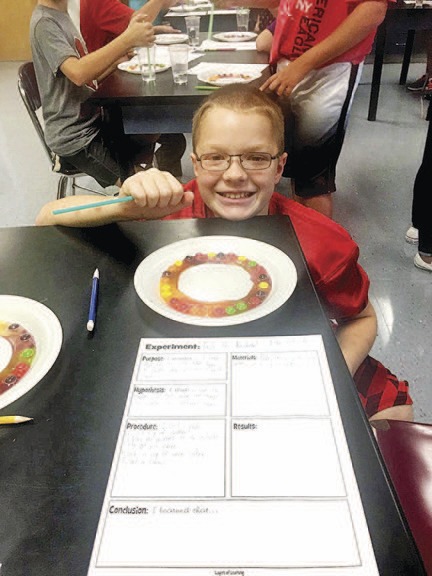
Sixth-graders in Mrs. Robinson’s science classes are off to a colorful start to the school year. They recently conducted a “Taste the Rainbow” experiment as a way to learn about the steps of scientific method. In order to get students thinking scientifically, Mrs. Robinson asked the questions: “I wonder,” “I think” and “I learned that.” The hypothesis is the answer you think you’ll find, the prediction is your specific belief or wonderment about the scientific idea, the experiment is the tool that you invent to answer the question, and the conclusion is the answer that the experiment gives.
Given all that, students used warm water to submerge Skittles that were placed on a plate. The water dissolved the outer coating of the Skittles and created a rainbow effect on the plate. Every student had a different pattern, the amount of water used changed the outcome, and temperature changed the rate in which the Skittles dissolved.
Needless to say, the science lab was buzzing with excitement over these discoveries. Students loved that this was one experiment they were allowed to eat.
Cooperative Learning
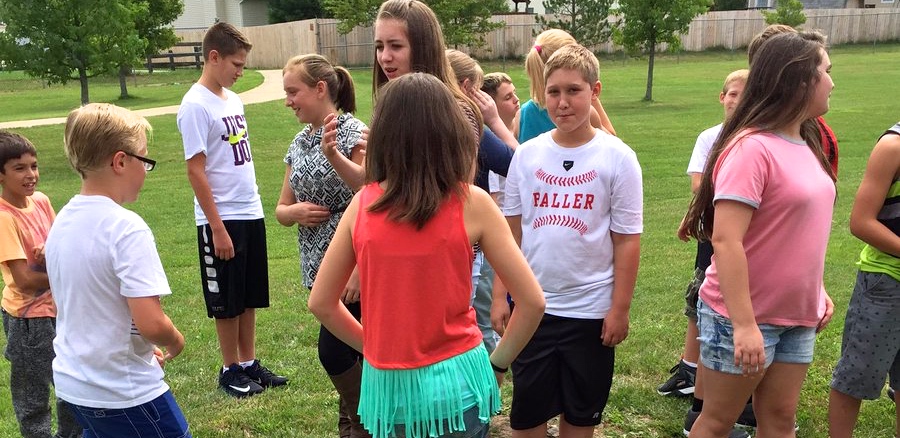
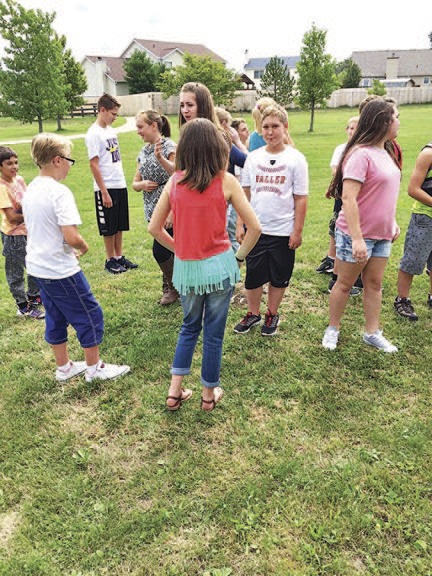
Students in Mr. Sherman’s classes are getting to know each other using the inside-outside circle cooperative learning strategy. While it sounds very technical, it’s actually a very casual and relaxed way for students to introduce themselves and work on developing those critical communication skills.
Students formed two concentric circles and exchanged information with a partner until a signal was given for the outer circle to move – this gave each student a new peer to talk to. The students learned much about each other from what they did over the summer to what color best describes them.
Mr. Sherman says, “It’s a great discussion technique that gets students up and moving, gives students the opportunity to respond to questions and/or discuss information with a variety of peers in a structured manner and provides a way to get students who normally would not talk to interact with others.”