


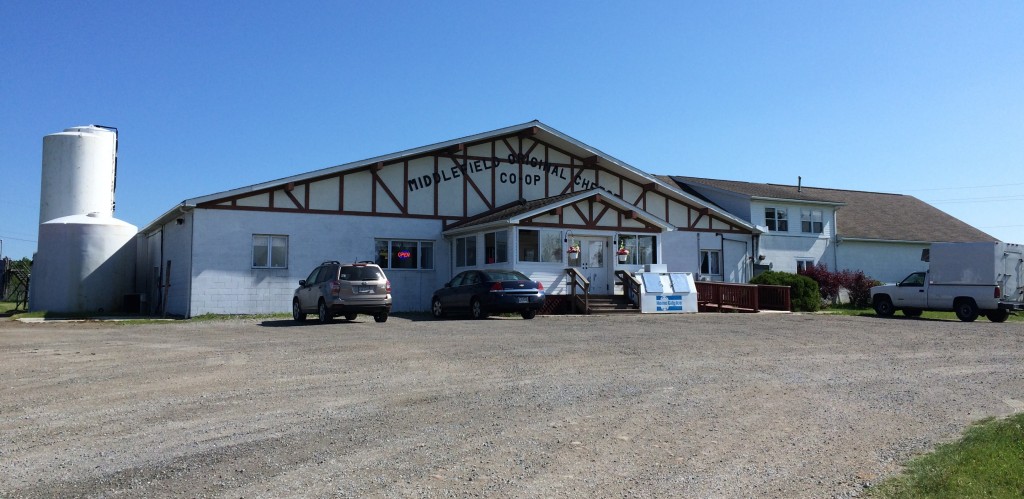
A steadfast tradition off of Kinsman Road in Middlefield stands as strong as the ties that bind the cheese-makers' simple customs.Hand-milked cows still have names,…
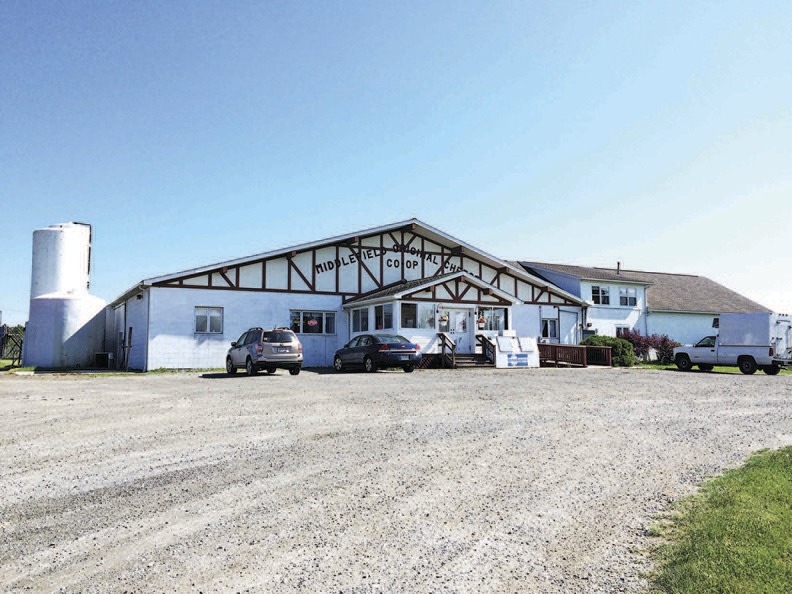
A steadfast tradition off of Kinsman Road in Middlefield stands as strong as the ties that bind the cheese-makers’ simple customs.
Hand-milked cows still have names, daily milk is still delivered in cans not tankers, and cheese is still made by hand in open vats.
“Employees make the cheese and it is still done the old fashioned way,” said Ed Gortos, owner of the electrified equipment for the Middlefield Original Cheese Co-Op plant. “The goal of farmers is to earn a living off their farms with their family.”
The award winning co-op is a farmer-owned cheese house going strong for nearly six decades in Geauga County’s Amish Country.
Gortos said the 74-farmer co-op is 98 percent Amish and all the cheese is made naturally, with cow milk from 15 cows per farm that are not treated with artificial growth hormones.
In early 1992, it became obvious to the farmers there was a need to build a new cheese house in order to ensure a market for milk from mostly Amish farms in Northeast Ohio.
The building is designed to handle up to 150,000 pounds of milk a day, which produces about 15,000 pounds of cheese.
The cheese continued to be made the old-fashioned way in order to preserve the mostly Amish farms in Northeast Ohio and to continue their traditions.
“We want to keep doing things the traditional way,” said Nevin Byler, a manager since 1999 who has 15 employees under him. “Nobody is making the big dollar.”
Back in Byler’s office, nothing is automated. There are no computers and the books are still done by hand.
“All things make it what it is,” Gortos said.
On a recent weekday morning, customers shuffled in for sliced cheese and deli meats behind the counter in the retail store.
“The people are really nice,” loyal customer Nichol Shimko said, shopping with her husband, Josh, and young sons, Bryce and Hunter of Madison. “For the amount of cheese, the price is great. We buy in bulk once a month. We buy five pound bags of shredded cheese and toss them in the freezer.”
“I guess we make a good quality, established product,” Byler said.
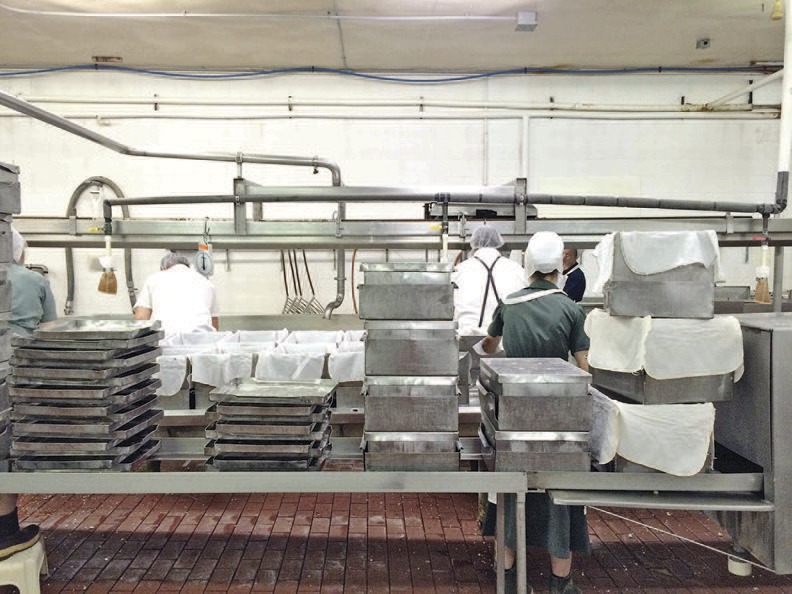
Around the corner from the counter is a large show window where customers may view the traditional cheese-making process, which takes nearly six hours from start to finish.
In the far right corner, a dumper takes in the milk.
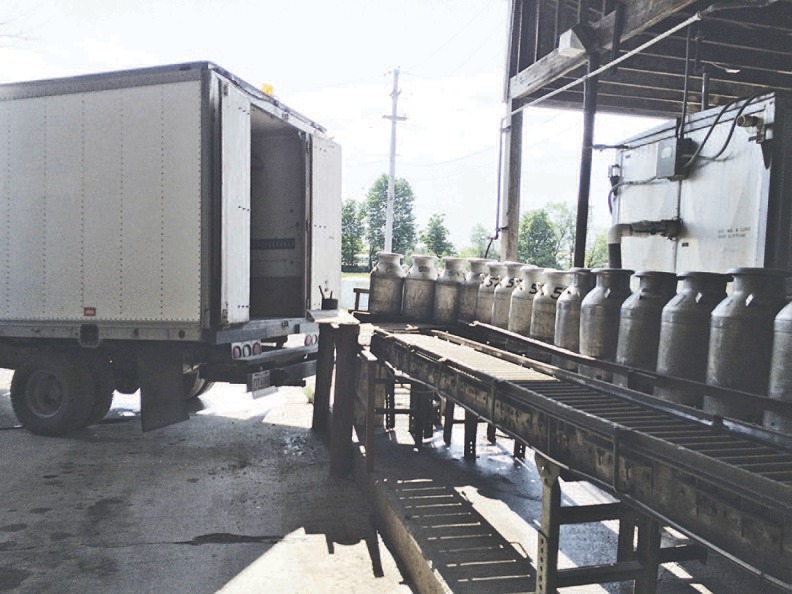
“Milk comes in from the farm in 10 gallon cans,” Gortos said. “Each family has a number on their can and gets paid on how much milk they ship and (its) quality.”
The milk is tested and can be traced back to its source — from the exact farm, to the very Holstein or Jersey from which it came.
At the same time, near the back of the building, numbered cans began being placed by hand on a conveyor belt for shipment inside.
The milk is pumped into holding tanks and, when the cheese-maker is ready to use it, it runs through the pasteurizer at 162 degrees.
It is then cooled to 90 degrees and put into large vats.
The starter and rennet are added and it gets thick like Jello before being cut with fine wire knives and cooked to 102 degrees.
Soon the curds form and separate from the whey.
Once it is stirred to just the right stage, it is pumped over to the finish table.
The whey “by-product” drains down through the center of the table, is cooled and put into a holding tank until it is trucked out and sold.
The cheese is watered down to help cool faster and stirred constantly as it dries.
Acid and PH levels are checked often. When ready, the cheese is salted and dipped, put into 40 pound block forms, where it is pressed for more than an hour. From there, it is put into plastic bags, vacuum sealed and boxed, and stored in the cooler until it is sold all over the United States.
The facility is approved by the United States Department of Agriculture, Ohio Department of Agriculture and is under strict inspections.
Gortos, who owns Western Reserve Foods, distributes the cheese to grocers, restaurants and food service companies.
The co-op makes mild cheddar, Monterey jack, marble, pepper jack, farmer’s, brick, marble pepper jack, colby, co-jack, and pepper jack longhorn varieties of cheese.
The Middlefield Original Cheese Co-Op’s cheddar was named 2012 Reserve Champion at the Ohio State Fair.
“It’s all in the benefit of the farmers,” Gortos said, as he looked through the window at the workers completing another cheese-making stage. “Bills get paid and money goes back to the farmers.”


