


"I don't think there is any evidence from anybody, to my knowledge, that granting the variances would have any adverse impact on any property in close proximity to the arboretum." Kirtland Law Director Daniel Richards
Visitors to The Holden Arboretum should be able to look down at trees rather than up at them pending final approval of a 65-foot-high elevated canopy walkway.
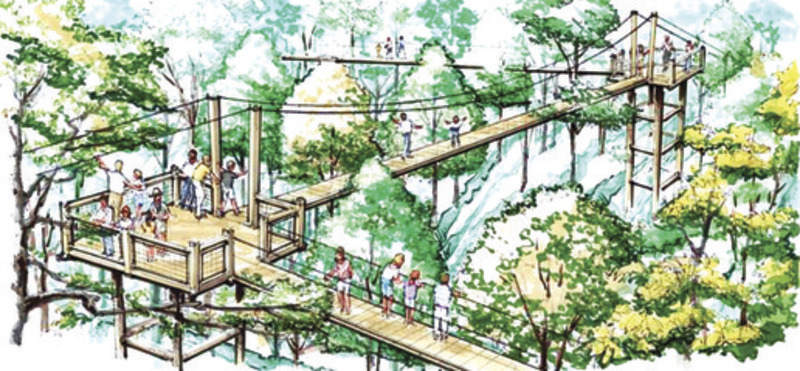
The first step in that approval came May 13 when the City of Kirtland Board of Zoning Appeals granted two height variances needed for construction of the 500-foot-long elevated Judith and Maynard H. Murch IV Canopy Walk to be built above a forested valley west of Sperry Road.
The variances were needed because current residential zoning of The Holden Arboretum land has a 35-foot height restriction.
The first variance allows up to a 70-foot height limit to accommodate the canopy walk while the second allows for construction of a 124-foot “emergent observation tower,” the tallest of several towers on which the triangular-shaped $1.3 million walkway is to be suspended.
Pending final approval by the city’s planning and zoning commission on June 6, Holden Arboretum President and CEO Clem Hamilton said work on the elevated canopy walk is expected to begin in July and be completed by the spring of 2015.
No zoning board of appeals member objected to the variance, nor did anyone attending the public meeting.
BZA Chairman Marvin Bahr, who said the purpose for the board meeting was published in local newspapers, noted the lack of any objections.
“If there were objections from nearby residents, then I would think they would be here. The fact they are not tells me something,” said Bahr, who then read a letter of support from a resident.
Brian Parsons, arboretum director of planning and special projects, who displayed conceptual photos of the project, said the nearest residences are more than a half-mile away from the proposed canopy walkway.
In addition, only the top of the tower would be barely visible from that distance, he added.
The entrance to the canopy walkway will be accessible to disabled people because its first platform will start at ground level and gradually increase to the maximum 65 feet height, Parsons said.
Overall, the structure will have four suspension bridges, according to the conceptual photos.
In addition, Parsons said the walkway will have various safety precautions, including a locked entrance and a 4-foot-high metal mesh guard, allowing visitors of all ages and abilities to safely view the surrounding forest.
“Although this will be enjoyable for visitors, it also will be an unique experience that will offer visitors a new perspective of the forest and the animals that inhabit it,” said Hamilton, who explained the structure will be one of several educational programs the arboretum offers.
The walkway and emergent tower will be an environmental research facility, where researchers from several Ohio universities can study environmental gas exchanges created by forests, Parsons added.
“By Holden doing this, we are really putting our money where our mouth is because we really want to be part this kind of research and help people understand the importance of forests,” Parsons said.
When asked for his opinion, Kirtland Law Director Daniel Richards said, “I don’t think there is any evidence from anybody, to my knowledge, that granting the variances would have any adverse impact on any property in close proximity to the arboretum.”
Neither should the walkway harm the valuations of nearby residential properties, he added.
“I think I am impressed by the fact that the arboretum is an asset not only to the community of Kirtland, but northern Ohio,” Richards said. “As part of its function, it has the responsibility to manage its forest assets appropriately and preserve them as part of its mission.”
The canopy walkway will help accomplish this, the law director said.
At the conclusion of the meeting, Bahr suggested the city consider changing zoning for the arboretum to eliminate the need for possible future residential variances.


