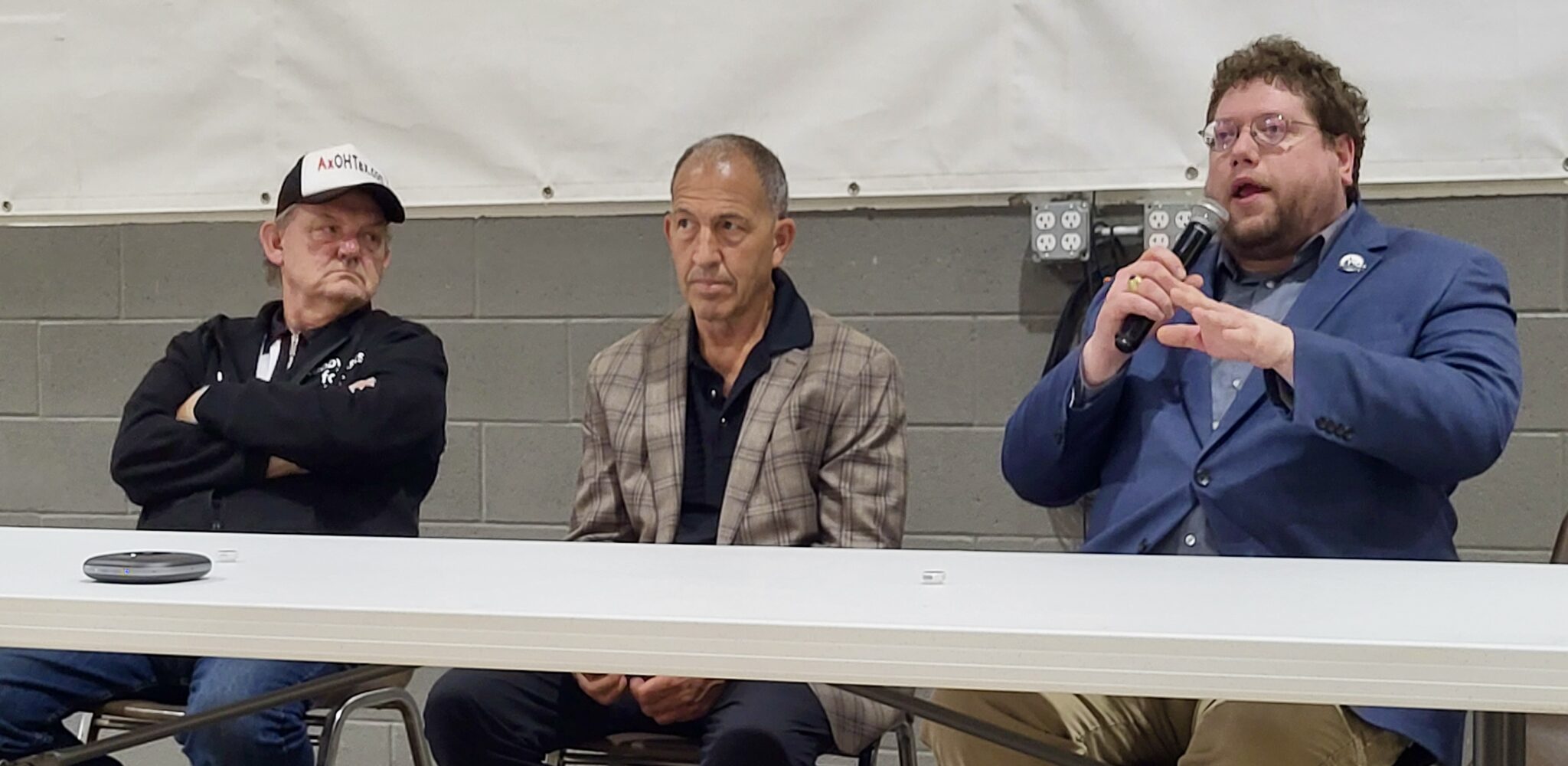
A small group gathered May 4 at Heritage Marketplace in Middlefield for a presentation advocating the abolition of property taxes, hosted by movement founder Brian Massie and featuring Lake County Commissioner John Plecnik and Timberlake Mayor John Marra.
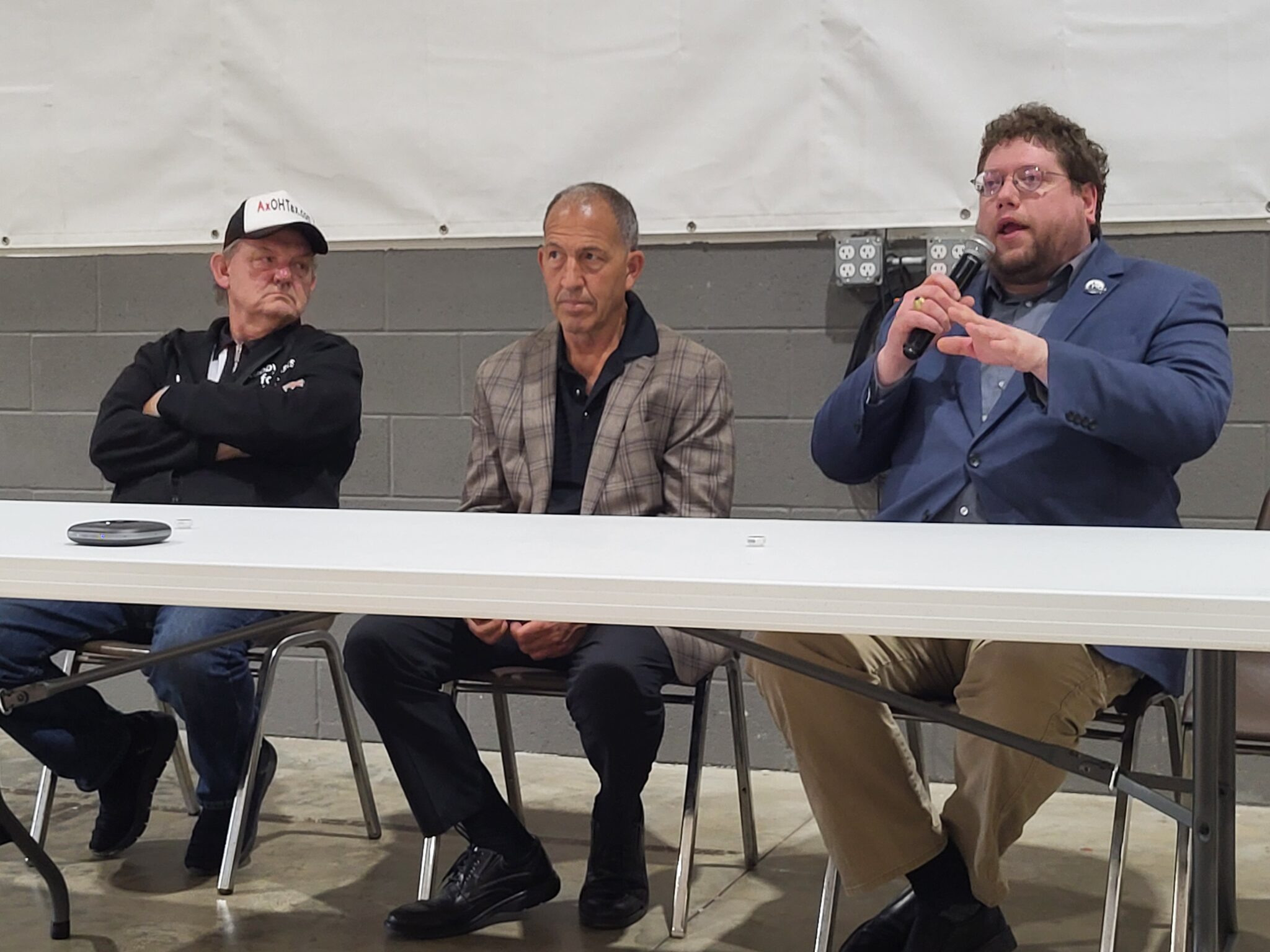
A small group gathered May 4 at Heritage Marketplace in Middlefield for a presentation advocating the abolition of property taxes, hosted by movement founder Brian Massie and featuring Lake County Commissioner John Plecnik and Timberlake Mayor John Marra.
While public officials at recent forums throughout Geauga County have cautioned against eliminating property taxes without a replacement funding mechanism, the May 4 panelists argued public services would not disappear if the tax were abolished.
The group has previously maintained that determining how to replace the lost revenue is not their responsibility.
Private property ownership is foundational to freedom and liberty, Massie said, arguing property taxes make residents “serfs” to the government.
The state does not have a problem generating revenue, it has a spending and prioritizing problem, he said.
Massie criticized the amount of money being spent on institutions such as libraries.
“Have you seen some of the libraries?” he asked. “You know you can also rent a lawnmower from some of these places, more than a book. What’s happened is mission creep on these libraries.”
Plecnik said elected officials often respond to proposals to abolish property taxes by warning essential services would collapse.
Rather than discuss alternatives, politicians use the possibility of lost funding as a defense, he said, referring to the scenario as “Mad Max 2.0.”

No one is actually able to point to the negatives of cutting property taxes, other than saying communities would not have funding for road, police or fire services, Plecnik said.
“Which everyone knows isn’t true,” he said. “Not a single person who says that believes that. Because they know darn well those politicians couldn’t get re-elected dog catcher if you didn’t have roads, police and fire. They would be forced to reorder their priorities, cut spending and there would still be too much money.”
However, opponents of abolition have argued the loss of property tax revenue would significantly impact local governments and schools.
In an April 23 article published by the Statehouse News Bureau, Ohio Sen. Jerry Cirino noted the roughly $24 billion collected annually through property taxes comes from voter-approved levies. He warned abolition efforts would eliminate services voters had chosen to fund.
A coalition called Ohioans to Protect Public Services has also formed in opposition to the movement. The group, which says it represents 65 organizations statewide, includes associations representing police, firefighters, libraries, parks, educators and county officials.
Participating organizations include the County Auditors’ Association of Ohio, County Commissioners Association of Ohio, County Engineers Association of Ohio, Ohio Association of Chiefs of Police, Ohio Association of Professional Firefighters, Ohio Association of Senior Centers and the United Way of Greater Cleveland.
The coalition emphasizes property tax revenue is levied and spent locally rather than collected by the state.
Plecnik, however, argued politicians claiming additional cuts are impossible cannot be trusted and taxpayers are bearing the burden.
“Imagine a world where we pump $24 billion back into the Ohio economy, where we go from being one of the highest to one of the lowest tax states in the nation,” he said. “You know that money’s going to be spent, right, and more than once.”
There is a “very real chance” the tax cut pays for itself, Plecnik said, adding reduced taxes can sometimes increase revenue.
Cirino disagreed in the April Statehouse News Bureau article, saying abolishing property taxes would create a multibillion-dollar funding problem and likely lead to increased taxes elsewhere.
Ohio Gov. Mike DeWine said in February that eliminating property tax could require a 20% sales tax to compensate for lost revenue.
Likewise, a February memo from the Ohio Office of Budget and Management warned abolishing property taxes would immediately destabilize local budgets and force cuts to schools, first responders, roads and services for seniors and people with disabilities.
Plecnik argued a constitutional amendment is a “blunt instrument” — one that proponents have pursued only after feeling ignored by lawmakers. He noted Ohio constitutional amendments are limited to one issue, meaning a comprehensive reform plan could not be included alongside abolition.
However, Geauga County Prosecutor Jim Flaiz disputed that interpretation in a May 11 email.
“Ohio voters have passed: redistricting reform amendments for both state legislative districts and congressional districts; various victims rights protections; and a comprehensive casino legalization scheme that includes detailed taxation provisions, establishment of a commission and the granting of specific casino locations, down to the parcel number,” he said. “I’m not sure how one could look at the casino amendment and argue that real tax reform across the board could not be accomplished in a single amendment.”
Plecnik said eliminating property taxes for seniors alone would cost less than 3% of the state budget, emphasizing repeatedly throughout the meeting that spending must be cut.
Earlier this year, Geauga County school districts estimated they could cease functioning by 2027 if property taxes were eliminated.
Marra and Plecnik disputed those claims.

“There’s $12 and a half billion in foregone revenue,” Marra said. “So, you’re just a half a billion short of funding the schools 100%.”
The remaining gap could be addressed through spending cuts, he said.
“No one’s taxes have to go up, income tax or sales tax, like the governor says,” Marra said.
Regarding roads, police and fire services, Marra suggested local governments could instead issue service bills.
The current tax system is unrepairable and needs to be dismantled, he said, adding the only people opposed to abolition are those “being paid by tax dollars.”
Former Geauga County Commissioner Skip Claypool echoed the panelists’ arguments, advocating for “zero-base budgeting.”
“To John’s point, if we start cutting and reprioritizing the local governments can then, on a local basis for police or whoever, start determining how best to pay for those services using the toolkit they’ve got locally,” he said. “It’s not an additional set of money that has to get created to cover the loss of property tax, no, the property tax is your money being paid for services that goes back into your pocket and we start from ground zero.”
Property tax revenue makes up approximately 24% of Geauga County’s general fund. Geauga County Commissioner Carolyn Brakey has previously said the county would be unable to absorb the additional demand created by abolition.
Brakey has suggested higher sales taxes, service consolidations and budget cuts as possible responses.
Plecnik also argued the state would ultimately be required to fund schools because the Ohio Constitution mandates public education funding. He proposed combining districts into countywide systems and significantly reducing administrative costs.
The only people who suffer if property taxes are cut are politicians, who will become irrelevant, Plecnik said.