


Berkshire Schools Board of Education discussed giving voters the opportunity to approve a 0.5% earned income tax increase that would replace the recent transfer of 2.5 mills of inside millage March 10.
Berkshire Schools Board of Education discussed giving voters the opportunity to approve a 0.5% earned income tax increase that would replace the recent transfer of 2.5 mills of inside millage March 10.
Board President John Manfredi said they want to ensure the revenue stream from the EIT is roughly equal to the amount that will be collected from the 2.5 mills the board voted to transfer during its February meeting.
The additional millage would be added to property taxes beginning in January 2026.
If voters approve an EIT in November 2025, collections from paychecks would not begin until January 2026.
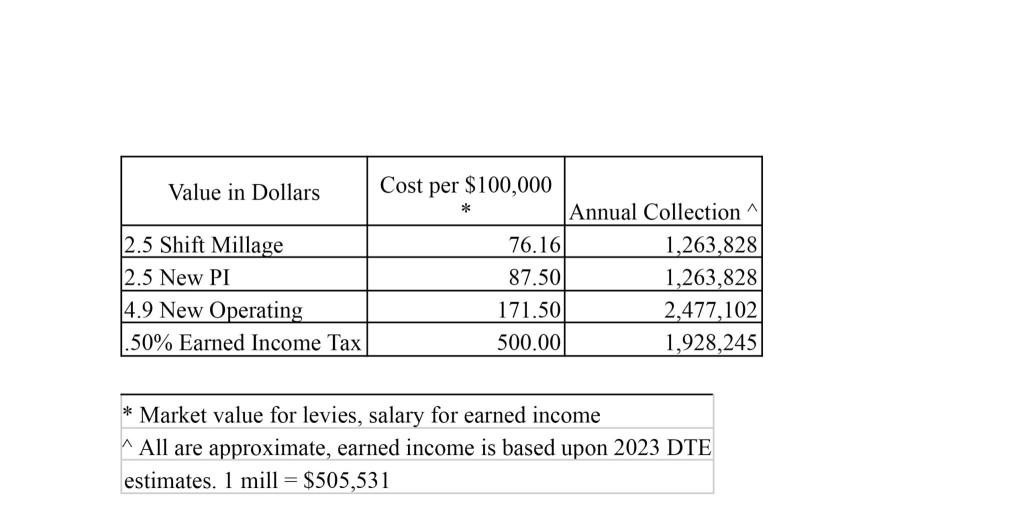
The 0.5% EIT would be added to the 1% EIT already in place. If passed in November, it would cost individuals $500 for every $100,000 of earned income they receive, but would not affect those who do not earn a paycheck, the board said.
Manfredi promised at the February meeting the board would reverse the transferred millage if voters approve the EIT, but district Treasurer Beth McCaffrey warned Monday there would be a period of time when the revenue streams from the transfer and the EIT would both occur.
“Income tax takes 18 months to collect. You would have to overlap a year,” she said. “If the EIT passes in November, it will (take effect) in 2026 — too late to shift the millage back. You could unshift (the transferred millage) for ‘27.”
However, that would leave the district a little short, financially, since income tax is not sent to the district until July.
“So, no (EIT) payment (to the district) until July. You’re kinda kicking the can down the road,” she said. “You could choose not to overlap. We would go another year without collecting that additional revenue.”

Several other options are available to the board to keep the district from going into the red in four years, but Manfredi supported the EIT.
“I’m not saying we shouldn’t pick another category. Only one makes sense,” he said.
McCaffrey said the 0.5% increased revenue can be restricted to the permanent improvement fund to make up for the 2.5-mill permanent improvement renewal levy that failed in 2024.
PI money can be spent on items or repairs that will last at least five years such as computers, equipment or repairs, she said.
“PI money doesn’t go to wages and benefits. We never discussed putting on a levy for that,” Manfredi said.
He directed McCaffrey to work with legal counsel to come up with wording on a resolution placing an EIT on the November ballot and language on the ballot issue to be considered at the April board meeting.
Both should reflect the board’s intent to eliminate the 2.5-mill transfer if the EIT or another levy passes, Manfredi said.
During a phone interview March 11, Superintendent John Stoddard verified if voters approve the proposed EIT, the board would reverse the transfer of the 2.5 mills approved in February.
“They are going to try to dial it in as close as possible to what the additional (earned) income tax will bring in,” he said.
In other words, the amount of revenue is the same as a 2.5-mill levy would yield, if it was placed on the ballot, he said.
“It is not going to increase our funding level,” he said. “The district is not asking for more.”
Stoddard estimated the 2.5-mill transfer from last month is going to cost a property owner an additional $76 per year per $100,000 property valuation, whereas a 0.5% earned income tax increase will cost an employee $500 per year for every $100,000 he or she earns.
A person on a fixed income would not be affected, he said.
“The bottom line is: Nobody likes taxes. Unfortunately, that’s how our schools are funded,” Stoddard said. “It puts us at odds with the taxpayers.”


