


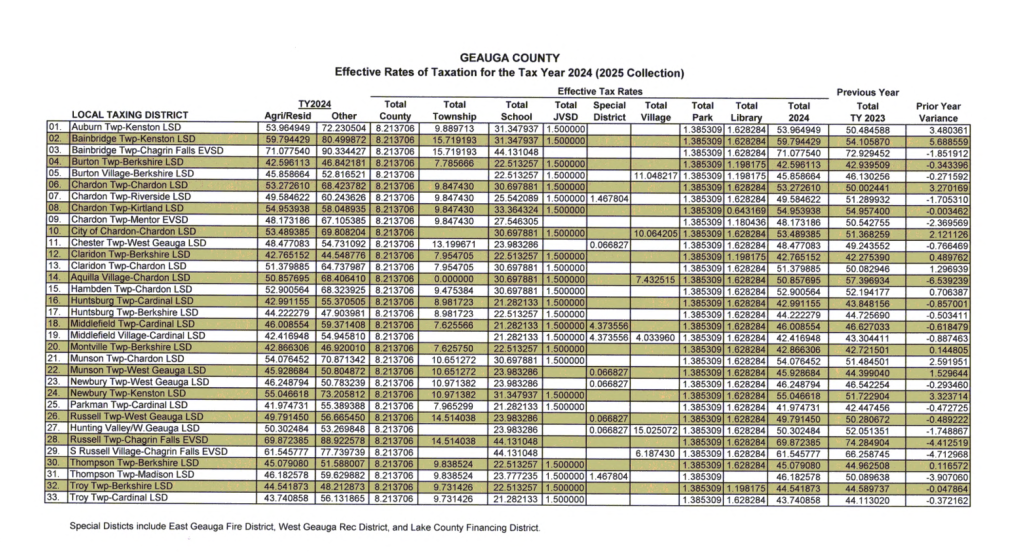
The Geauga County Budget Commission approved county tax rates for 2024 and discussed a policy to eliminate dormant funds during a Jan. 15 special meeting.
The Geauga County Budget Commission approved county tax rates for 2024 and discussed a policy to eliminate dormant funds during a Jan. 15 special meeting.
Tax bills will go out a week later than usual, said Treasurer Chris Hitchcock, who sits on the commissioner with county Auditor Chuck Waldler and county Prosecutor Jim Flaiz.
Rates appear to be as anticipated, Walder said, with Flaiz adding he’s received questions as to why last year’s rates were impacted as they were.
“It was because of equalization,” Flaiz said. “Our (revaluation), while the state imposes a county-wide percentage, within the county, ours was based on reality and home sales, which along the (state Route) 306 corridor were higher.”
The biggest decrease in effective rate was Aquilla Village, with a variance of – 6.5, while the largest increase was Bainbridge Township-Kenston Schools district at 5.7.
The impact in both cases is from levies, Walder said — Aquilla saw two drop off the ballot, while Bainbridge saw two additional levies pass.
Regarding dormant funds, commission members were each given a print-out of funds showing those with no increase or decrease in two years marked red.
An additional column meant to indicate a fund’s last activity was blank — money could have gone in or out in a period of time they didn’t capture, Walder noted.
“This will be our first attempt at starting a clean-up process,” he said.

Walder asked Flaiz to mark the funds he thought should be interrogated and said they would have to check if funds can be deactivated.
“There are some funds in there that have balances. We have to go through a statutory process,” Walder added.
Per a 2011 opinion by former county Prosecutor Dave Joyce, funds have to be moved into a trust category where they sit for five years before being transferred to the general fund.
“We have not been diligent in doing that,” Walder said. “There was some consternation of previous administrations who just elected to not go down that road.”
He said he suspected administrators had reservations about having to explain to taxpayers why there’s money sitting in the treasury.
“Let’s say the parks wrote a check to a vendor for $10,000. Let’s say that vendor never cashed that check for some reason. It then goes into unclaimed funds and the clock starts for five years,” he said. “The parks is no longer under our authority, so even if somebody were to approach us and say remit it, we don’t have the resources to remit it because now it’s in unclaimed funds. After five years, unclaimed funds moves it to the general fund.”
Other funds use the same process, he said.
“Transit’s a good example. There may be residual money from transit that comes in and we can’t remit it out and it just sits there. It sits there indefinitely,” Walder said. “There’s many of these funds that could have happened to.”
The situation is explainable, but he doesn’t know all the history, he said.
Hitchcock drew attention to a red-marked fund labeled “Sick and Vacation Accrual” with $400,000 in it.
“I think there are funds that were created with great intention. This is one of them. The question is, has anybody ever tapped that fund for that purpose, and if not, then it’s only a mechanism to shelter money,” Walder said.
Paring down the list will also prompt them to explore better uses for those funds, he added.
He estimated the work would take about a year.
Red-marked funds include a Wetland Mitigation Bank Fund at $62,907, Youth Center at $111,062 and Courthouse Donation Fund at $169,441.
The donation fund money was leftover from a class action lawsuit a former judge presided over, Flaiz said.
The law firm had put in the settlement agreement that remaining money would go to that fund.
“I’d like to take a whole page off this thing. That’s my goal,” Flaiz said. “This is government at its worst.”


