


Ten years ago, Cardinal Schools received about $2 million that year from tangible personal property taxes to help keep the small district afloat.
Ten years ago, Cardinal Schools received about $2 million that year from tangible personal property taxes to help keep the small district afloat.
In 2024, the district’s income from taxes on business inventories will be less than $164,000, according to its five-year forecast. And in 2025, its TTP is projected to be $62,680.68.
By 2026, Cardinal will receive no TTP.
“This is due to the locally-generated tangible personal property tax being eliminated,” district Treasurer Terry Armstrong said in a summary of the forecast. “Based on phase-out payments, since the elimination (of TTP by) the State of Ohio, the district has lost an accumulated over $13 million dollars the past 10 years.”
Armstrong presented the five-year forecast of Cardinal’s general fund at the May 29 Cardinal Schools Board of Education meeting, explaining the year-to-year carryover balances, surplus or deficit spending for each year, as well as the percentage of carryover to expenses.
“Generally, districts try to maintain a 40-percent carryover, which Cardinal is doing (in 2024) and for the next couple of years,” he said in the summary.
Over the last several years, the board and administration worked to make the operation of the district more efficient, selling the Cardinal Intermediate School property to All Around Children child care, closing Jordak Elementary School, and restructuring grades in the high school and the middle school.
“We discussed strategies to maintain closer to a 40% carryover by continuing to right-size the district,” Armstrong said. “Currently, our building operation costs are 40% higher than similar districts in Ohio. The closing of Jordak will help lower building cost.”
The board plans to reduce staffing costs by decreasing personnel when possible through attrition, he said.
Cardinal has an enrollment of about 700 students.

The securing of a $250,000 grant to complete district-wide LED lighting installation is one example of how the district is coping with increasing costs, Armstrong said.
“We also discussed the fact that Cardinal Schools has the lowest effective tax millage in Geauga County,” Armstrong said, pointing to a slide showing projected local taxes of $10,498,985 in 2024, projected state funding of $3,626,761 and all other revenue projected to be $1,822,402.
Expenditures for 2024 are expected to include personnel salaries of about $6.3 million, benefits of about $3.5 million, purchased services at roughly $2.3 million and all others at $2.6 million, he said.
Cardinal is a funding guarantee district. Ohio law requires the state to increase funding to schools on the guarantee in accordance with inflation, especially those like Cardinal that have low property tax income, Armstrong said.
This is particularly important in looking five years down the road.
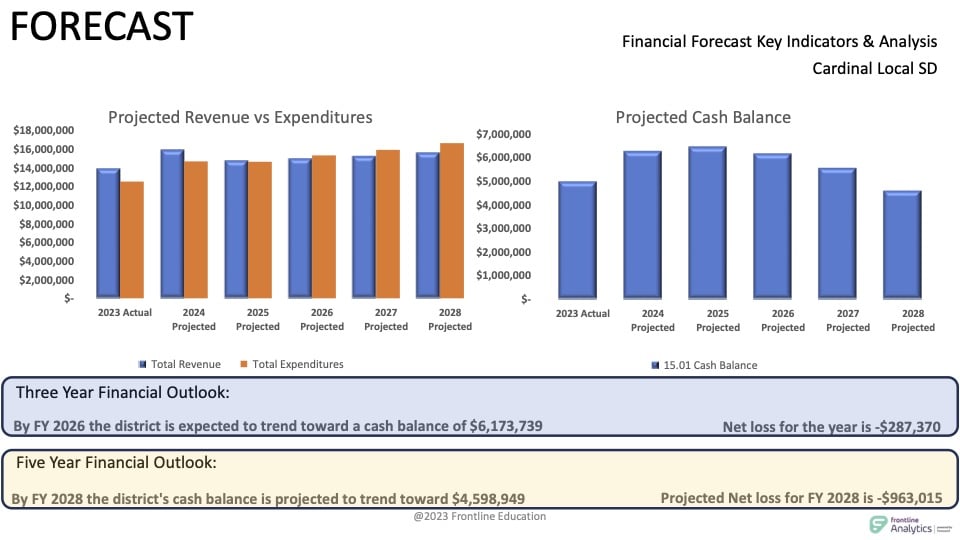
In fiscal year 2024, Cardinal has slightly more revenue projected than expenditures. In 2025, Armstrong said income versus outgo will be close to equal and after that, expenses are expected to be higher than revenue through 2028.
The general fund cash balance will decrease as carryover funds are needed to maintain Cardinal’s operations.
Cash balance in 2026 is projected to be about $6.27 million, falling to $4.6 million in 2028, according to Armstrong’s figures.


PHOTO
Cardinal Local Schools
This chart from Cardinal Schools’ five-year forecast shows the difference between revenue and expenses projected through 2028 and the decreasing of the general fund cash balance for the same period.


