


“I only regret I can’t do it again.” – Haydn Cummins
Imagination and enthusiasm, coupled with a collaborative spirit, earned Cardinal Middle School awards at the National Engineers Week Future City Competition in Columbus last month.
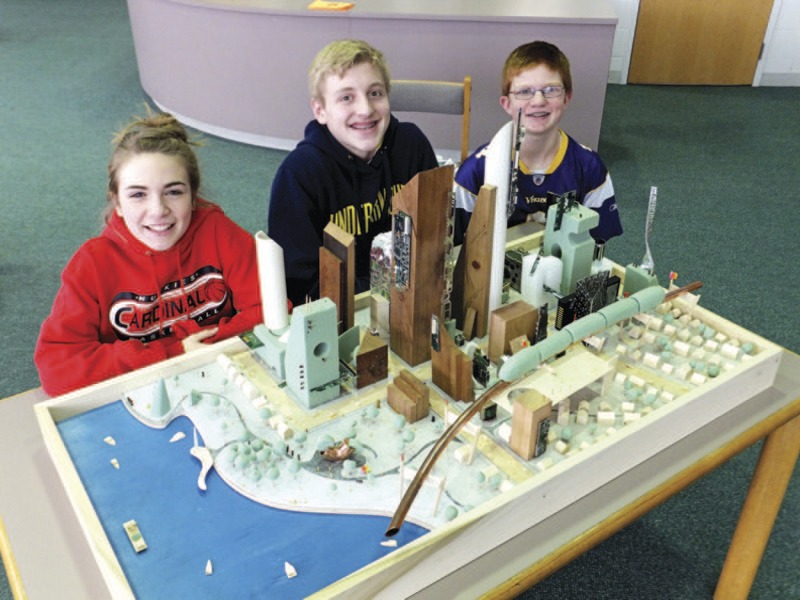
Sixth-, seventh- and eighth-grade students from Cardinal were involved in developing a model of what a city in 2164 might look like with a focus on transportation.
The three Cardinal eighth-graders who presented the model Jan. 18, at Columbus State Community College in Columbus were Hanna Traggiai, Haydn Cummins and Brendan White.
All three agreed imagination led to their first place in special awards categories of Best Architectural Model and Best Land Surveying Practice and an honorable mention as Rookie Team of the Year.
It was the first time Cardinal has entered the competition to encourage math and science skills, and the students had some qualms.
“We were all really nervous going into it,” Hanna said.
As judges circulated among the 100-plus teams competing in the convention area, asking questions about all the models, the trio realized they needed answers — quick.
“We never had a concrete idea” about how the competition would be run, said Brendan.
Hanna added, “We listened to the other competitors” and their imaginations did the rest.
One building became a convention center/broadcast station in the imaginary city of Weilai Yanshu, located on the West Coast of British Columbia.
“We just made up random stuff,” said Haydn.
But the model had been designed within the parameters of the contest, i.e., transportation in the next century.
Central to the theme was a monorail connecting the two residential ends of the city through downtown, where a multitude of passengers would debark at a central location and take public transportation to work, shop or recreate.
“There has to be access for everyone — cars, boats, elevators,” Hanna said, adding students Anna Avalon and Megan Maddox worked with them on the physical model while Drew List and Jacob Revak used the SimCity software to do research for the project.
Her father, Jason, served as their engineering mentor for the program. He also supplied many of the recycled components of the city.
“Dad built a deck and donated the wood,” Hanna said.
The scraps were cut and formed to fit the model. Some Styrofoam and green florist’s foam, all shaped with sandpaper, provided some buildings and treetops.
Runways for the airport were conspicuously absent. Brendan explained the vertical building is set up for helicopter-to-jet air transport of the future that Haydn calls ATLASS — Advanced Transportation Lane Access System.
Giving the city a futuristic appearance were a variety of small computer motherboards and chips attached to or making up buildings.
When asked what a large mechanical item on the board was, the trio explained it was the community recycling crusher — or part of an old radio tuning dial in a previous, archaic life.
The fast-thinking, fast-talking trio will be toting their model to other public and private schools in the area, encouraging those students to participate in the competition. They also credited Shaun Spence, the Cardinal teacher and Deborah Morgan, gifted coordinator, who helped the team with the project.
Cardinal has been invited to compete again next year, but since Hanna, Haydn and Brendan will be freshmen, someone else will have to carry on.
“Next year, they’ll have a whole different topic,” Haydn said. “I only regret I can’t do it again.”
The Future City Competition is a national, nonprofit education program. Across the country, more than 30,000 students from 1,100 schools have participated in the 2014 competition.
For more information, contact Future City Ohio at www.futurecity.org/ohio.


