If projections hold true, Chardon Schools is facing a funding deficit in 2029, prompting officials to discuss options, including placing a levy on the ballot in 2027.
If projections hold true, Chardon Schools is facing a funding deficit in 2029, prompting officials to discuss options, including placing a levy on the ballot in 2027.
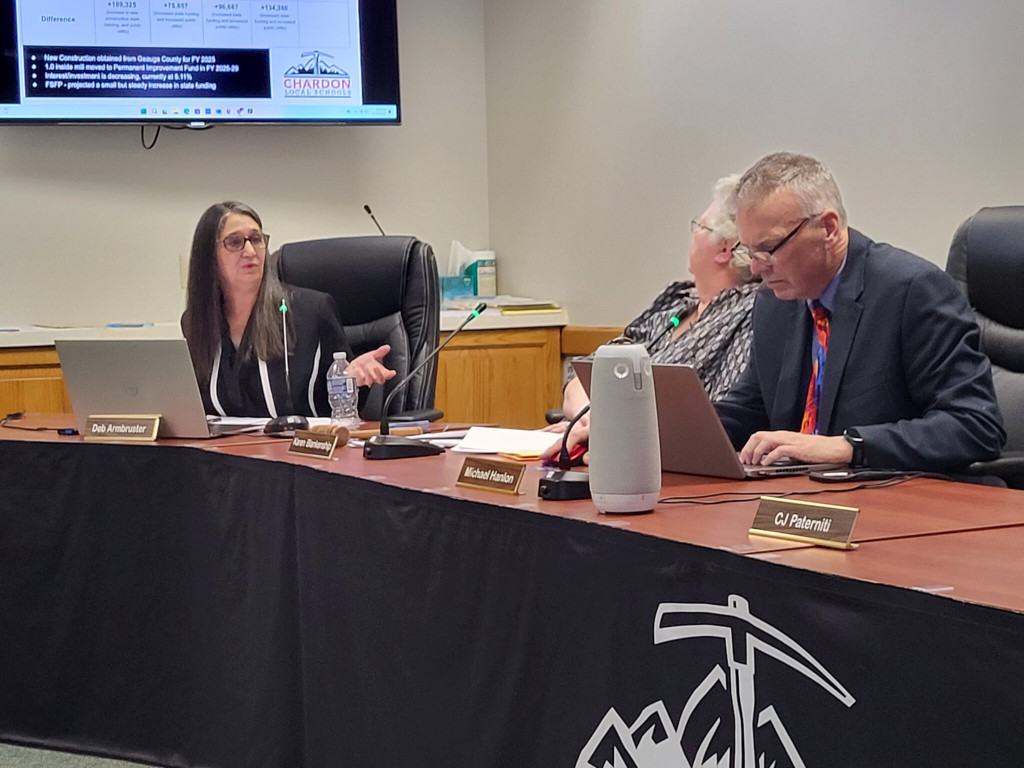
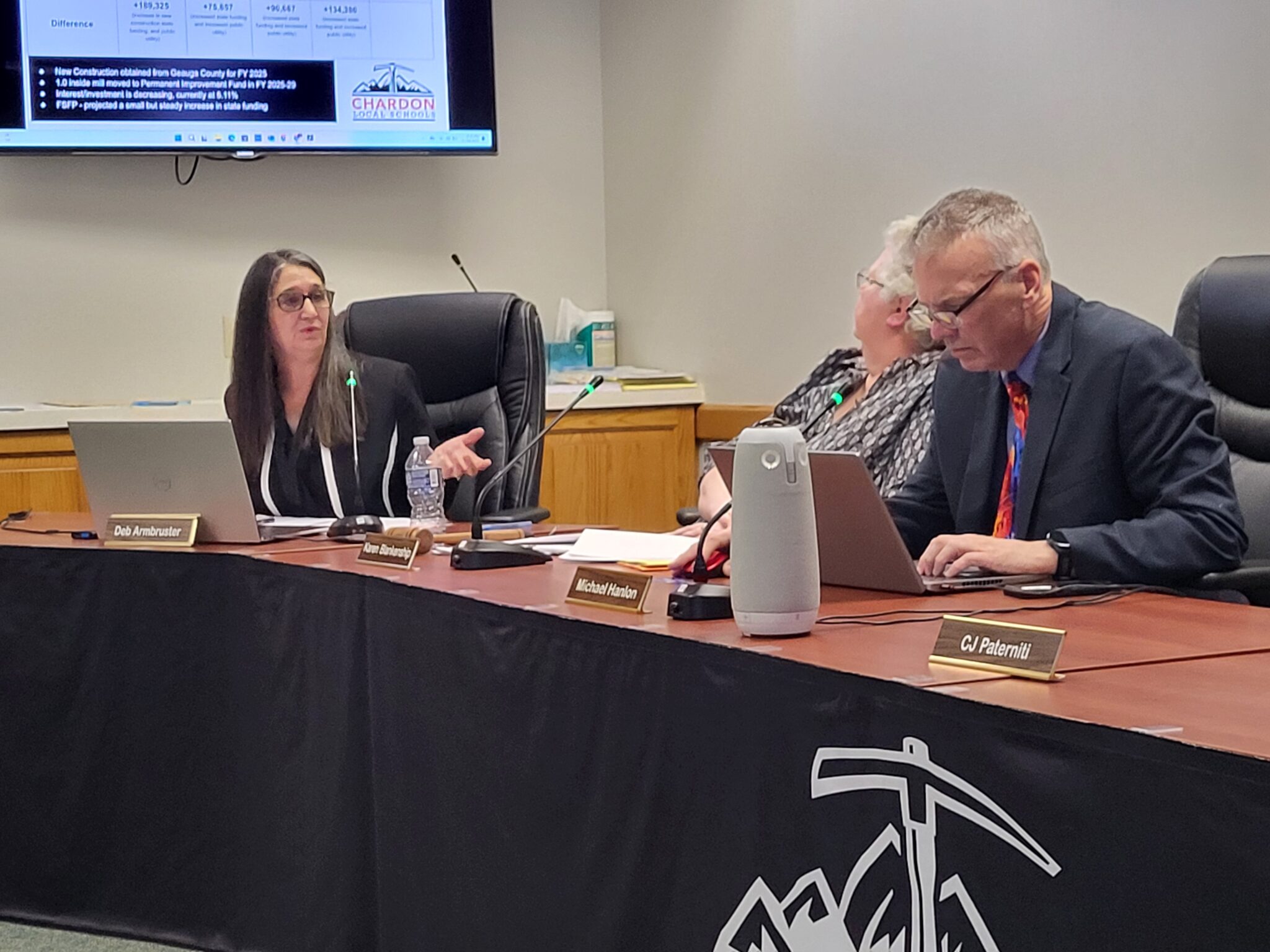
Treasurer Deb Armbruster presented Chardon Schools Board of Education her five-year forecast during the regular board meeting Nov. 18.
The forecast, which the board approved, is required by the state and done twice per year — once in May and once in November.
Armbruster collaborates with Superintendent Mike Hanlon, the director of student services and the assistant superintendent of business affairs to capitalize on grants and additional funding in an effort to relieve the general fund, she said, emphasizing the forecast is an estimate based on current information.
“Circumstances in Ohio always change and we have inflation and state funding, tax collections — the forecast makes assumptions concerning numerous variables of property values, supply chain (and) interest rates,” she said
The May 2024 five-year forecast projected an ending cash balance for fiscal year 2024 at
$23,406,366 (before open encumbrances). The actual ending cash balance for June 2024 was slightly more at $23,696,999, according to Armbruster’s presentation.
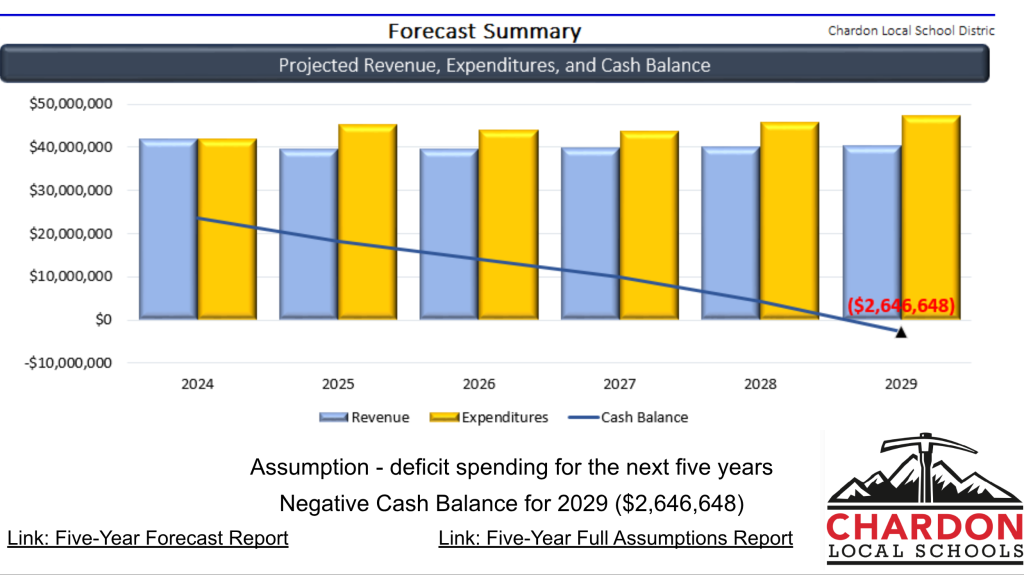
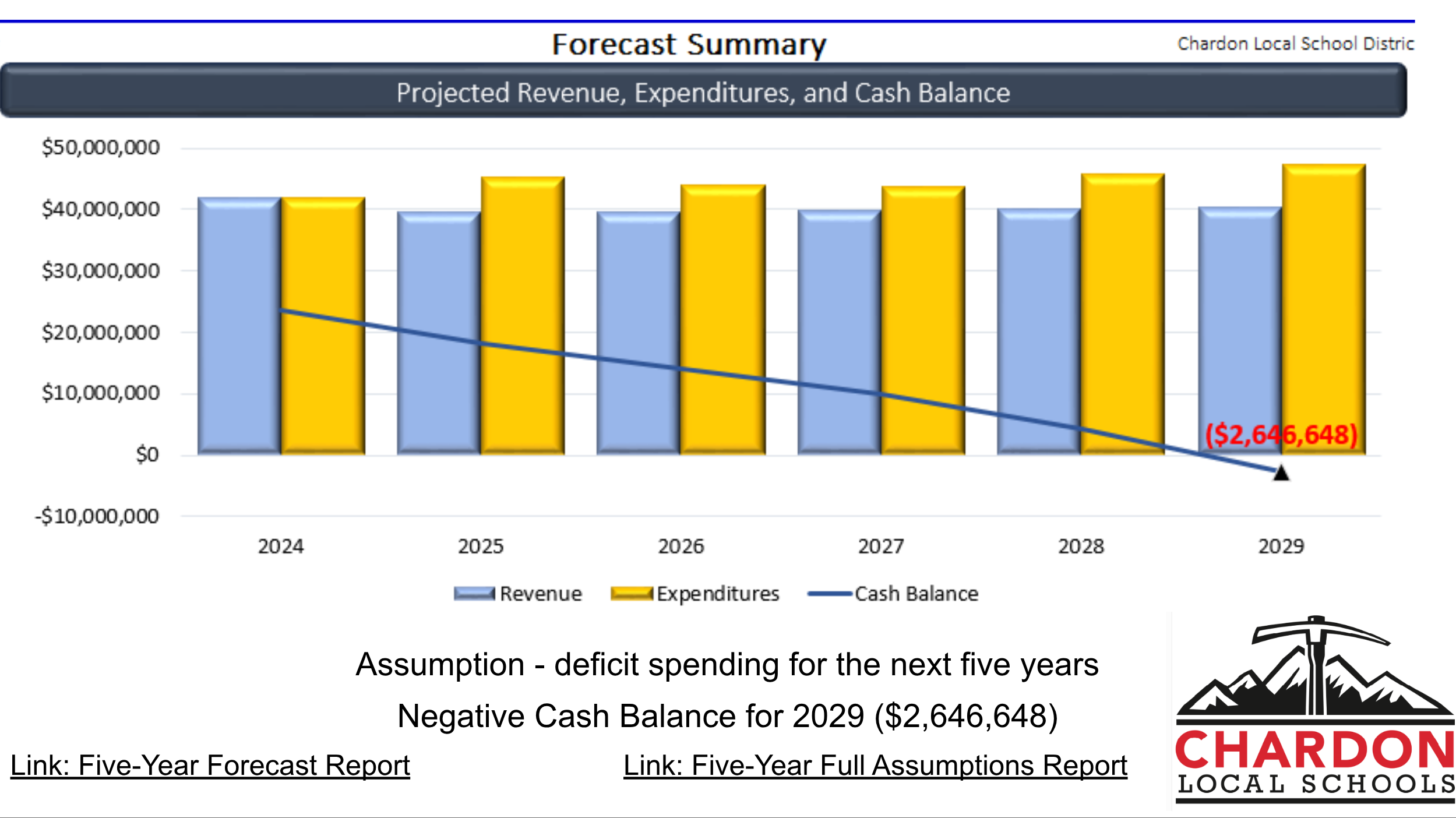
However, revenue is expected to drop in fiscal year 2025, Armbruster said in her report, which showed a projected ending cash balance for fiscal year 2025 at $18,126,779 that continues to trend down, resulting in a deficit of $2,646,648 by year 2029.
“The district would either need to cut its fiscal year 2029 projected expenses by 14.62% or increase revenue by 17.13% in order to balance the budget,” Armbruster said in her report.
Deficit spending almost seems unavoidable, said board member James Midyette.
“My household income, I get a raise every year, you know,” he said. “But, we don’t. We only get a raise when we pass a levy. We don’t get a raise when property values go up.”
Armbruster did note some small increases in revenue from new construction in the community in 2025, as well as some estimated increases in state funding and the transportation budget.
Revenue is estimated to increase from $39,841,428 in 2026 to $40,537,205 in 2029.
However, the overall downward trend in cash balance is a result of expenditures continuing to outpace revenue, with the forecast showing expenditures jumping from $44,016,223 in 2026 to $47,279,209 in 2029.
When calculating costs, Armbruster took into account increases to the district’s property value that will result in higher taxes. Interest rates are also projected to decrease by the end of the forecast, she said, adding there will be a point when the district will not be able to invest as much as it has.
Student wellness money is declining, as is the reimbursement for special education services, according to the forecast.

Financial Break-Down
Chardon Schools’ two largest revenue sources are property taxes and state funding, Armbruster said, adding real estate property tax accounts for 61.49% of general fund revenue.
While fiscal year 2025 will see a slight drop in real estate property tax on account of 1 mill being moved to the district’s permanent improvement fund, every year after is projected to slightly increase.
Hanlon explained how the district’s current enrollment trends impact its state funding.
“Primarily, we’re on the guarantee because our enrollment continues to go down,” he said, referring to a provision in state funding that guarantees a minimum amount of funding. “We’re being funded by the state at a higher level even though our enrollment is declining and the property valuation is going up.”
Being on a guarantee means the district is guaranteed the same funding they got in 2020, Armbruster said, adding while state funding dropped in 2022, it has been slightly increasing each year since then.
Armbruster also noted a projected increase in health insurance costs was not as high as previously expected.
“We had planned for a 9% health increase and our health increase — health insurance increase — was only 5%,” she said. “So, this opened up some of that budget that we thought we were gonna have to spend on health insurance.”
That added revenue means the transportation compound currently being constructed on Washington Street will be able to be completed in 2026 with $1.3 million being added for its final phase, Armbruster said.
Seventy-one percent of the district’s expenditures is in salary and benefits, she said, noting the percentage is usually much higher.
“We are putting a lot of money from our general fund in capital outlay,” she said, referring to money slated for capital improvement projects.
The district earmarked $4.1 million in capital outlay for 2025 alone, the treasurer said.
“So, our capital outlay, as you can see, percentage is way up to 15.49% and it drove down our salary expense,” she said, adding once capital outlay is returned to normal, she estimates salary and benefits will return to the usual 77-80%.
In terms of taxpayer savings, athletic/activity and supply fees were reduced in 2023 and the former were eliminated in 2024, with supply fees reduced further.
Between 2023-2025, Armbruster estimated a total savings of $1.3 million.
“This really gives an opportunity for students to join whatever they want and they’re not limited by the constraints of the cost,” she said.

Funding Options
With current financial trends, the board discussed possibly putting a levy on the ballot in 2027.
“If (a levy) passes in ‘27, we won’t collect until ‘28,” board President Karen Blankenship said.
Armbruster said when she presented the forecast to the Fiscal Advisory Committee, solutions such as adding fees back in, cutting programs or potentially moving 1 mill from the permanent improvement fund back to the general fund had been discussed.
“This committee of parents, they went out and talked to all their peers and came back — they didn’t want to do any of those things,” Armbruster said. “They wanted the forecast exactly presented like this because they were well aware that we have need and they were more willing to present the forecast with the probability that we’ll go on the ballot for an operating levy.”
The district takes its responsibility to stretch resources seriously, the treasurer said, noting they have gone without putting a new levy on the ballot for the past nine years — a historic high.
You usually hope to get five to seven years, Blankenship added.
A school district cannot operate in the red, she said.
“So, if we get down to a negative balance or we look like we’re projected to be in a negative balance, we have to make the necessary cuts to balance everything out,” she said.
The district is constantly saving costs, Hanlon said, adding the question is when to start throttling back.
Stalling an operating levy to 2028 could be pushing the district too close to the edge, he said.