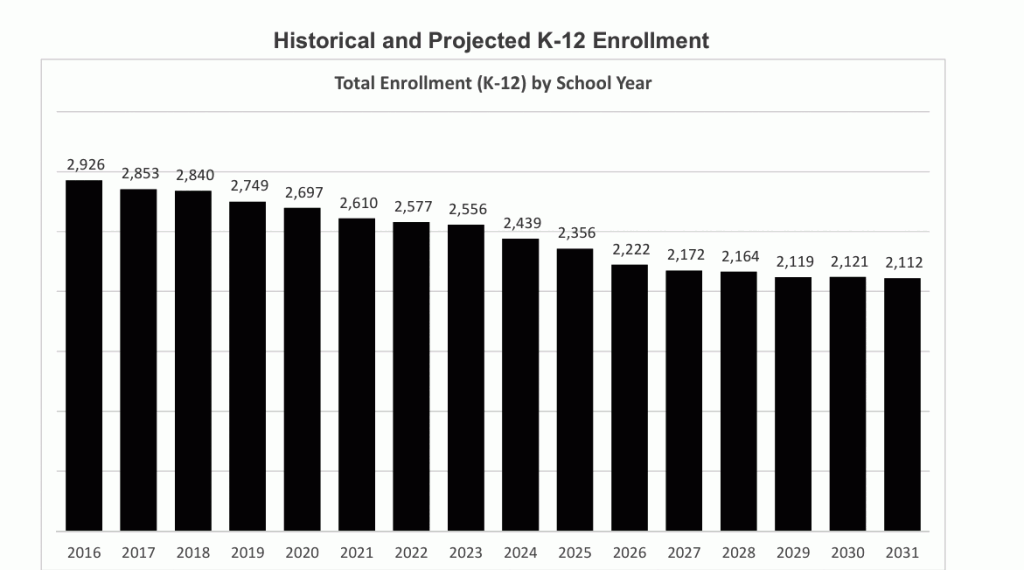
Enrollment across Chardon Schools has been gradually dropping over time, a trend reflective of the wider state as a whole, according to a 2026 Student Enrollment Projection Report.
Enrollment across Chardon Schools has been gradually dropping over time, a trend reflective of the wider state as a whole, according to a 2026 Student Enrollment Projection Report.
“The enrollment project process that Frontline undertakes now really takes into account the industry standard projection methodologies that are available to school districts,” said Superintendent Mike Hanlon during the Oct. 13 Chardon Schools Board of Education meeting, noting it is somewhat of an imprecise science.
“But you can get fairly strong projections based on a couple of factors,” he said.
Officials can track live birth rates and housing starts in the community, which this enrollment projection takes into account, Hanlon said.
Chardon’s data shows a downward trend over the last 10 years, with some leveling out projected in the next several years, he said.
“I said last year, I’ll say again this year that most school districts across the state of Ohio are mimicking this pattern or trend of enrollment, kind of a gradual decline,” Hanlon said. “It’s not a mass exodus from the public schools to other schools. In fact, if you look at the number of students that withdraw from our district that go to non-public schools, it’s in the teens each year, which is pretty typical.”
Generally, the district is seeing a decline in the number of families with children in the community, with the state overall seeing about a 1% decline in public education enrollment figures from year to year, he said.
“It’s generally the impact of people staying in their homes after their children move out of school and are no longer school aged,” he said.
Current predictions show roughly 2,100 students enrolled in Chardon Schools in 2031, about 110 students down from today, Hanlon said.

The district is already down approximately 1,000 students since board President Karen Blankenship was first elected, she said, noting there were 3,200 students back in 2012.
A house used to generate one to one and a half students, Hanlon said, adding today’s data shows less than half a student per house, a number that continues to decline.
“It’s economic conditions, it’s everything. People are having fewer children,” he said.
The idea that if enrollment increases, the district would get more money from the state is unfounded, Hanlon said.
“That is actually not the case,” he said. “Chardon Schools, under the current funding model, is on what we call a funding guarantee.”
In essence, the district does not receive less state aid than it received in fiscal year 2020, despite declining enrollment, he explained.
To come out of the guarantee, the district would need to increase enrollment by 1,278 students, Treasurer Deb Armbruster added.
“I want to impress on the board and the community, if we increased 100 students tomorrow, we wouldn’t get any more money from the state. We are on a guarantee,” Hanlon emphasized. “If we increased 500 students, we wouldn’t get any more money from the state. We would incur additional expense to educate those students. We would need classroom spaces. We would need instructional materials. We would need, most importantly, teachers and staff and bus drivers and everyone to support those students. But until we increase nearly 1,300 students in enrollment in our district, we won’t see a penny more from state support.”
In the event the district did increase enrollment by 1,300 students, removing the state’s share in funding, it would cost the district about $8.8 million to educate them, Armbruster said.
“We would not receive $8.8 million,” she said. “In fact, we’d come off the guarantee in ‘26, we’d get a bonus for enrollment in ‘27. We’d be back on the guarantee on ‘28.”
There have also been misconceptions about open enrollment, the process of accepting students from outside the district, Hanlon said.
In the early days of open enrollment, Chardon Schools received approximately $6,000 per open-enrolled student, he said.
“When the fair school funding plan went into effect back in fiscal (year) ‘21, one of the things that was eliminated was that … subtraction for open enrollment students,” Hanlon said. “Students were funded where (they were) educated. We counted the number of students that you were educating in your district … and if the enrollment was at a certain level, you received what the formula said that you received.”
Taking in 100 students from the surrounding districts tomorrow would not generate a penny, Hanlon said.