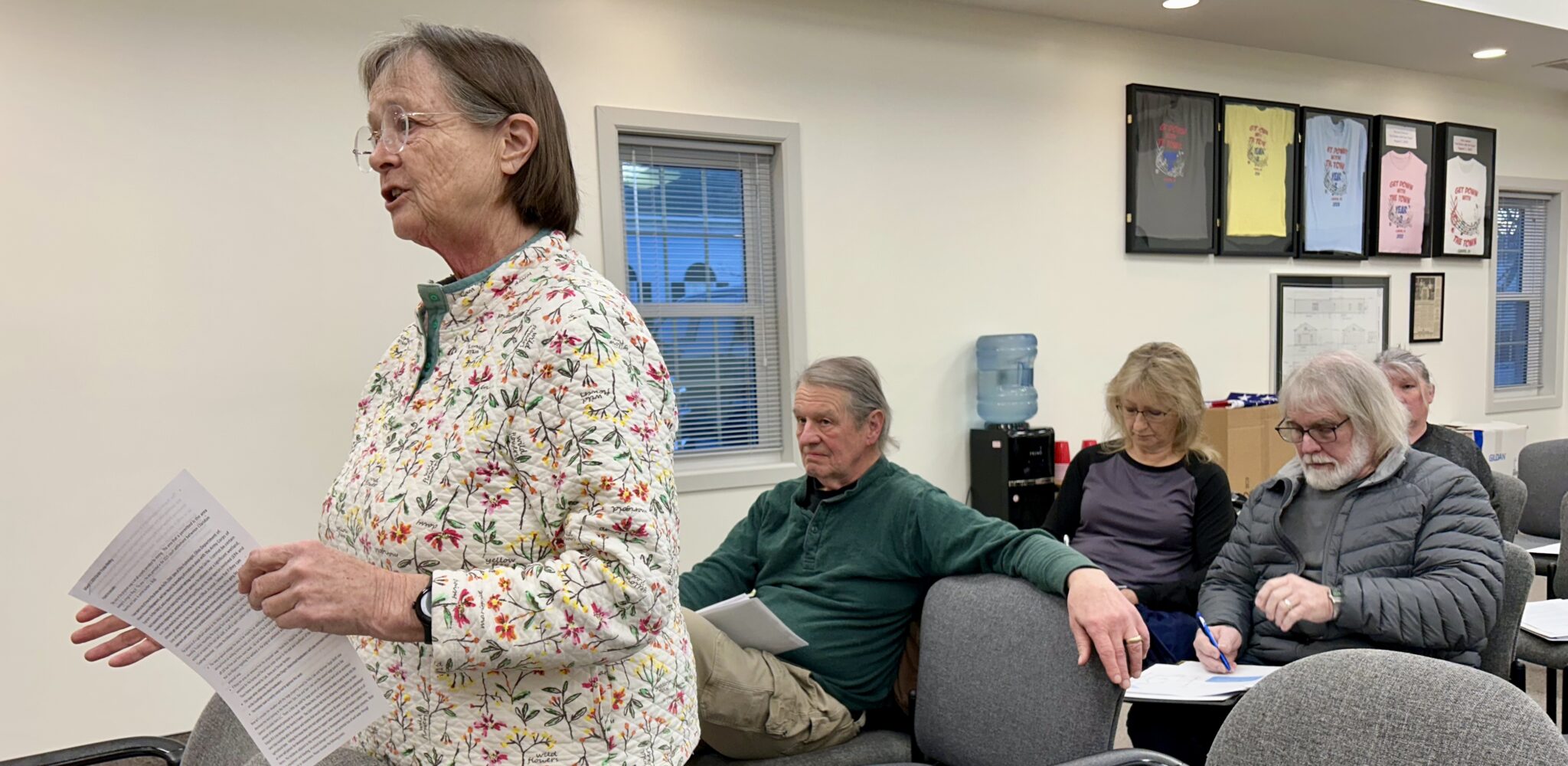
Claridon Township resident Anne Clouser presented extensive research during a March 2 trustees meeting regarding a proposed sand and gravel mining expansion by Covia Corp. near her home.
Claridon Township resident Anne Clouser presented extensive research during a March 2 trustees meeting regarding a proposed sand and gravel mining expansion by Covia Corp. near her home.
Clouser urged trustees to reconsider negotiations with Covia after they denied an application Feb. 6 that sought to enlarge the company’s mining footprint through a land swap that would have added 10 acres closer to homes on Aquilla Road.
The mining operation, known as the Covia/Best Sand mine, is primarily located in Munson Township west of state Route 44. Covia has an existing agreement with Claridon Township to mine about 62 acres of a 77-acre parcel east of Route 44 that extends into wetlands in the township.
Covia is now owned by Sibelco, a multinational corporation based in Belgium, Clouser said.
“I cannot be certain, but it appears that Covia, upon realizing that the property granted in the settlement was a significant wetland (part of the Chagrin Watershed), decided that mitigating that wetland and the permitting and filings with the major agencies involved (Ohio Environmental Protection Agency and U.S. Army Corps of Engineers) would be too time consuming, expensive and difficult,” she said. “I believe, if they can ultimately get approval from the trustees, or by returning to the courts, that they will be going for an Army Corps of Engineers nationwide wetland permit, which involves a streamlined approval process with less paperwork and over site. This is possible because the swapped land has only a minor wetland (part of the Cuyahoga River Watershed) in place.”
Clouser argued the proposed land swap would place mining operations within 200 feet of homes on Aquilla Road. She recommended the additional 10 acres not be mined and instead serve as a buffer between residences — including properties owned by the Clouser, Cole and Bena families — and the operation.
At the Feb. 6 meeting, Clouser voiced concerns that mining could affect residential water wells. On March 2, she said research from various agencies indicates drilled wells would not be impacted.
During the Feb. 6 meeting, members of the Cole family — who own the farmland in Claridon Township involved in the proposed land swap — said leasing part of the property to Covia is necessary to maintain the farm’s financial viability.

Clouser said Monday the family faces significant pressure to allow their land to be developed for housing.
“This farm has to be able to pay its way into the future if it is to remain in the family’s hands. The Cole family felt that, by allowing a mining lease on their land, they would be able to produce an income that would support the remaining property in an undeveloped agricultural state. Failing this lease, their only real option over the next 30 years is to either sporadically, or all at once, sell parcels for development,” she said.
The Coles have indicated they intend to place the swapped wetland area in a conservancy agreement to prevent further development.
“Tom and Sam (Cole) have told me that they intend to do this once the lease is set in motion. I think this should be considered and, perhaps, tied down to the land swap as it will prevent further northward migration of Covia in the area between (Route) 44 and Aquilla Road,” Clouser said. “There are still rich sand beds north of the proposed mine and Covia is owned by a multinational mining operation and best sand is a unique and valuable commodity. There will be continued pressure to expand mining northward in the (Route) 44-Aquilla Road corridor in the future. We should be considering how to prevent this in the future.”
Clouser added that if the land were developed for housing, the impact on the watershed could also be significant.
“A mine that will be played out in the next 30 years will have far less impact on our groundwater than the development of Spencer Lotusdale Farms LLC with homes,” she said. “Homes, roads and septic systems will be there forever. The mine will come, be mined, the land reclaimed and a lake will be left and owned by the Cole family where it will enhance wildlife and the watershed to the benefit of all.
“I would strongly urge the trustees to accept a swap, but limit the swap to the original settlement size of 62 acres and to use the reduced acreage to buffer the eastern homes and the primary order stream of the Cuyahoga that runs through the property owned by the Cole, Bena and Clouser family,” she added. “I also feel that part of the agreement should be with the Cole family to make certain a conservation easement is in place on the wetlands to the north of the mining area, partially to preserve the wetland and, more importantly, to prevent any further northward expansion of the mining operation in the future.”
Following her presentation — which included multiple maps — Trustee Jonathan Tiber praised Clouser’s research and said trustees must continue evaluating conservation agreements.
He also noted that discussions with the Cole family will be necessary before any potential negotiations with Covia resume.
The matter is far from over, Tiber said via phone March 3.
“We did the right thing by denying Covia’s request, initially,” Tiber said. “We expect them to want to come to the table.”