



It's funny how the cycle all starts with nature. Then people build things, but nothing is built to last. Eventually nature takes it back and only nature remains. Johnny Joo
A fascination with how nature reclaims what man abandons has led to fame and adventure for photo journalist Johnny Joo of Mentor.
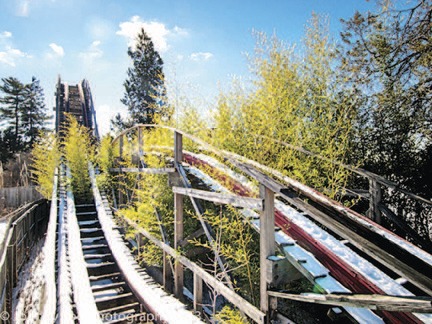
Joo (pronounced “Yo”), 25, has become internationally known for his dramatic photographs of abandoned shopping malls, amusement parks, rusted train cars and the interior of vacant houses throughout the country.
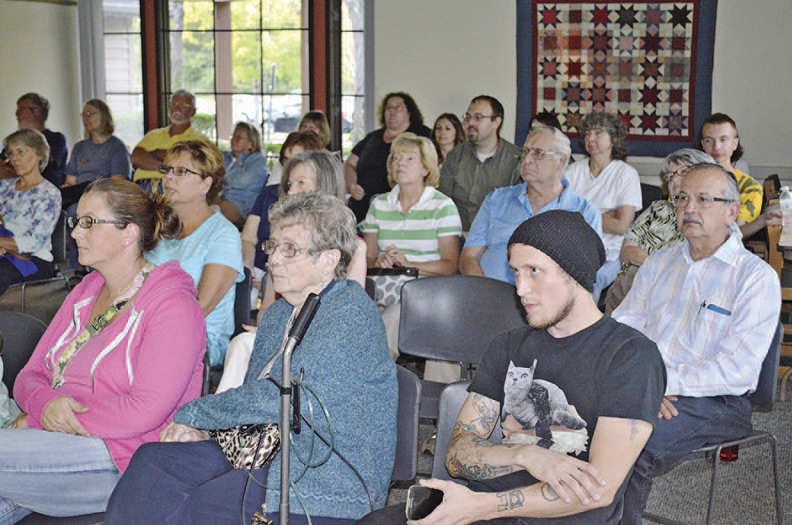
Last Thursday, he gave a presentation of his prize-winning documentary, “Our Future,” at Geauga County Public Library’s Bainbridge branch.
“I’ve always been interested in art in general, and creepy video games and movies,” Joo said as a crowd of about 40 began filing into the library’s community room.
Joo grew up in a quiet, tree-lined neighborhood of Old Mentor, in a classic old house. He always felt drawn to anything odd, historic and artistic that appealed to his imagination.
“On our way to my sister’s house in Chardon, we’d pass an old, abandoned farm house that was covered with ivy and looked like something out of a fantasy. It always fascinated me,” he said.
A high school photography class started him thinking about the art of capturing nature and history.
“With my camera, I could capture a moment and freeze it in time,” he said. “I’d see photos from the early 1900s and think how I could look back on a moment in time that happened a long time in the past.”
He began documenting blighted buildings that were scheduled for demolition as a way to preserve them in memory. His shots of the abandoned Randall Park and Rolling Acres Malls, once centers of elegance and commerce, now with their escalators open to the sky and blanketed with snow, grabbed the attention of the local media.
“That was my first big story,” Joo recalled. “The art of photographing abandoned places has been around since the 30s and 40s, especially in the UK. I have friends in Philadelphia and Kentucky that do this, too. There’s a big group of us.
“Abandoned buildings look cool and have an interesting history that is fun to uncover. It’s something different that’s not gonna be there forever,” he said. “Ansel Adams photographed natural places that you can go to today and see they haven’t changed much. But abandoned places could be torn down and gone a week later.”
Joo said photography is a “way of preserving the memory of what it was.”
He and friends go into abandoned buildings — sometimes with permission, sometimes not — and use cameras to capture a sense of their former grandeur. Sometimes his adventures get him into trouble.
“We were arrested once, in Toledo,” he recalled with a sheepish grin. “The building was all boarded up, so we went in through a second story window. All of a sudden there were all these guns pointed at us. Police tackled my friend and drew their guns on us. We tried to explain that we were just there to take pictures.
“We found out that someone in that area had killed someone, was on the loose and police were looking for them,” he said. “We were released without charges, but the judge told us, ‘You should have pulled up the ladder.’ That made it into a lot of news articles around the world.”
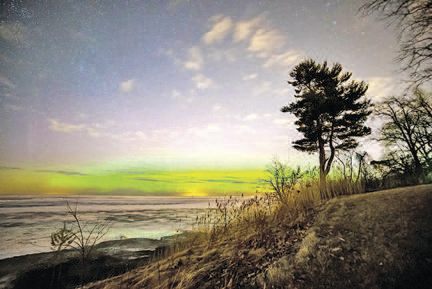
Joo is a little bewildered by his new-found fame, and admits he’s not comfortable talking about himself and his work, which has been featured in local media as well as Good Morning America and the Huffington Post. His photos of the Northern Lights over Lake Erie this summer were shown on local TV stations and shared extensively in local media.
He shows his works at art shows, has a website and his book of photographs, “Empty Spaces,” sells out rapidly. He recently created a video documentary, “Our Future,” that shows abandoned buildings at a time when many are homeless. The documentary has won many awards.
Joo spent much of the summer traveling with friends throughout the American west, which he said was a constant source of ghost towns, rusted-out vehicles and abandoned dreams, all great subjects for his camera.
“It’s funny how the cycle all starts with nature,” he explained. “Then people build things, but nothing is built to last. Eventually nature takes it back and only nature remains.”


