Geauga Economic Leadership’s networking event Feb. 2 brought together panelists from across the county with specialties ranging from wine making to elections.
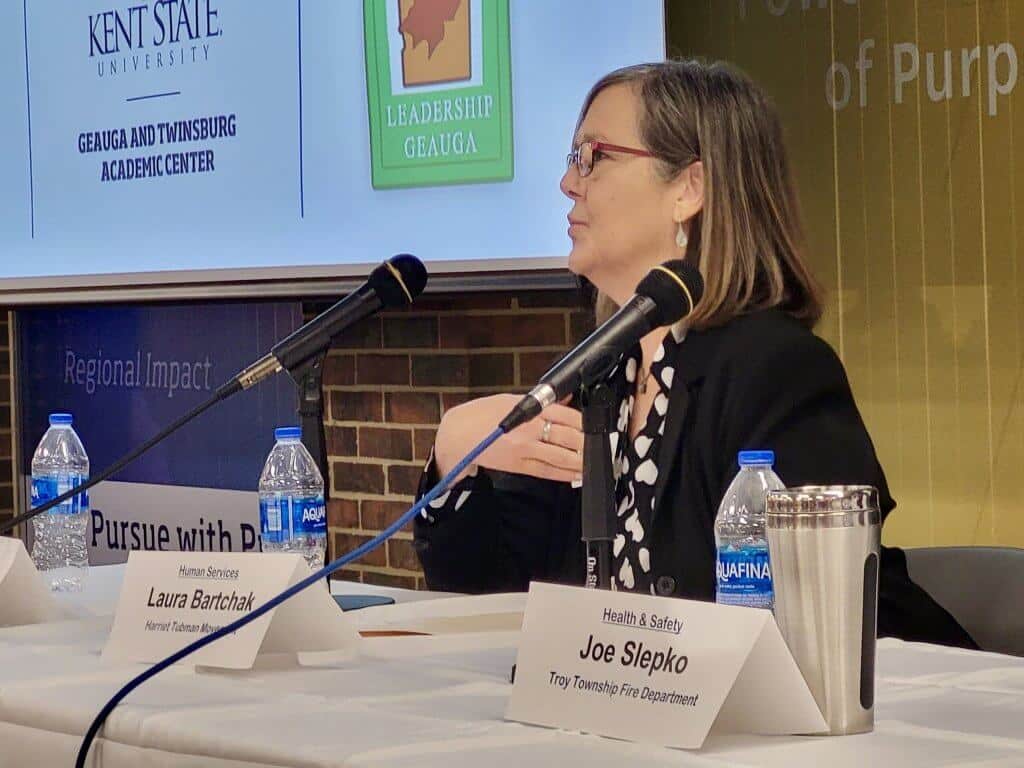
Geauga Economic Leadership’s networking event Feb. 2 brought together panelists from across the county with specialties ranging from wine making to elections.
Among the panelists at the event — held at Kent State University-Geauga campus — was Laura Bartchak, founder of the Harriet Tubman Movement, an advocacy group working to help victims of human trafficking.
“HTM formed in 2016 after identifying a gap in services across Northeast Ohio for people who have experienced human trafficking in their lives,” she said. “We connect victims to services needed and provide support to navigate through barriers along their road to freedom.”
Bartchak’s interest in human trafficking was sparked in 2011, when she heard a sheriff’s deputy describe a local case.
“He talked about a case in Chesterland in 2009 where four Chinese women were found in a basement of a Chesterland home. And I was appalled. I had no idea that trafficking was even happening anywhere around us,” she said.
When Bartchak assisted a trafficking victim’s escape, she faced firsthand the difficulties many trafficked people encounter on their journey to freedom.
“She was 19 years old, she was being sold by her family. I quickly jumped to try to help and found out the barriers to getting help. It was unbelievable and I thought, ‘How would anybody do this by themselves?’” she recalled
HTM assists organizations within a community who may not have the knowledge or resources to help trafficking victims, such as social workers or police. They have assisted over 300 individuals since 2016, Bartchak said.

Law enforcement may not be able to provide a victim with clothing, food or shelter after identifying them, or a hospital social worker might not have the ability to transport a victim home across state lines, Bartchak explained, but HTM can step in.
“We help with trafficking victims by meeting their immediate needs and then we will connect them with various services no matter what county they’re in or what state they’re in. We serve regionally,” Bartchak said, explaining the organization often has to reach out to organizations outside Ohio.
While Ohio is fifth in the nation for trafficking, it lacks necessary resources to combat it, she said, adding the average person’s idea of what trafficking is differs from reality.
“We tend to think of the movie ‘Taken,’ or the movie ‘The Sound of Freedom’ (which imply) that victims are always kidnapped or that they’re being trafficked across our nation’s borders or that they are in chains in basements and, therefore, we look at trafficking victims as probably missing, hidden, foreign or not out interacting in the community,” she said. “And that’s simply not true. Human trafficking victims are hiding in plain sight.”
Bartchak recalled pastors identifying trafficking victims within their congregations.
She defined trafficking as “the use of force, fraud or coercion to obtain some type of labor or commercial sex act” and listed the vulnerabilities and populations often exploited for trafficking. Individuals who are vulnerable to being trafficked range from adults lacking financial stability, housing or a support system to youth aging out of the foster system to people with addictions, mental illnesses or disabilities, as well as LGBTQ individuals and members of other minority populations.
Labor trafficking is more common worldwide, Bartchak said, but sex trafficking is more common in the United States.
While she was unable to provide data for Geauga County, Bartchak did note there have been more cases identified in Lake County as the area has more hotels.
“While I agree that tourism is great, we also find that, like in Lake County, we have identified more cases because we are identifying the girls taken to hotels at (state Route 306) and (Interstate 90), at (state Route 2) and (state Route 91),” she said.
Bartchak called upon those present to support the vulnerable populations of the community, prevent their exploitation and prevent traffickers from gaining a foothold.
“Human service organizations are serving the vulnerable … in our community. And traffickers are preying on those (with) vulnerabilities,” she said. “So, as a community, if we want to keep the bad elements out of our county, we don’t ignore the vulnerable members of our population.”