
Mother in Juvenile Case Speaks Out
Geauga County Juvenile/Probate Court Judge Tim Grendell has been suspended without pay from the practice of law for 18 months, with 12 months conditionally stayed, according to a Nov. 21 Ohio Supreme Court opinion.
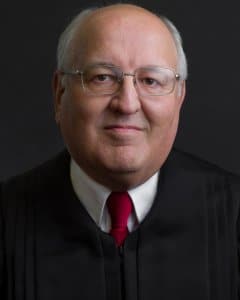
Geauga County Juvenile/Probate Court Judge Tim Grendell has been suspended without pay from the practice of law for 18 months, with 12 months conditionally stayed, according to a Nov. 21 Ohio Supreme Court opinion.
The order takes effect immediately.
Grendell faced three charges of judicial misconduct — one stemming from a case in which he ordered two teenage boys to be detained after they refused to see their father, one from a dispute between the Geauga County Auditor’s Office and Grendell and one related to his testimony supporting Ohio House Bill 624, sponsored by his wife, former state Rep. Diane Grendell.
Two of the counts — the HB 624 testimony and the dispute with the auditor’s office — were dismissed, according to the opinion, authored by Supreme Court Justice Patrick DeWine.
Juvenile Case Misconduct
Geauga County Court of Common Pleas Judge Carolyn Paschke had referred the juvenile case in question to Grendell, noting the clinical psychologist on the case had found parental alienation and that the parties had agreed to reunite the children with their father. Those efforts were unsuccessful because the children refused to see him or Skype with him.
According to previous reporting, the children had repeatedly told a court-appointed guardian ad litem they did not want to see their father, who had allegedly slammed one into a wall in February of 2017.
The boys had been ordered to visit their father on alternating weekends starting that weekend, DeWine said.
After being dropped off with the constable, the boys were initially calm but became nervous, with the older boy eventually indicating they were both unwilling to visit their father, DeWine said in his opinion.
“Worried that the visitation would fall through, the constable contacted Judge Grendell by telephone. Before the panel in this case, Judge Grendell said that he told the constable to call (the mother) and tell her to again instruct the boys to attend the visitation,” DeWine said. “But Judge Grendell’s actions after the call with the constable suggest otherwise. After the call, Judge Grendell immediately called the juvenile court’s director of probation to inform her that two children were being placed in detention for unruliness based on their refusal to attend visitation.”
Grendell also told the director the boys were not allowed to contact their mother during detention, scheduled from Friday night to noon on Monday, DeWine said.
“The constable’s actions also suggest that Judge Grendell initiated the decision to detain the children on unruly charges. After the call with Judge Grendell, the constable called the sheriff’s office,” DeWine said. “The constable testified that he could not remember why he called the sheriff’s office, but that the only reason he would call the sheriff’s office at that time would be to take the boys into custody.”
According to the opinion, Grendell instructed that the boys be kept separate from the general population and from each other.
The court ultimately held that Grendell violated the Code of Judicial Conduct in connection to the case, DeWine said, adding the record shows more than good-faith errors of law.
“Rather, the picture that emerges is of a judge who had a strong belief that parental visitation was in the best interests of the children and who was legitimately frustrated by the failure of other means to achieve reunification between the boys and their father,” he said. “But that frustration mounted to the point that Judge Grendell used the threat of detention — and when that failed, actual detention — in an attempt to coerce the boys to attend visitation with their father.
“He used his constable to orchestrate the filing of trumped-up charges and ordered the boys detained on those charges with little basis,” DeWine continued. “In doing so, he willfully turned a blind eye to legal safeguards designed to protect the best interests of children and avoid unnecessary detentions.”
While Grendell may have taken the case with good intentions, his objectivity eroded and he could not be impartial, his actions did not promote public confidence in the judiciary, DeWine said.
He referenced an instance when Grendell reviewed a GoFundMe page set up by community members to support the boys’ mother and threatened, during a hearing, to “claw back” donations to help pay for the boys’ appointed counsel.
“We are not aware of any basis for such a ‘claw back’ and Judge Grendell’s comments at the hearing appear to have been motivated more by his own anger at the page’s negative portrayal of him than by a legitimate concern for the welfare of the children,” DeWine said.
No punishment will be enough compared to the suffering her family endured at Grendell’s hands, said Stacy Hartman, the mother of the two juveniles, Nov. 24.
“After five years of waiting for justice, the Supreme Court Of Ohio disciplined a rogue judge whose misconduct in and out of the courtroom has permanently damaged and scarred my family,” she said. “This judge believed himself to be untouchable. On my behalf and for the good of the public, the disciplinary council laid bare Timothy Grendell’s abuse of power, dishonesty, unethical tactics, bias, ex parte communication, courtroom hostility and failure to uphold the integrity of the judiciary.”
Despite everything, he has remained arrogant and unremorseful, Hartman said.
“Memories of his courtroom, the belittlement, repeated threats and hostility live on,” she said. “Transcripts of my case read as a fictional horror story as Judge Grendell writes the script with bias impunity. It is my hope that no family be made to endure such anguish and fear in such a courtroom again, as well as its horrific aftermath. This judge lawlessly imposed his agenda turned vendetta on my family no matter the cost to the children involved.”
Hartman thanked everyone involved in exposing Grendell’s misconduct and encouraged “…any and all families whom this judge has unjustly targeted to step forward and have your voice heard.”

Charges Dismissed
As for the other two charges against Grendell, DeWine said in his opinion, “We reject the board’s conclusion that by testifying, Judge Grendell abused the prestige of his judicial office for his personal benefit or for the benefit of others in violation of Jud.Cond.R. 1.3 (the Ohio Code of Judicial Conduct). Because we conclude that (the code’s) broad restriction on testimony and consultation with government officials regarding all but a few topics is a content-based speech restriction in violation of the First Amendment, we will not discipline Judge Grendell for violation of that provision.”
There are other plausible reasons for Grendell to have testified on the legislation beyond promoting his or his wife’s interests, DeWine said.
While the court does not endorse judges testifying at public hearings on matters unrelated to their judicial duties, disciplining someone for engaging in constitutionally-protected conduct is not the same question as whether such conduct is a good idea, DeWine said.
The second charge involved Grendell appearing and making statements at a Tea Party meeting following an altercation with Geauga County Auditor Chuck Walder and his office that involved police. While both Grendell and Walder were invited to the meeting, Walder did not attend, DeWine said.
Grendell’s remarks at that meeting were protected by the First Amendment, DeWine said.
Grendell presented his understanding of events with the information available to him at the time and cannot be punished for doing so, DeWine said.
Grendell’s conduct before and after the meeting had also been questioned, with allegations he was “throwing the weight of his judicial office around to influence a possible investigation into his staff,” however, DeWine rejected those assertions.
“The record indicates that he was not acting to advance the personal or economic interests of himself or others. Rather, he was acting in what he perceived to be the interests of the probate court,” DeWine said. “There is no indication that Judge Grendell was furthering any interest other than the court’s interest in doing court business.”
The Ohio Supreme Court’s role is not to determine whether Grendell acted perfectly but whether the disciplinary counsel provided clear and convincing evidence that he violated the Code of Judicial Conduct, DeWine said.
“We conclude that he has not,” he said.
Sentence
In September, the Ohio Board of Professional Conduct recommended an 18-month suspension with six months stayed, however, the court deviated from the recommendation.
“While the board recommended a finding of violations across three separate matters, we have found violations in a single matter,” DeWine said, adding the board found six aggravating factors and the court only found one.
“Here, the facts that we find most salient in identifying comparable cases are (1) that Judge Grendell’s violation resulted in the improper detention of two juveniles and (2) that Judge Grendell committed disciplinary violations in a single case,” he said.
The board’s recommendation is harsher than warranted, as this case involves violations in a single matter and a stayed suspension is appropriate per court precedent, he said.
“Timothy J. Grendell is suspended from the practice of law in Ohio for 18 months with 12 months stayed on the condition that he commit no further misconduct,” DeWine said. “If Judge Grendell fails to comply with the condition of the stay, the stay will be lifted and he will serve the entire 18-month suspension.”
Grendell did not respond to a request for comment prior to press deadline.