


May 4, 1970 was a beautiful spring day on the Kent State University campus – until Hank Penttila and dozens of students came under the fire of Ohio National Guard troops who were there to quell demonstrations.
May 4, 1970 was a beautiful spring day on the Kent State University campus – until Hank Penttila and dozens of students came under the fire of Ohio National Guard troops who were there to quell demonstrations.
Penttila, now a Chardon architect, recalled his first-hand experience at the Geauga Economic Leadership breakfast May 6, 52 years after he dodged behind a Volkswagen beetle in the KSU parking lot.
Before the disastrous events that lead to four students being killed and others wounded, Penttila said his main concern that day was to complete his course load as a third-year architect student.
“Armored vehicles were on Main Street. The front campus was ringed with guardsmen – hundreds of them,” he said. “They were quite friendly. Students were out to see what was going on. They strolled around and talked to them, trying to figure out what was planned. It was not at all adversarial.”
But he did not deny there was some tension in the air.
“There was some animosity there, no doubt about that. The overriding question was ‘How could you do this to us, bring the National Guard onto our property?’” Penttila said, adding students harbored a lot of resentment toward the governor and his administration that sent in the troops.
He recalled there was a lot of action in downtown Kent the night before the tragic event.
“It was just a result of a lot of alcohol and some people looking to have some excitement in their life,” Penttila said, adding there were a lot of people there from out of town.

Party time in downtown Kent culminated with someone torching the ROTC building on campus, said Bradley Keefer, associate professor of history at KSU –Ashtabula.
At 11 p.m. on May 3, activists gathered to negotiate with KSU officials, but they were dispersed by helicopters and tear gas.
“The night ended with violence,” he said, adding students planned a rally for noon Saturday.
When the group started to form just before noon Saturday, law enforcement declared it an illegal assembly and read them the Riot Act, ordering them to disperse, Keefer said.
“This is where my day began,” Penttila said. “I was out there after class to see what was going on. I saw this gentleman in the Jeep going back and forth telling them to disperse – needling the crowd – to no effect.”
He’d been on the third floor of the architect building taking a final exam until just before noon.
“I exited into a crowd in front of the building and stood there with a couple of friends. I thought it was completely ridiculous what was going on,” Penttila said, remembering he was very tired after pulling an all-nighter to finish a term paper.
“All the students were basically in the same situation as I was — upset about what’s going on, but on their way to the next class,” he said.
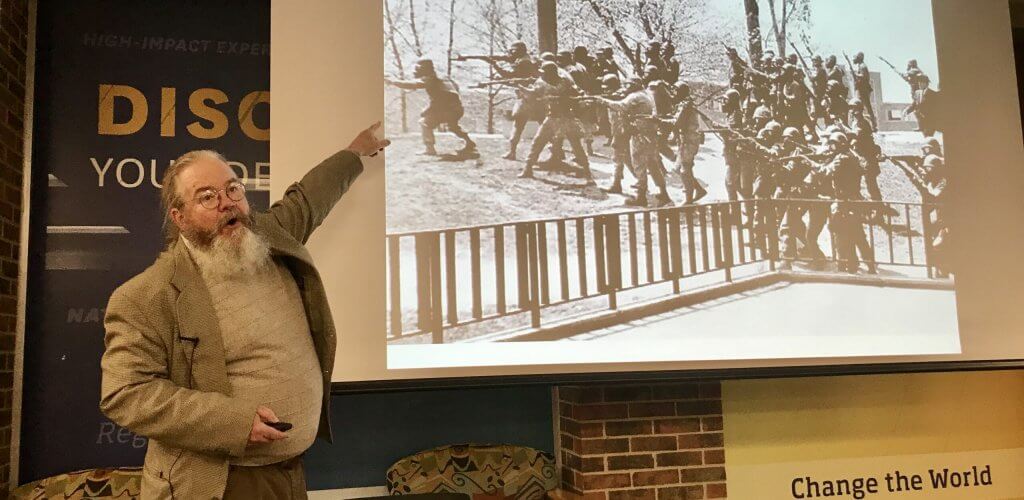
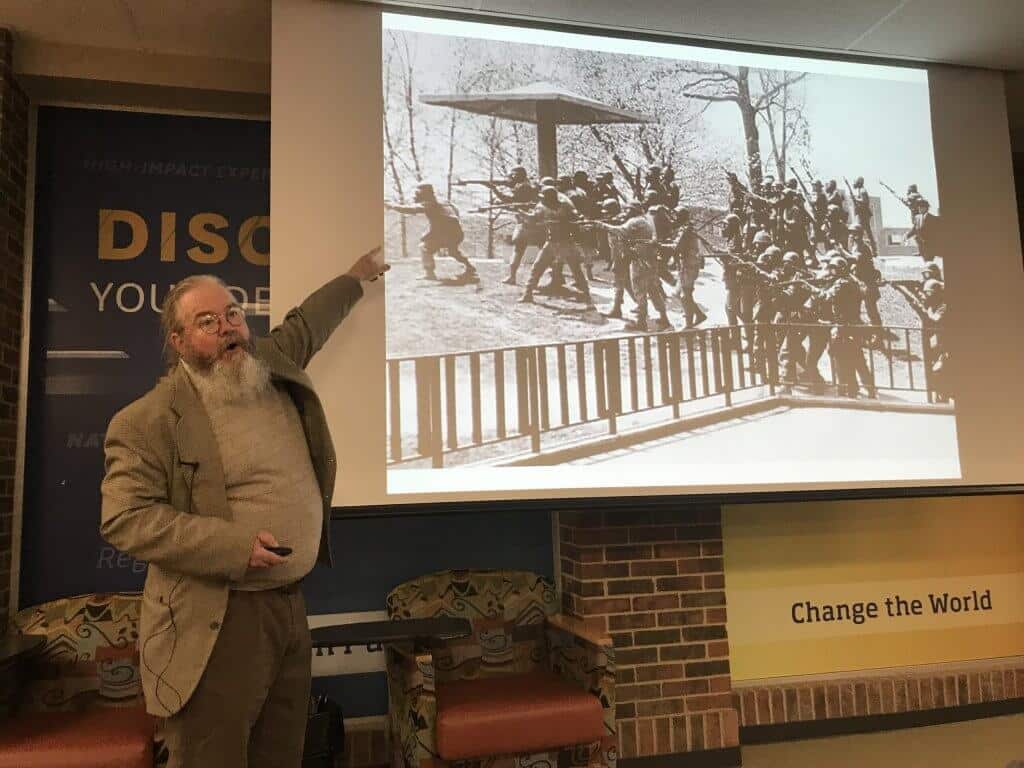
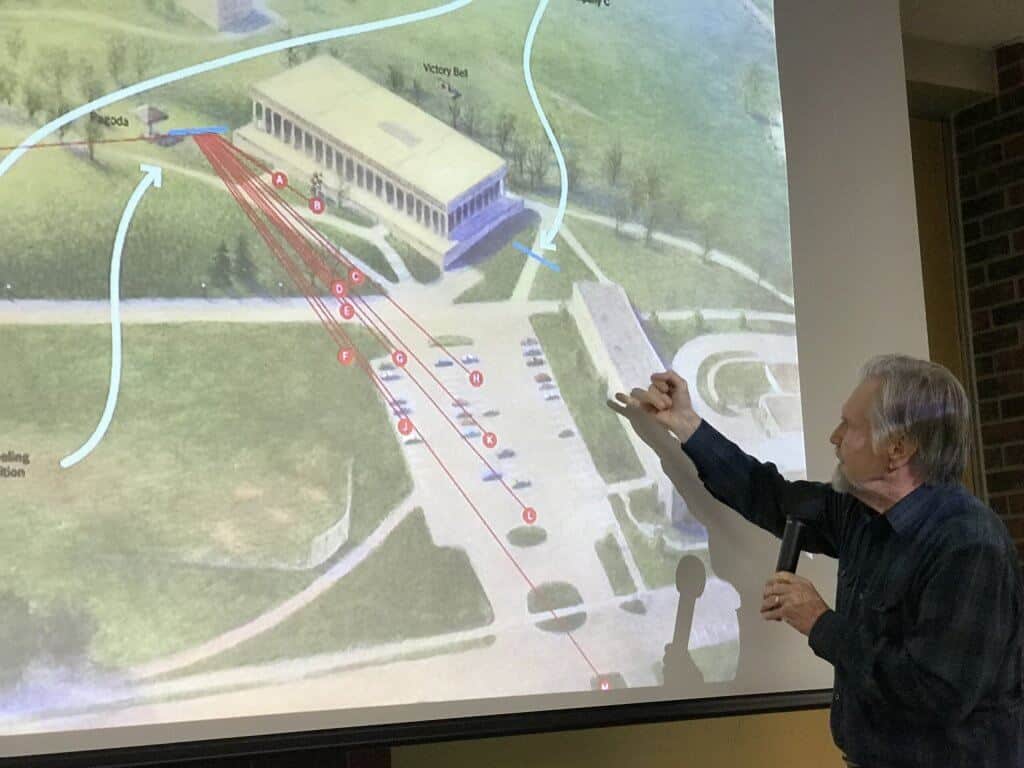
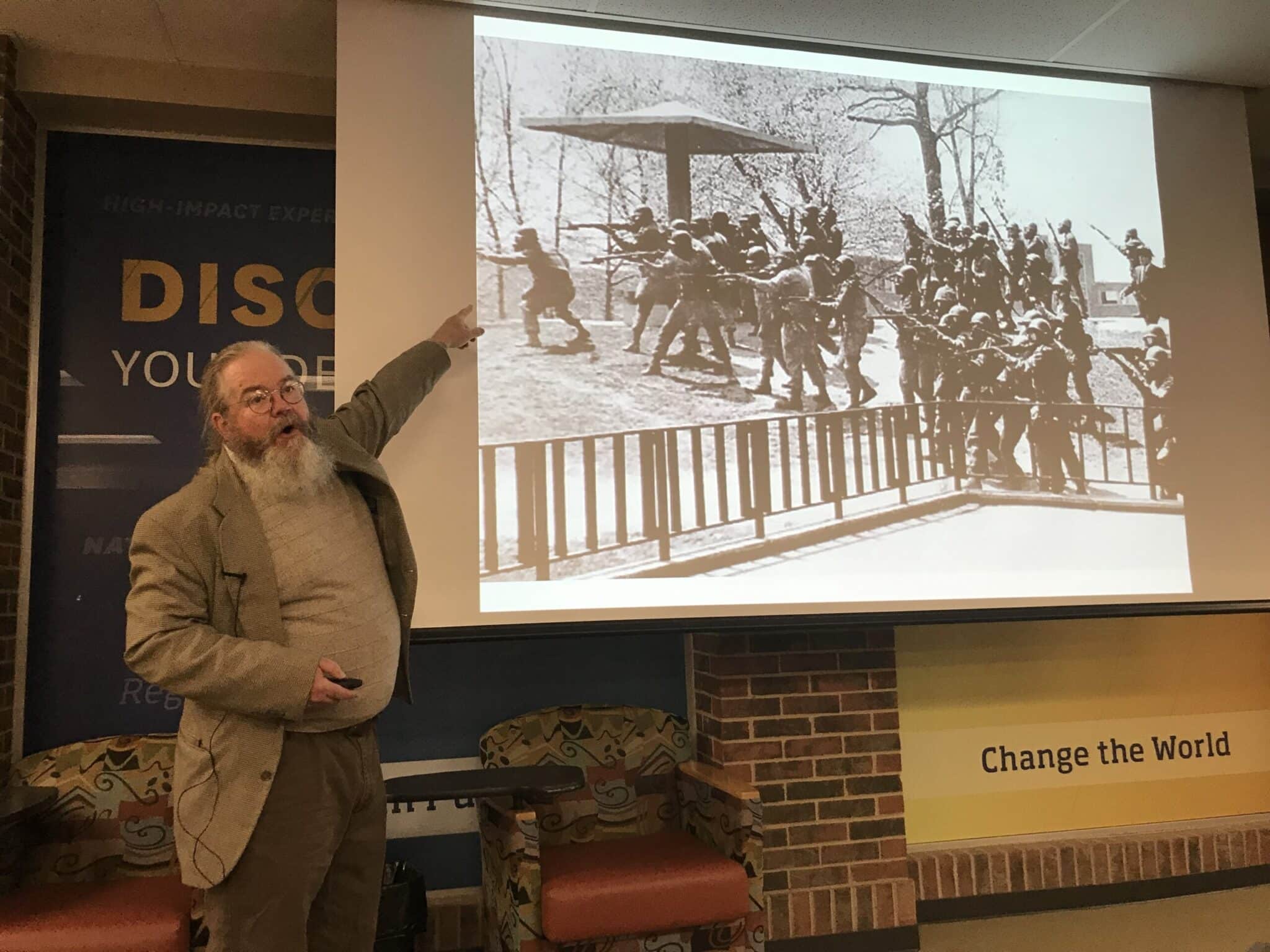
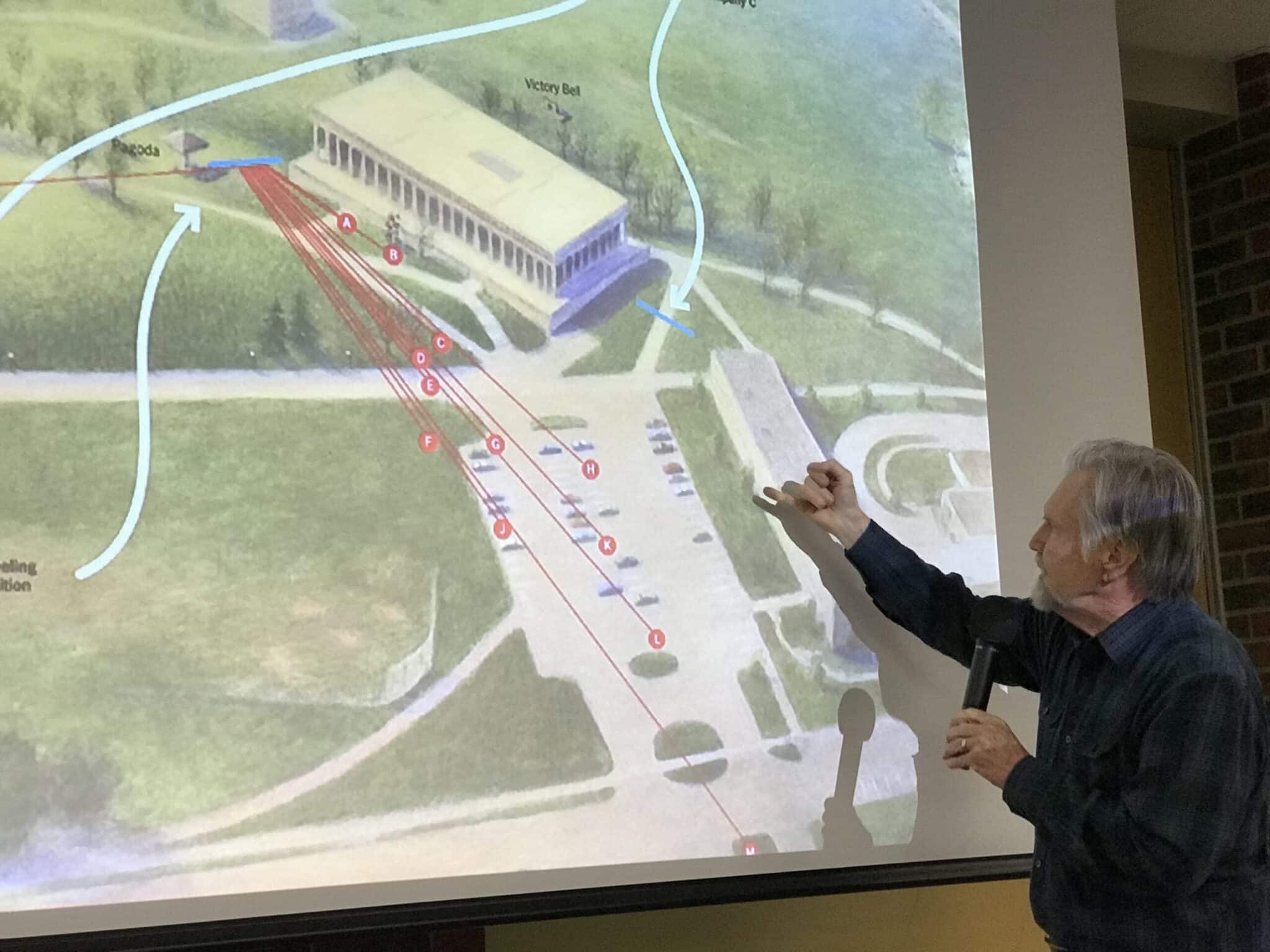
Keefer put up slides for the audience of about 75 showing the 50-year-old photos and the layout of the campus.
He called attention to the students in the pictures. While there was some flag-waving and shouting near Taylor Hall, no one was armed or in attack mode.
“It’s hardly a confrontational look,” Keefer said, noting the guardsmen had formed a line shoulder-to-shoulder and were attempting crowd control.
“(This formation) is just to drive the crowd back. It can only be used if no one has anything to shoot at you with,” he said.
Penttila said he was on the terrace of Taylor Hall when he learned classes were cancelled for the rest of the day and decided to go back to his apartment.
“I was totally unaware of Company C. I came down the steps in front of Taylor Hall and proceeded to the Prentiss Hall parking lot when the troops came around (the building) to the practice field,” he said. “When the guard marched off the practice field, I started my second journey to my apartment with an armload of books. I got halfway across the parking lot and … I looked over my shoulder and saw the guardsmen pointing rifles in our direction.
“I dove behind a VW. I can remember to this day diving to the ground and my books flying all over the place and hearing the screaming. It was terrible!”
He’d been assured the rifles would only have blanks loaded, Penttila said.
“Nobody imagines these guys have live ammo or they are going to shoot,” Keefer said. “(The guardsmen) shoot fast, then everyone rushes out to Jeff Miller and Dean Taylor. The demeanor of the crowd is stunned. They’re going to get mad later.”
The faculty marshal, Glen Frank, was pleading with the crowd not to go after the guardsmen.
“On the slope above the Victory Bell, Frank was trying to reason with the crowd not to attack the guardsmen. He tried to reason with the commander,” Keefer said, adding Frank convinced the students to disperse.

“He said, ‘If you guys go for it, it will be a massacre,’” he said.
Penttila said most of the students at the site were in shock.
“It was as if we had all experienced a serious auto accident. We were just dazed, looking around to see who was injured, what was going on,” he said. “It was just very strange and there was a little bit of group hysteria. Some people just lost it. I was walking around in a daze. I couldn’t comprehend what had happened.”
One of Keefer’s slides shows the VW Penttila landed behind – with a big hole in the back windshield where a bullet went through, Keefer said.
Judson Kline, Chagrin Falls architect, was attending Miami University in Oxford, Ohio, when he became aware of the movement fueled by the civil rights issues, the U.S. bombing and invasion of Cambodia, the war in Vietnam and racial injustice.
“I didn’t come to Kent State to see what was going on until right before the protests,” he said. “Miami (University) is where things began to unravel.”
He drove his VW bus north following the trail of campus dissent.
“(Gov. James) Rhodes was becoming more and more irked and less and less tolerant,” Kline said. “He felt he needed to do something far more radical to stop this effort.”
He called out the National Guard and gave them more and more authority to act, Kline said, recalling protests at Ohio University in Athens and The Ohio State University in Columbus.
“Things slowly escalated as (the protests) moved north,” Kline said. “When it arrives here at Kent State, the results are an earthquake.”
Killed that day in 1970 were Allison Krause, Jeffrey Miller, Sandra Scheuer and William Schroeder. Others were injured and lives changed.
Keefer said some of the wounded were arrested, but the charges were dropped. Efforts to charge the guard or university leadership went nowhere.
Families of the students killed were reimbursed their tuition for the quarter, but there was still a shadow over the event, he said.
“It took (Kent State) University a long time to unravel itself from complicity,” Keefer said, adding what was supposed to be the 50th anniversary of the shooting in 2020 was put off because of COVID-19.


