


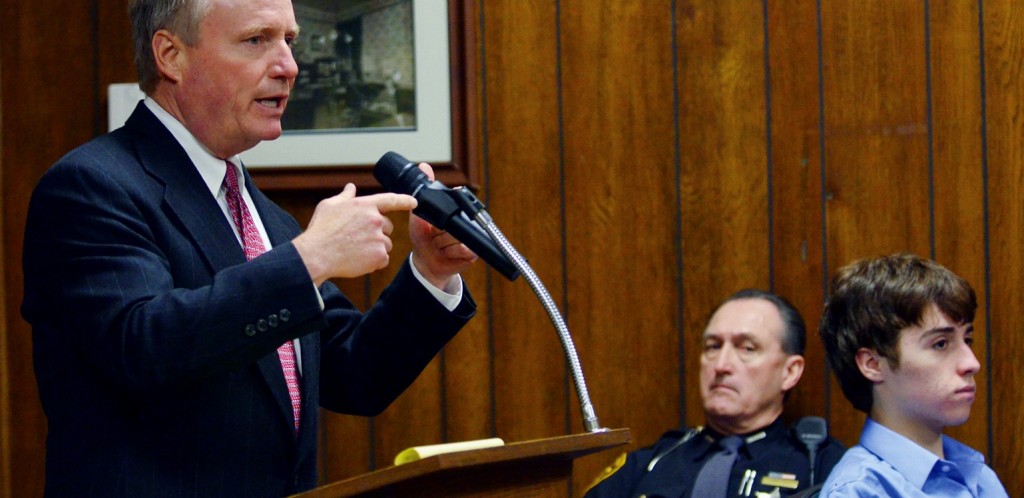
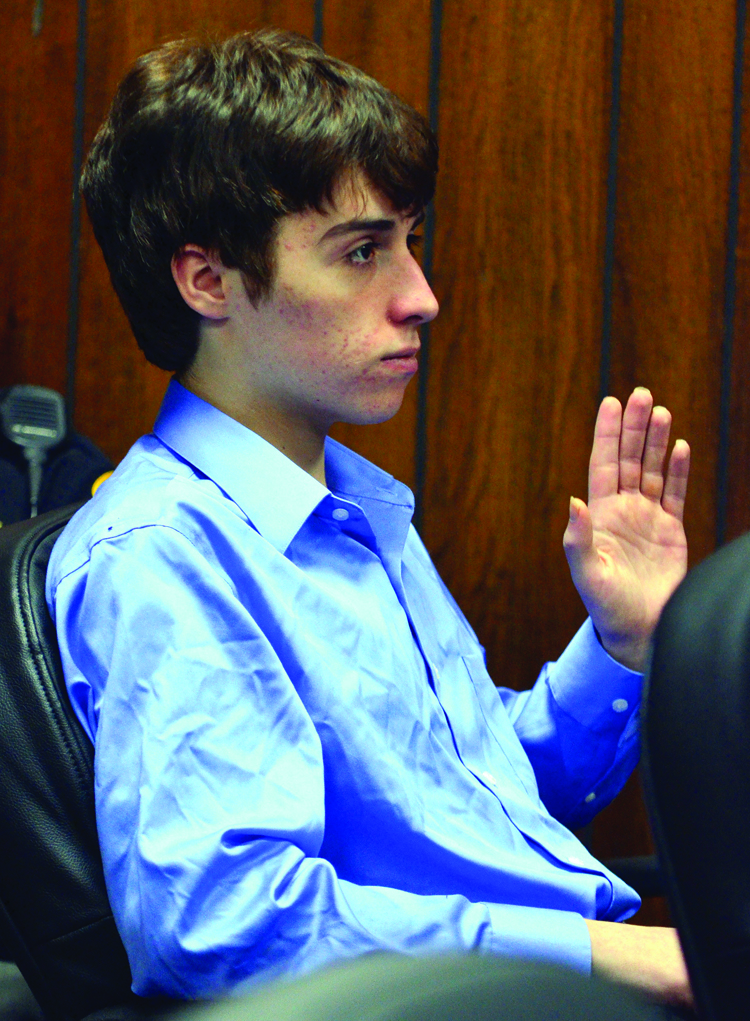
As T.J. Lane watched his grandmother take the stand last Wednesday morning, the normally expressionless accused Chardon High School shooter’s eyes lit up as he gave a slight nod, a quick raise of his hand and mouthed the word “hi” to her.
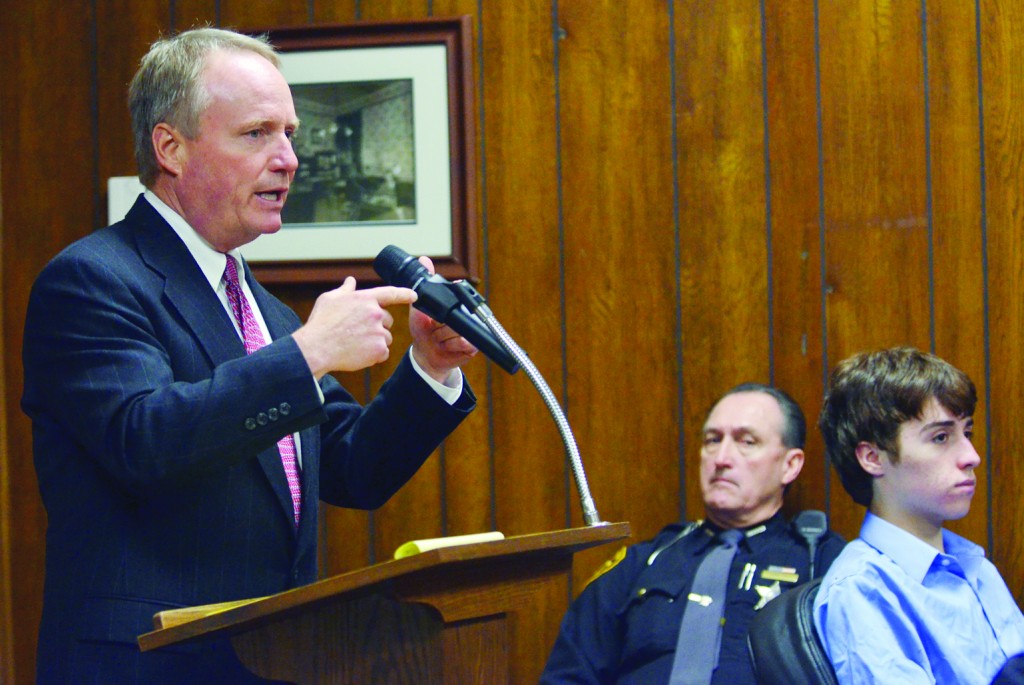
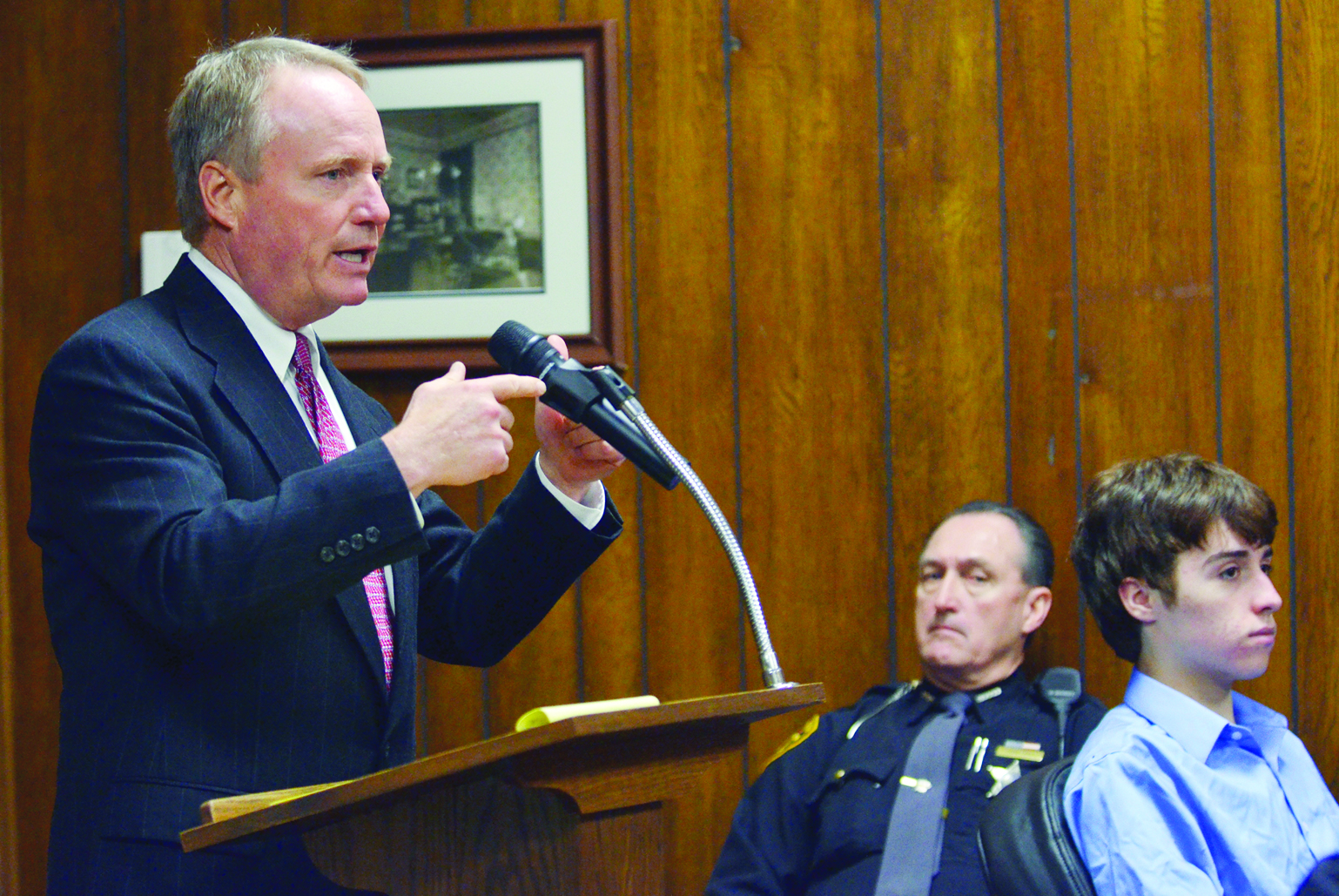
As T.J. Lane watched his grandmother take the stand last Wednesday morning, the normally expressionless accused Chardon High School shooter’s eyes lit up as he gave a slight nod, a quick raise of his hand and mouthed the word “hi” to her.
It was perhaps the first time Lane — who is accused of opening fire at the high school Feb. 27, killing three students and wounding three others — showed any sign of emotion during all his court proceedings thus far.
His grandmother, Carole Nolan, was called to the stand by Lane’s defense attorney, Mark DeVan, who also called his grandfather, Jack Nolan; mother, Sarah Nolan; 15-year-old sister, Sadie Nolan; and father, Thomas Lane Jr., to testify about statements they made at the Chardon police station the morning of the shooting.
Defense counsel has asked Geauga County Common Pleas Court Judge David Fuhry to exclude or suppress “unlawfully intercepted communications” among Lane family members while they were at the station that morning.
DeVan said those communica-tions were “electronically intercepted and recorded in violation of state and federal wire tap and electronic interception statutes, and their use would violate state and federal law.”
“They had a private conversation amongst themselves. None of them knew that they were being recorded,” DeVan said in his opening argument Wednesday. “Those conversations are the ones we seek to suppress.”
The state, however, contended that by the time the Lane family was at the police station, they had already been told T.J. was a suspect.
They chose to wait in an interview room while each member of the family was interviewed separately. In accordance with customary law enforcement practice, the interview room was equipped with audio and video recording devices, the state said in its response to DeVan’s motion.
“Not only does the person have to have a subjective belief they’re not being recorded, but that subjective belief has to actually be supported by the evidence,” said Geauga County Assistant Prosecutor Nick Burling in his opening remarks.
“In this case, you’re going to hear evidence that all of these statements that were recorded occurred in a police interview room at a police station, filled with police, responding to a shooting that happened on Feb. 27,” he said. “The state anticipates that the evidence is going to show that there is no basis for anyone to believe they can have a private conversation in an interview room in a police station and expect that no one would be able to overhear that.”
Burling also told Fuhry the prosecution does not intend to use any of the statements as direct evidence at trial.
“You would have to presume that we would be using it for the purposes of our case-in-chief directly prosecuting the defendant. What if it’s simply to use as an impeachment against those family members were they to take the stand and give inconsistent stories of what had happened that morning?” Burling argued.
He added, “It’s only being used to call in the credibility of that specific witness; it wouldn’t necessarily have anything to do with the defendant.”
All four family members requested they not be photographed, filmed or recorded during their testimonies.
As his grandparents, sister and mother approached the bench, Lane, who rarely made eye contact with anyone in the courtroom prior to today, kept his eyes locked on them — his grandfather winking at him before his testimony.
All five family members testified they did not know they were being recorded while in the interview room, all of them throwing out statements such as, “I was in shock,” “I don’t remember,” “I don’t recall,” “It was all a blur.”
When cross examined Geauga County Prosecutor David Joyce — now U.S. representative-elect — regarding the nature of their conversations while in that interview room, all five family members said they were “private” or “personal conversations.”
Depending on the witness, the prosecution had Burling, Joyce or Lake County Assistant Prosecutor Karen Kowall conduct the cross examination.
“So you knew your grandson shot people at the high school even before you got to the station?” Joyce asked Carole.
“It was not confirmed or nobody, you know, we were still asking a lot of questions and we were in shock,” she responded.
“You say you were in shock? But you remember everything you responded to Mr. DeVan very clearly,” Joyce said.
“Some things I remember, some things I don’t remember, like exact moments when we knew T.J. Lane was the shooter,” Carole answered.
When Joyce asked whether Carole noticed the visible cameras in the entrance area of the police station, she said no.
“When you walked in, you didn’t see the dispatch center?” Joyce asked. Again, she responded no.
Joyce approached her with a picture of the entrance of the police station.
“I think we went to this window and said, ‘Is Sadie here?’” Carole said.
Joyce informed her that was police dispatch and asked her if she saw the bank of cameras while she approached that window.
“I didn’t even see any cameras. I didn’t pay any attention,” she said.
Joyce then asked her what she talked about when in the interview room with her family. DeVan objected. Both parties then approached the bench and Fuhry decided to allow the question.
“We talked about the shooting, we were in shock. I don’t remember everything at all. We talked about what had happened, it was terrible,” she said.
Carole also could not recall what room their family was taken to or the sign on the door that read: Interview Room 1.
“I remember a door, walking into a door,” she said, adding she didn’t know that she saw the sign.
“You remember a lot of stuff, but you remember that, correct?” Joyce asked.
“I don’t remember a lot,” she said. “We were in shock. We were all just horrified.”
All the family members recalled getting to the station the morning of the shooting and a man — which the prosecution later identified as one of the victim’s family members — yelling and cussing at the officers, indicating kids had died in the shooting.
It was then the family was escorted to the interview room, they said.
“I, not for a minute, believed it was T.J.,” said his mother, who teared up at the beginning of her testimony. “I thought maybe they thought it was T.J. because T.J. was standing in the wrong place at the wrong time. I thought he was being wrongly accused.”
When asked about specifics in the conversation she had with family members, Sarah kept repeating they were private conversations.
“OK, well there is nothing private right now. What was the conversation?” Joyce said, his voice notably elevated with impatience.
“It was … we were trying to make sense of everything that we were being told,” she responded.
The state called Chardon Police Lt. Troy Duncan to the stand at the end.
Duncan, who was assigned to oversee the case the day of the shooting, said there were visible cameras outside the police station as well as inside.
He added the one in the interview room, which was mounted on the ceiling and looked like a fire alarm, was motion activated.
He also said the one-way mirror in the room was “very visible” and the “only thing in that room on the walls,” however, no officers, to his knowledge, had been monitoring anything in that room during the time the family was in there.
None of T.J.’s family said they remembered the one-way mirror or noticed any recording devices. They also said they couldn’t remember how many times officers were in and out of the room.
However, Duncan noted at one point, Carole said the place was “crawling with officers.”
DeVan closed by saying no one in the Lane family was asked for permission to be recorded and had “no idea” they were subjects of a video recording.
Fuhry raised the comparison DeVan brought up in his motion, which cited a case where the officer’s car is considered his “office on wheels” and not a place where there’s no reasonable expectation of privacy.
“Isn’t a police station an office of a law enforcement agency?” Fuhry asked DeVan.
“In a police car … the possibility of it being recorded in this modern day and age is very real,” he said. “It depends on the setting. If you go to a police station and you’re sitting in a room and you’re not told that you’re being recorded. You are not a suspect and you have no reason to believe that you might be a suspect. You are simply sitting in a room and you are having what you believe to be a private conversation. That subjective expectation is what rules.”
He added, “The question then is, whether or not it is a reasonable expect-9ation of privacy. And that is shown in this case because every time an officer would enter a room, they would stop conversing about those private matters they had been talking about. They showed that they thought they were talking in private.”
Burling closed saying the family testified they didn’t know they were being recorded, however, the defense would have to show if the circumstances justified that belief.
“Mr. DeVan said, ‘Well, they would stop when someone would come into the room’ … all that shows is the subjective belief that what they were talking about was private. You have to look at all the circumstances. Where were they? What was the purpose they were there for? What were they talking about with the officers?” Burling said.
He continued, “The facts in this case show that this family was contacted by the police that morning and told their grandson or their son was a suspect in a shooting at Chardon High School. They go to a police station, the police station that’s investigating that shooting. They walk by a sign that says, ‘This is a secured area, you may be subject to a search.’ Sure it doesn’t say anything about being recorded, but there’s people all around. There’s testimony that there were 20, maybe more police officers at that station, any one of which could have overhead anything they were saying.”
Burling said the Lane family was escorted into an interview room with a one-way mirror in a place where, as Duncan testified, “official police business” is conducted.
“The defense is asking the court to rule that a police department cannot record things happening within its own department. The department that’s set up to conduct police business and farret out crime. To rule otherwise would hamper the police department and just make it absurd … and really hamper the way police go about doing their business,” he argued. “No person today can reasonably say, ‘I’m going to go into a police department … as a civilian’ … and say, ‘Yeah, I think I’m going to go there and have a quiet conversation with someone and no one’s going to overhear.’”
Fuhry said he will make a decision on whether or not the statements in question will be admissible in trial within a week.
Lane, who has been charged with three counts of aggravated murder, two counts of felonious assault and one count of attempted felonious assault, has a trial date set for Jan. 14 and a pretrial hearing date set for Jan. 7.
If convicted, he could face up to life in prison without parole.


