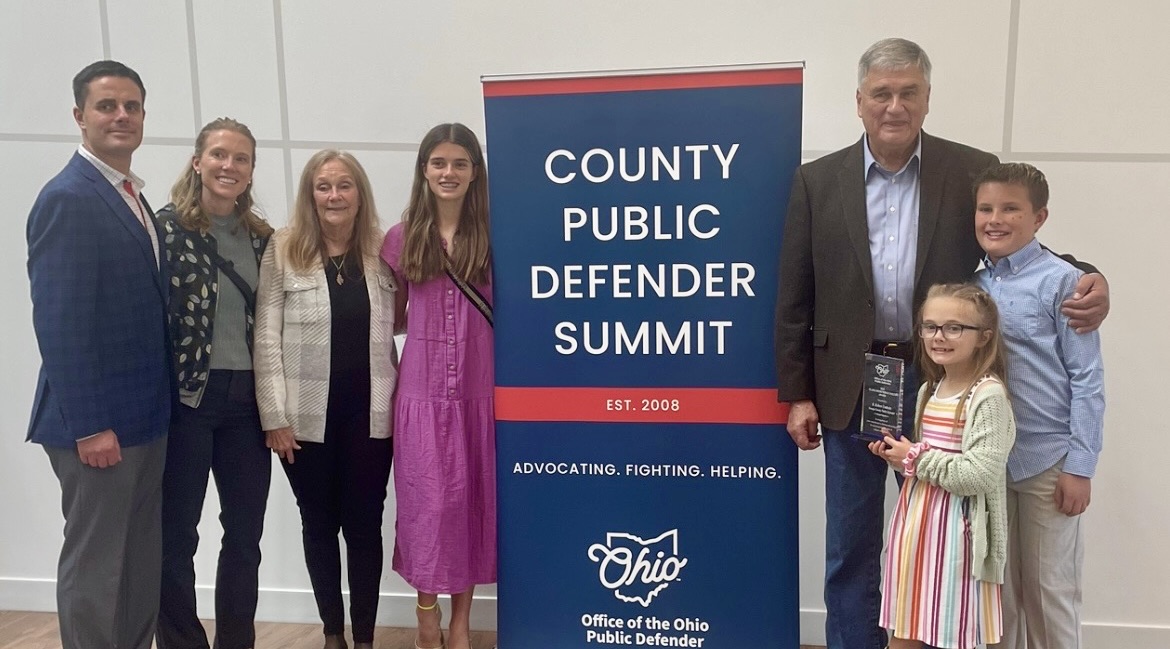
Umholtz Reflects on Winding Path of Service
When Bob Umholtz spent a summer shoeing horses for a judge, he had no idea it would lead to a decades-long career in public defense — or to becoming the longest-serving chief county public defender in Ohio.


When Bob Umholtz spent a summer shoeing horses for a judge, he had no idea it would lead to a decades-long career in public defense — or to becoming the longest-serving chief county public defender in Ohio.
Umholtz retired Dec. 8, 2025, after 36 years as Geauga County’s chief public defender. Paul Mooney officially succeeded him following approval by the Geauga County Public Defender Commission.
“Bob Umholtz was a remarkable boss and mentor,” Mooney said Jan. 26. “His guidance and leadership left an indelible mark on everyone in the public defender office. I hope to carry forward with the same decency and integrity he demonstrated every day.”
Umholtz, who recently completed his third four-year term on the Ohio Public Defender Commission, said he believes the office is in capable hands.
“The office is not going to miss a beat,” he said. “If anything, Paul may do a better job. He’s got the right temperament, he’s intelligent, he’s experienced, he’s tried a number of cases in his own right. Everybody in the office loves him, everybody knows him. I couldn’t be more pleased. That made it much easier for me to retire, knowing Paul was going to step in.”
Originally from Ashtabula County, Umholtz did not envision a future in law.
“I never really thought about law,” he said. “I was a Chinese linguist with the (United State) Air Force and when I got out of the air force I went to Malone College, studying social studies with a concentration in far Eastern studies.”
Umholtz enlisted in the U.S. Air Force immediately after graduating high school in 1969.
“As a matter of fact, the day that my senior class at Jefferson had their class picnic, I was at the federal building getting my physical,” he said.
With the Vietnam War and the draft looming, he said enlisting was a calculated decision.
“I knew I was gonna get drafted,” Umholtz said. “I couldn’t afford to go to college. And that was before they came up with the lottery. And I figured, if I’m going to go into the military, I at least want to hopefully get some training that will help me when I get out of the military.”

Though he initially hoped to pursue veterinary work, Umholtz was selected for foreign language aptitude testing and, after months of waiting and travel, began learning Mandarin.
During his service, he monitored Chinese aircraft activity along the coast of China to the Gulf of Tonkin.
Umholtz’s entry into law came unexpectedly. A lifelong interest in horses led him to take a summer agriculture class at Penn State University after his freshman year at Malone College.
“I was a farrier. I was shoeing horses for a federal judge and I got accepted into Texas Christian University’s ranch management program,” he said. “So, I told the judge, ‘You’re gonna have to find someone else to shoe your horses, I’m going back to Texas.’ He said, ‘Bob, let’s talk about this. Why don’t you take the (Law School Admission Test). If you do well, go to Cleveland Marshall at night. You can work for me during the day and go to Marshall at night.’”
Although Umholtz said he was not interested in law, he believed it might provide a path back east.
That path, however, took another turn when he met his wife, Marie, at law school.
The two were engaged after 18 days and married within their first year, Umholtz said.
“The lure of the Orient dissipated,” he recalled. “And then I had to figure out what in the heck am I gonna do because I don’t really want to practice law.”
A staunch conservative, Umholtz initially hoped to work as a prosecutor but struggled to find available positions. He instead became a public defender in Wayne County, where he worked for three years before relocating to be closer to family and church after his son suffered a traumatic brain injury.
Although a private law firm offered him a position, Umholtz said an opening at the Geauga County Public Defender’s Office ultimately led him there. Six months later, in November of 1989, he was appointed chief public defender.
“My wife once said that the Lord sent me to the public defender’s office to learn to be compassionate,” he joked.
A quip it may have been, over time, compassion became central to Umholtz’s work.
“When you sit across the table from somebody at the jail, when I’m meeting with my clients when they come into my office and you get to know them as a person, and you see their life circumstances, how they came to the point they are, you begin to look at them differently,” he said.
Over the course of his career, Umholtz said he represented clients charged with aggravated murder, rape and kidnapping.
“No matter what they’ve done, no matter how bad the offense is, it’s not justified, but you can understand how they arrived there once you get to know their life story,” he said. “If it wasn’t for alcohol or drugs, I’d say 90% of the people I represented over the years would have never been in court.”
Many clients committed acts they would not have otherwise, he said, noting substance abuse, lack of education and limited job skills as recurring factors.
“They oftentimes don’t have an education. They don’t have a skill. And the only times they can feel good about themselves is when they’re under the influence,” he said. “Of all the clients I’ve represented, I can only think of three that you would consider to be so truly evil, mean, almost unsalvageable people that they should be locked up for the rest of their lives.”

Umholtz referenced a 15-year-old he had represented in 2000 who shot and killed a gas station attendant in Chester Township.
The defendant was born as the result of a rape and suffered abuse while growing up in the foster system, he recalled.
The shooting was the result of pressure from someone the defendant respected, who gave him the gun because he was a minor, Umholtz said.
“From the news reports I had, in my mind, pictured a young punk from Cleveland who came out here with an attitude and committed a murder,” he said. “I couldn’t have been more wrong when I went to the detention center and saw little Marcus (Moorer). He was the most polite, clean-cut looking young man.”
While cleaning out his office recently, Umholtz said he came across a portrait Moorer had drawn for him.
“He has to pay for the consequences of his conduct, but he never should have been put in that position,” he said.
Umholtz said he hopes his career has reflected his Christian faith, referencing something his son — also named Bob Umholtz — once said when asked about accomplishments.
Individual achievements are not what people remember. What lasts is the impact you have on other people’s lives, he said.
That impact can vary widely in public defense, Umholtz said.
He recalled being asked by serial killer Edward Edwards — who sought and ultimately received the death penalty — to serve as a witness in the death chamber.
“Thankfully for (the people asked to witness), he died of natural causes before the execution date,” Umholtz said. “But it all circles back to, we represent people, not causes. People are what matter.”